
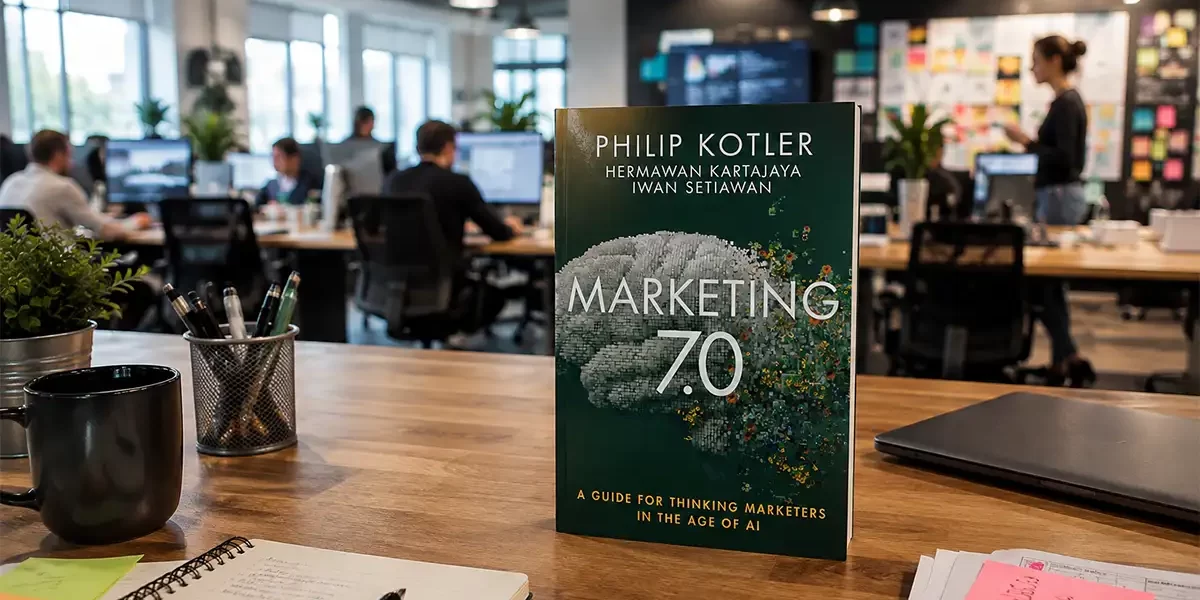
Book Review : Marketing 7.0: A Guide for Thinking Marketers in the Age of AI by Philip Kotler, Hermawan Kartajaya and Iwan Setiawa.
Marketing has a slight obsession with declaring that everything has changed.
A new platform shows up. A new technology launches. Someone coins a new acronym. Within about two days, we hear that marketing as we know it is over.
Again.
Marketing 7.0: A Guide for Thinking Marketers in the Age of AI takes a more thoughtful approach.
Published in 2026, the book asks an important question: As artificial intelligence, algorithms, and automation take over, should marketers spend more time understanding the one piece of technology that hasn’t changed as quickly?
The human mind.
The answer, reassuringly, is yes.
The Big Idea: Mind-Centric Marketing
The central concept of Marketing 7.0 is what the authors call mind-centric marketing.
Instead of turning marketing into a constant exercise in AI-powered optimisation, the authors say technology should help us better understand how people think, connect, and buy. They call today’s consumer the “augmented human”, someone whose behaviour is shaped by digital technology but is still, at the core, human.
This distinction matters.
AI can analyse extraordinary amounts of data.
It can identify patterns.
It can personalise content.
It can optimise campaigns faster than any human marketing team could reasonably hope to.
But customers don’t experience brands as spreadsheets.
They experience them as people.
People are emotional, social, biased, and sometimes contradictory. They might even spend £6 on a coffee just because the café has nice lighting.
AI Is the Tool, Not the Strategy
One of the best things about Marketing 7.0 is that it isn’t another book urging marketers to add AI to everything.
The authors examine how being too focused on performance marketing and AI can hurt authenticity. They suggest that humans and machines should work together, with technology supporting, not replacing, our understanding of customers.
That’s an important distinction.
More and more, people see AI as the strategy itself, instead of a tool that helps deliver the strategy.
But “we’re using AI” isn’t a marketing strategy.
That’s about the same as saying “we’re using Excel.”
Useful to know.
But I’d still like to hear the plan.
Back to Understanding People
The book gets especially interesting when it focuses on cognitive science and customer insight. The authors look at how marketers can observe and understand the human mind, then use those insights in brand storytelling, value propositions, sales, and customer experience.
And this is where Marketing 7.0 feels particularly relevant.
Even though marketing technology has advanced a lot, the basic job hasn’t changed as much as we sometimes think.
We still need to understand people.
What do they want?
What worries them?
What do they value?
What influences their decisions?
Why do they choose one brand rather than another?
And why do people spend three weeks researching a £40 purchase, but then casually agree to a £600 annual subscription just because there’s a free trial?
Human beings remain fascinatingly inconsistent.
That’s good news for marketers. It means we still have jobs.
Storytelling, Value and Trust Still Matter
The second half of the book brings these ideas into familiar marketing topics like storytelling, value propositions, sales, and customer experience.
There’s a whole chapter on brand storytelling, another on the mental trade-offs behind value propositions, one about trust in selling, and one on customer experience and creating memorable moments that encourage advocacy.
None of those subjects sounds particularly futuristic.
And that’s rather the point.
Marketing technology is changing fast, but the basics stay the same.
People still respond to stories.
They still make trade-offs.
They still need trust.
They still remember experiences.
AI doesn’t make those things obsolete.
It might give us better tools to understand and deliver these things.
A Book for Thinking Marketers
The subtitle is important: A Guide for Thinking Marketers in the Age of AI.
Not AI Marketing Hacks.
Not 17 Prompts That Will Transform Your Funnel Before Tuesday.
Thinking marketers.
That’s perhaps what I liked most about it.
Marketing 7.0 isn’t against technology at all. The authors look at AI, social media, and immersive tech as powerful ways to understand and engage customers. But technology is still just a tool, not the main goal.
That’s an important reminder, especially now, when marketers can get more excited about what technology can do than whether anyone actually wants it.
The Overthinker’s Verdict
Philip Kotler has shaped modern marketing for decades. Along with Hermawan Kartajaya and Iwan Setiawan, Marketing 7.0 looks at AI without getting carried away. Their earlier books covered Marketing 3.0, 4.0, 5.0, and 6.0, so this is the next step in their evolving framework.
It’s thoughtful, up-to-date, and especially helpful for marketers figuring out where people fit in a more automated field.
The answer is:
Right in the middle.
That’s where they should have been all along.
The Quiet Takeaway
The most powerful idea in Marketing 7.0 isn’t really about artificial intelligence.
It’s about human intelligence.
AI will definitely change how we research, analyse, create, personalise, and deliver marketing.
But better technology doesn’t take away the need to understand people.
If anything, it makes that understanding more important.
When everyone has access to similar technology, the real advantage won’t just come from having the smartest tools.
It will come from knowing how to use them.
And, even more importantly, from understanding the person on the other side of the screen.
Purchase this book online through our Amazon affiliate link https://amzn.to/3SDpKXd
Marketing 7.0: A Guide for Thinking Marketers in the Age of AI
Writing Style
Content
Insight
Timely
Marketing 7.0: A Guide for Thinking Marketers in the Age of AI by Philip Kotler, Hermawan Kartajaya and Iwan Setiawan is a thoughtful and timely exploration of where marketing is heading as AI becomes increasingly embedded in our profession. Rather than getting carried away with algorithms and automation, the authors introduce the idea of mind-centric marketing, arguing that technology should help us better understand how people think, connect and buy, not replace the human understanding at the heart of good marketing. Covering customer insight, storytelling, value propositions, trust and customer experience, it's a reassuring reminder that while our tools are becoming remarkably clever, customers remain wonderfully human. For marketers wondering how much AI belongs in their strategy, the answer seems to be: plenty, but preferably with a human still in charge.