Book Review : Writing for Busy Readers: communicate more effectively in the real world by Todd Rogers and Jessica Lasky-Fink.
We are all busy. Or at least we like telling people we are.
Our inboxes are full, our phones are buzzing, our calendars resemble unsuccessful games of Tetris, and somewhere in the middle of all this, someone has sent us a 1,400-word email beginning: “I hope this message finds you well.”
It probably doesn’t.
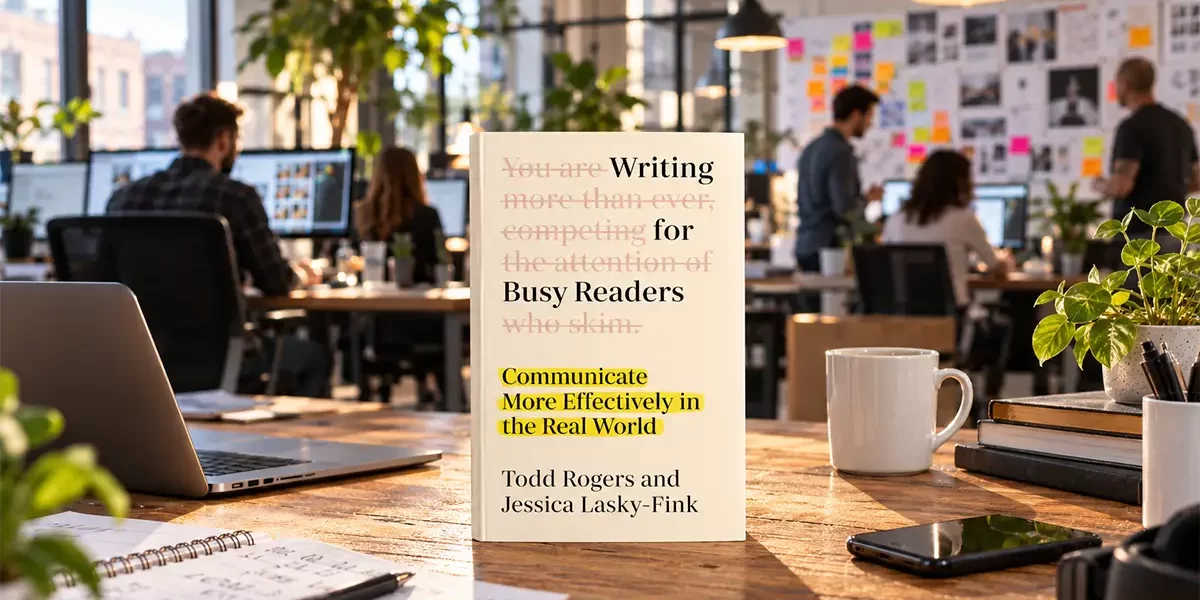
Writing for Busy Readers: Communicate More Effectively in the Real World by Todd Rogers and Jessica Lasky-Fink tackles a problem almost everyone in business encounters: how do you get people actually to read what you’ve written?
The answer, somewhat inconveniently for those of us who enjoy words, is often to use fewer.
The Big Idea: Nobody Owes You Their Attention
Rogers and Lasky-Fink are behavioural scientists, and the book approaches writing from that perspective rather than treating it purely as a question of grammar or style. Rogers is a professor of public policy at Harvard Kennedy School, while Lasky-Fink is research director at The People Lab there. Their recommendations draw heavily on behavioural research into how people actually interact with written communication.
And that’s an important distinction.
This isn’t really a book about becoming a beautiful writer.
It’s about becoming an effective communicator.
Your reader is probably distracted.
They’re probably skimming.
They’re probably reading your email while thinking about something else.
And they may decide within seconds whether your lovingly crafted paragraph deserves any more of their attention.
A slightly depressing thought for writers.
An extremely useful one for marketers.
Six Principles. Thankfully, Not 47.
The book is built around six research-backed principles: less is more; make reading easy; design for easy navigation; use enough formatting but no more; tell readers why they should care; and make responding easy.
The first is perhaps the most painful.
Less is more.
Use fewer words.
Include fewer ideas.
Make fewer requests.
This sounds obvious until you look at the average corporate email, proposal, landing page or internal memo and discover that apparently nobody received the memo about the memo.
The authors aren’t arguing that everything should be reduced to three-word sentences.
They’re arguing that every additional piece of information creates another demand on the reader’s limited attention.
That’s very different.
People Don’t Read. They Navigate.
One of the book’s most useful ideas is that we should design writing around how people actually read, or, more accurately, how they don’t.
Busy readers skim.
They look for headings.
They search for important information.
They jump around.
They decide what deserves attention before deciding whether to read it properly.
The authors therefore recommend making the purpose immediately obvious, grouping related ideas, ordering information by importance and using headings and visual structure to help people navigate.
Marketers should find this familiar.
It’s why good website copy isn’t simply good prose.
It’s information design.
Your reader shouldn’t need to do an archaeological excavation to get to the point.
Why Should I Care?
Perhaps the most important principle for marketers is wonderfully straightforward: Tell readers why they should care.
Businesses are often very good at explaining what they want to say.
- We’re delighted to announce…
- We’re excited to introduce…
- We’re proud to reveal…
- We are thrilled beyond all reasonable emotional boundaries to have redesigned the customer portal.
The customer, meanwhile, is wondering: So what?
Rogers and Lasky-Fink encourage writers to consider both what readers value and why a particular reader should care about the message.
It’s a small shift in perspective.
But it’s basically the difference between communication built around the organisation and communication built around the audience.
Which, when you think about it, is also the difference between quite a lot of bad marketing and good marketing.
Make Reading Easy
There’s another lesson marketers occasionally struggle with: Simple language is not stupid language.
The authors recommend short, familiar words and straightforward sentences.
That matters because businesses can take simple concepts and dress them in language normally associated with international trade agreements.
- We don’t help customers.
- We facilitate customer-centric outcome optimisation.
- We don’t make software easier to use.
- We enable frictionless digital transformation ecosystems.
Nobody talks like this. Except businesses talking to other businesses who also don’t talk like this.
Clear writing respects the reader.
Complex writing often merely demonstrates that the writer knows several long words.
Make Doing Something Easy Too
The book doesn’t stop at getting people to read.
It also considers what happens next.
If you want someone to respond, the authors argue, make the requested action clear and reduce the effort required to complete it.
Again, painfully obvious.
And routinely ignored.
We’ve all received emails where, after reading three times, we’re still unsure whether we’re being asked to approve something, attend something, send something or admire the sender’s impressive command of paragraphs.
Effective communication should make the next step obvious.
Good marketing works the same way.
If someone understands your message but doesn’t know what to do next, you’ve only completed half the job.
Particularly Useful in the Age of AI
The book feels even more relevant now that AI has made producing enormous quantities of perfectly competent writing extraordinarily easy.
We can create more emails.
More articles.
More social posts.
More reports.
More proposals.
More words.
Wonderful.
Unfortunately, nobody has simultaneously invented more hours in the day for people to read them.
If anything, AI makes the principles in Writing for Busy Readers more important.
The constraint is no longer our ability to produce content.
It’s the reader’s willingness to give us their attention.
And no amount of automated content generation solves that.
The Overthinker’s Verdict
Writing for Busy Readers is one of those books that immediately makes you aware of your own bad habits.
You’ll start shortening emails.
Moving important information upwards.
Deleting unnecessary paragraphs.
Making requests clearer.
And wondering why you needed three sentences to say something that could have been said in one.
The book itself wisely practices what it preaches. The advice is practical, accessible and grounded in research rather than simply being another collection of writing rules handed down by someone with strong opinions about semicolons.
For marketers, copywriters, consultants, founders, and business leaders, there’s an enormous amount here that you can apply immediately.
The Quiet Takeaway
Good writing isn’t about proving how clever the writer is.
It’s about making life easier for the reader.
That means respecting their time.
Making information easy to find.
Explaining why it matters.
And making the next step obvious.
In marketing, that’s especially important because attention isn’t something we’re entitled to.
We have to earn it.
Writing for Busy Readers is a useful reminder that sometimes the best way to make your communication more powerful isn’t to add another paragraph.
It’s to delete one.
Purchase this book online through our Amazon affiliate link https://link.amazon/B06NQU6P8
Writing for Busy Readers
Writing Style
Content
Insight
Great
Writing for Busy Readers by Todd Rogers and Jessica Lasky-Fink is a practical, research-backed guide to communicating more effectively with people who are busy, distracted and probably skimming. Drawing on behavioural science, the authors show how using fewer words, clearer structure, simple language and obvious calls to action can make emails, websites, reports and marketing communications far more effective. Particularly relevant in an age when AI makes producing more content easier than ever, the book reminds marketers that the real challenge isn't creating words, it's earning someone's attention. Clear, useful and immediately applicable, it's an excellent reminder that good writing isn't about demonstrating how clever the writer is; it's about making life easier for the reader.