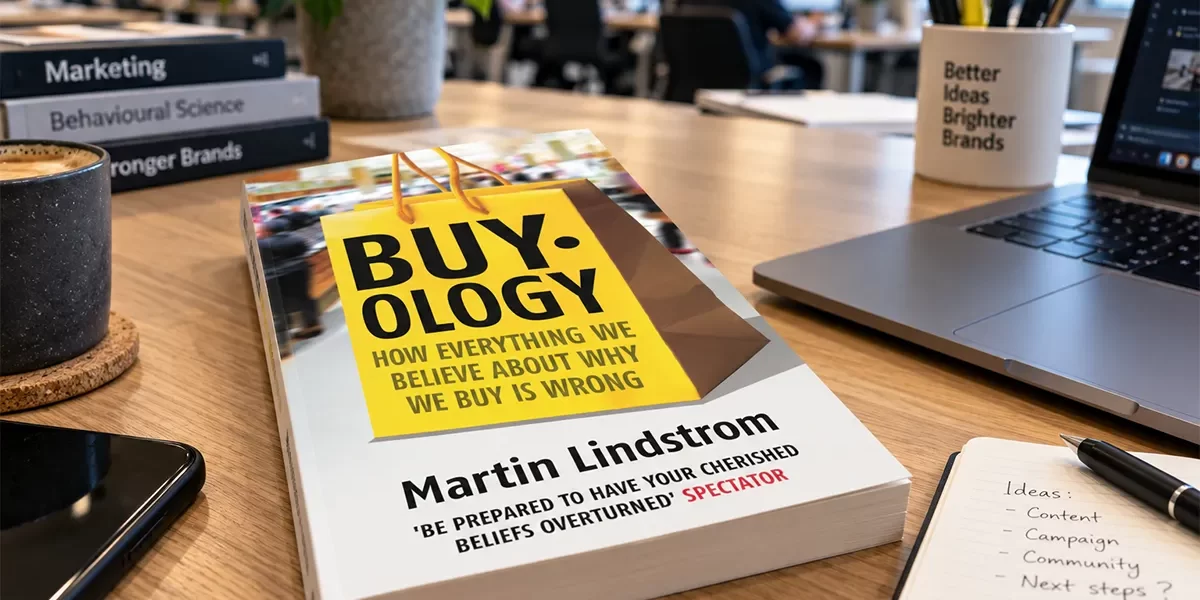
Book Review : Buyology: How Everything We Believe About Why We Buy is Wrong by Martin Lindstrom.
We like to believe we’re rational consumers.
We compare prices. Read reviews. Consider the alternatives. Weigh up the pros and cons.
Make an informed decision.
Then we buy something because the packaging felt nice.
Buyology: How Everything We Believe About Why We Buy Is Wrong by Martin Lindstrom explores the rather uncomfortable gap between why we think we buy things and what may actually be influencing us.
First published in 2008, with editions appearing around 2009-10, Buyology emerged when neuromarketing was still relatively novel. Lindstrom drew on a three-year study involving around 2,000 volunteers, examining their responses to brands, advertising, products and other marketing stimuli.
Nearly two decades later, some of the technology inevitably feels less revolutionary.
The human behaviour behind it doesn’t.
And that’s what makes Buyology still worth reading today.
The Big Idea: We Don’t Really Know Why We Buy
Buyology’s premise is wonderfully unsettling.
Ask customers why they bought something and they’ll usually give you an answer.
The problem is that the answer might not be entirely accurate.
Not because they’re lying.
Because they don’t necessarily know.
Lindstrom explores how subconscious associations, emotions, memories, sensory experiences, and established behaviours can influence purchasing decisions without our full awareness. His study examined reactions to advertising, logos, brands, and products, while the book tackles questions ranging from subliminal advertising to the influence of sight, smell, touch, and sound.
In other words, somewhere inside your brain there’s a marketing department you don’t have access to.
Which seems slightly unfair.
What Customers Say Versus What Customers Do
This is where Buyology becomes particularly useful for marketers.
We spend enormous amounts of time asking people what they want.
Surveys.
Focus groups.
Customer interviews.
Feedback forms.
All of these are useful.
But they’re only part of the picture.
There’s often a difference between what people say influences them and what actually shapes their behaviour.
Someone might tell you they choose a particular brand because of quality, value or functionality. Meanwhile, familiarity, packaging, colour, memory, social signalling or an emotional association may be quietly doing much of the heavy lifting.
This doesn’t mean we should stop asking customers questions.
It means we should also pay attention to what they actually do.
The Power of the Senses
One of the more fascinating areas of Buyology is Lindstrom’s exploration of sensory branding. Brands aren’t experienced purely visually.
Sound matters.
Smell matters.
Touch matters.
Context matters.
Memory matters.
Lindstrom asks whether products and branding can activate our senses in ways that influence what we choose.
This feels particularly relevant in modern marketing because we’ve become so focused on screens.
Brands obsess over websites, social feeds, digital advertising and visual identities, sometimes forgetting that customers experience businesses in the physical world too.
The sound of the packaging opening.
The feel of the product.
The atmosphere of a shop.
The way something arrives.
The smell when you walk through the door.
Not everything meaningful to a customer shows up conveniently in Google Analytics.
Brands, Rituals and Familiarity
Another interesting theme is how brands become embedded in routines and rituals.
Many purchasing decisions aren’t made from scratch every time.
We develop habits.
We recognise familiar signals.
We associate products with moments, places and emotions.
Brands that become part of those routines can gain an advantage that has little to do with someone sitting down and rationally comparing product specifications.
This is particularly interesting when you consider how much modern marketing concentrates on acquisition.
We’re forever trying to get someone’s attention. But perhaps an equally powerful position is becoming so familiar and embedded in someone’s life that choosing you barely feels like a decision at all.
Does It Still Hold Up?
Buyology comes from a period when neuroscience and marketing were being enthusiastically introduced to each other, so some of its claims are best read as provocative arguments rather than timeless laws of consumer behaviour.
That’s not necessarily a weakness.
The book’s real value lies in the questions it encourages marketers to ask.
- Why did someone really choose us?
- What associations have they formed with our brand?
- Which parts of their experience influence them?
- Are we relying too heavily on what customers tell us?
- What are we failing to notice because it can’t easily be measured on a dashboard?
Those questions remain extremely relevant. Perhaps even more so now.
Even More Relevant in the Age of Data
Modern marketers have access to extraordinary quantities of information.
- Clicks
- Impressions
- Conversions
- Heatmaps
- Search behaviour
- Customer journeys
- CRM data
- Attribution models
Enough dashboards to recreate the flight deck of a moderately ambitious spaceship.
But data usually tells us what happened.
Understanding why it happened is considerably harder. That’s where Buyology’s underlying thinking remains valuable.
Behind every click, conversion and purchase is a human being whose decisions are influenced by memory, emotion, habit, context and subconscious associations.
Customers are not conversion rates with shoes on.
They’re people.
The Overthinker’s Verdict
Buyology is fascinating, provocative and highly readable.
Lindstrom has spent his career studying brands and consumer behaviour, and the book combines marketing examples with his large-scale neuromarketing study to challenge some comfortable assumptions about how purchasing decisions are made.
Some elements inevitably reflect the excitement surrounding neuromarketing when the book appeared.
But its central argument has aged remarkably well: Human beings are considerably less rational than we’d like to believe.
For marketers, that’s not permission to manipulate people.
It’s a reason to understand them better.
The Quiet Takeaway
Perhaps the most important lesson from Buyology isn’t that marketers have discovered a secret button inside the human brain labelled BUY NOW.
We haven’t.
It’s that buying decisions are more complicated, emotional and subconscious than traditional marketing models sometimes suggest.
Nearly two decades after the book first appeared, we have AI, sophisticated analytics, behavioural targeting and more customer data than Lindstrom could have imagined when writing it.
Yet we’re still trying to answer the same fundamental question:
Why do people choose what they choose?
And that makes Buyology remarkably relevant today.
Because the technology has changed.
The dashboards have multiplied.
The algorithms have become smarter.
But the wonderfully irrational human being sitting at the centre of marketing remains reassuringly difficult to explain.
Purchase this book online through our Amazon affiliate link https://amzn.to/4gRuySp
Buyology: How Everything We Believe About Why We Buy is Wrong
Writing Style
Content
Insight
Smart!
Buyology by Martin Lindstrom is a fascinating and highly readable exploration of the often irrational forces that influence why we buy, from emotions and memories to sensory experiences, habits and subconscious associations. Although first published nearly two decades ago, its central argument remains remarkably relevant: customers don't always know, or accurately explain, why they make the choices they do. For marketers surrounded by ever-growing amounts of data, analytics and AI, the book is a useful reminder that numbers can tell us what people did, but understanding why still requires a deeper appreciation of human behaviour. Some of its neuromarketing claims are best approached with a little healthy scepticism, but Buyology remains thought-provoking, entertaining and valuable for anyone interested in what really happens between seeing something and deciding, entirely rationally of course, that we absolutely must have it.