
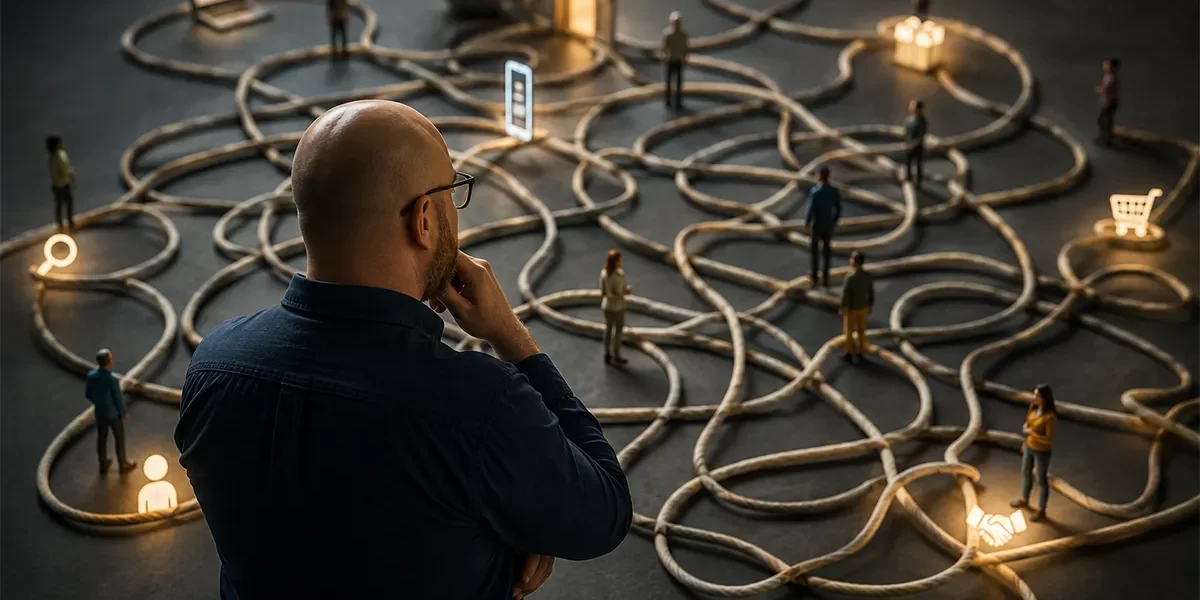
Why customers refuse to behave properly.
Marketers love funnels.
They’re neat. Logical. Comforting.
Someone becomes aware of your business, develops interest, considers their options, makes a decision and eventually becomes a customer.
Lovely.
This model has only one significant flaw.
Actual human beings.
Customers have an irritating habit of behaving like people rather than obedient little dots moving steadily down a PowerPoint diagram.
They discover you on LinkedIn. Forget you exist. Find one of your articles three months later. Visit your website. Leave. Hear somebody mention you. Listen to a podcast. Google you again.
Read some reviews. Get distracted by lunch.
Then, six months later, they suddenly email: “We’ve been following you for ages. Can we have a chat?”
Your analytics confidently reports this as Direct Traffic.
Excellent work, everyone.
The Customer Journey Looks More Like Spaghetti
The traditional funnel suggests customers move neatly from awareness to purchase.
Reality looks more like someone dropped a bowl of spaghetti onto a map.
Customers move backwards.
They disappear.
They return.
They compare you with competitors.
They ask colleagues.
They read reviews.
They look at your LinkedIn profile.
They visit your website at 11:47 pm for reasons known only to themselves.
And throughout all of this, they’re forming an opinion about your business.
Which is why the customer journey isn’t simply about marketing channels.
It’s about experiences.
Every Interaction Changes the Journey
Imagine someone discovers your business through a brilliant article. Good start.
They visit your website. Still good.
They send an enquiry. Nobody replies for four days. Journey altered.
Eventually someone calls and is extremely helpful. Journey improves.
A proposal arrives promptly. Excellent.
Then onboarding involves seventeen forms, three forgotten passwords, and a portal apparently designed by someone who actively dislikes customers. Journey altered again.
Every interaction adds or removes confidence.
Your marketing may have started the journey, but the rest of the business determines where it goes.
Customers Don’t See Your Organisation Chart
This is where businesses often get confused.
Internally, the customer journey crosses departments.
Marketing generated the lead.
Sales converted it.
Operations delivered it.
Finance invoiced it.
Customer service dealt with the problem.
Perfectly sensible.
Except customers don’t experience departments.
They experience you.
They don’t care that the terrible onboarding experience technically belongs to Operations.
Or that Finance owns the incomprehensible invoice.
To them, it’s all one brand.
Which means customer experience isn’t something that happens after marketing.
It’s part of marketing.
The Most Important Moment Might Happen After the Sale
Funnels tend to place the purchase at the bottom.
Mission accomplished.
Customer acquired.
Everyone celebrates, and Marketing updates the dashboard.
But what happens afterwards may be considerably more valuable.
- Does the customer come back?
- Do they leave a review?
- Do they recommend you?
- Do they mention you when somebody asks for advice?
- Do they become an advocate?
One great customer experience can create another customer without that person ever entering the top of your carefully constructed funnel.
They arrive halfway through because somebody they trust said: “Speak to these people. They’re good.”
Try putting that neatly into your funnel.
Customer Experience Is the New Advertising
This is exactly what I explore in Episode 14 of The Overthinker’s Guide to Modern Marketing: “Customer Experience Is the New Advertising, Why Your Customers Have Become Your Marketing Department.”
The episode looks at how phone calls, emails, invoices, reviews, recommendations and after-sales support all shape what customers think about your brand, often far more powerfully than the advertising that introduced them in the first place.
If you’re mapping your customer journey, it’s worth a listen, particularly before creating another funnel with seventeen boxes and several exciting arrows.
Stop Designing Funnels. Start Removing Friction.
Funnels can still be useful.
They help us understand broad stages in the buying process.
The mistake is assuming customers actually experience them that way.
Instead of obsessing over whether somebody is at Stage 3B of the consideration journey, ask simpler questions.
- Where are customers getting stuck?
- Where are we making things unnecessarily difficult?
- Where are expectations being broken?
- Where could we make the experience unexpectedly better?
Those questions are considerably less glamorous than designing another customer journey diagram.
They’re also considerably more useful.
People, Unfortunately, Are Not Flowcharts
Your customers aren’t moving neatly through a funnel. They’re wandering around.
They’re searching, listening, comparing, forgetting, remembering, asking, reading, experiencing and occasionally disappearing altogether because someone suggested going for lunch.
That’s fine.
Your job isn’t to force them through an imaginary marketing funnel.
It’s to make every interaction good enough that, whenever they encounter your business again, they want to keep going.
Because the customer journey isn’t a funnel.
It’s a relationship.
And relationships have always been considerably messier than PowerPoint would have us believe.