
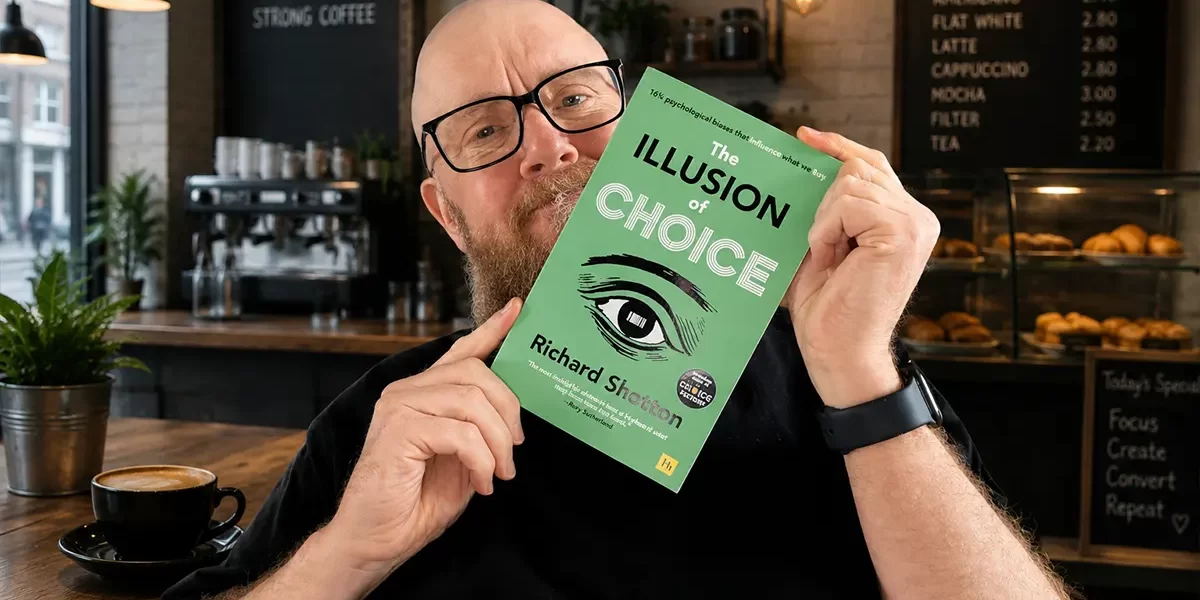
Book Review : The Illusion of Choice by Richard Shotton.
Many of us like to think our buying choices are thoughtful, logical, and completely our own. Richard Shotton’s The Illusion of Choice shows us that this belief is a bit too optimistic.
It turns out that many of our choices are influenced less by logic and more by subtle psychological nudges that guide us toward things we suddenly want to buy.
This could be unsettling, but it’s also fascinating.
The Big Idea (Spoiler: Choice Is Complicated)
In this follow-up to The Choice Factory, Richard Shotton explores 16½ psychological biases that influence what we buy, how we decide, and why seemingly small details can dramatically alter behaviour.
The book dives into ideas like habit formation, extremeness aversion, precision effects, social proof, and the wonderfully human tendency to avoid unnecessary effort whenever possible.
Which, frankly, explains a lot about modern marketing.
And supermarket meal deals.
Why This Book Works So Well
One of Shotton’s main strengths is making his ideas easy to understand.
Some behavioral science books can feel like sitting through a dry economics lecture. The Illusion of Choice is the opposite.
The chapters are short, conversational, and full of real-world examples, experiments, and practical tips that make the science feel useful instead of overly academic.
Importantly, Shotton does more than just explain these biases. He shows how marketers, advertisers, and brands use these biases every day, often in ways you’ll notice from now on.
It’s a risky book to read before your next trip to the supermarket.
Behavioural Science Without the Behavioural Science Ego
What makes The Illusion of Choice especially enjoyable is that it avoids the smug tone some behavioral science books can have.
Instead, the book feels down-to-earth, curious, and practical.
Shotton mixes academic studies, advertising examples, and his own research to show how small changes in framing, language, structure, and timing can influence behavior much more than most marketers think. Most importantly, the ideas are truly practical.
By the end of the book, you’ll probably have:
- a longer list of campaign ideas
- a mild distrust of your own decision-making
- and a strong urge to bring up “choice architecture” in meetings more often than you need to
Why It Feels So Relevant Right Now
Today, with so much AI-generated content, algorithmic targeting, and constant optimisation, Shotton’s main message stands out: Technology changes fast, but human psychology stays the same.
People still look for shortcuts, avoid hassle, react emotionally before thinking things through, and like to believe they’re making their own choices even when hidden cues are guiding them.
That’s why understanding behavioural science isn’t just a marketing trend, it’s a lasting advantage.
The Overthinker’s Verdict
If The Choice Factory explained why people act irrationally, The Illusion of Choice looks at how environments, framing, and subtle context shape those decisions from the start.
The book is insightful, easy to read, and full of moments that make you realize your own behavior is easier to influence than you might like to admit.
That’s exactly what makes it so useful.
The Quiet Takeaway
Most customers don’t want more options; they want simpler ones.
The Illusion of Choice reminds us that the brands getting noticed today are usually the ones that make things easier, help people decide quickly, and understand human behavior better than others.
It’s not always the loudest brands that win.
You can learn more about the author, Richard Shotton, by visiting his website at www.richardshotton.com
Purchase this book online through our Amazon affiliate link https://amzn.to/4dBS1VU or download the audiobook from https://amzn.to/4d4Y0T1
The Illusion of Choice
Writing Style
Content
Insight
Great
The Illusion of Choice by Richard Shotton is a smart, accessible, and highly engaging exploration of the hidden psychological biases that shape consumer behaviour and decision-making. Blending behavioural science with practical marketing examples, the book reveals how subtle factors like framing, habit, social proof, and simplicity can significantly influence the choices people make, often without them realising it. Insightful without becoming overly academic, it offers marketers a timely reminder that while technology and platforms continue to evolve, human psychology remains remarkably predictable, irrational, and endlessly fascinating.


My copy arrived yesterday and I am already hooked. Thanks for highlighting it.