
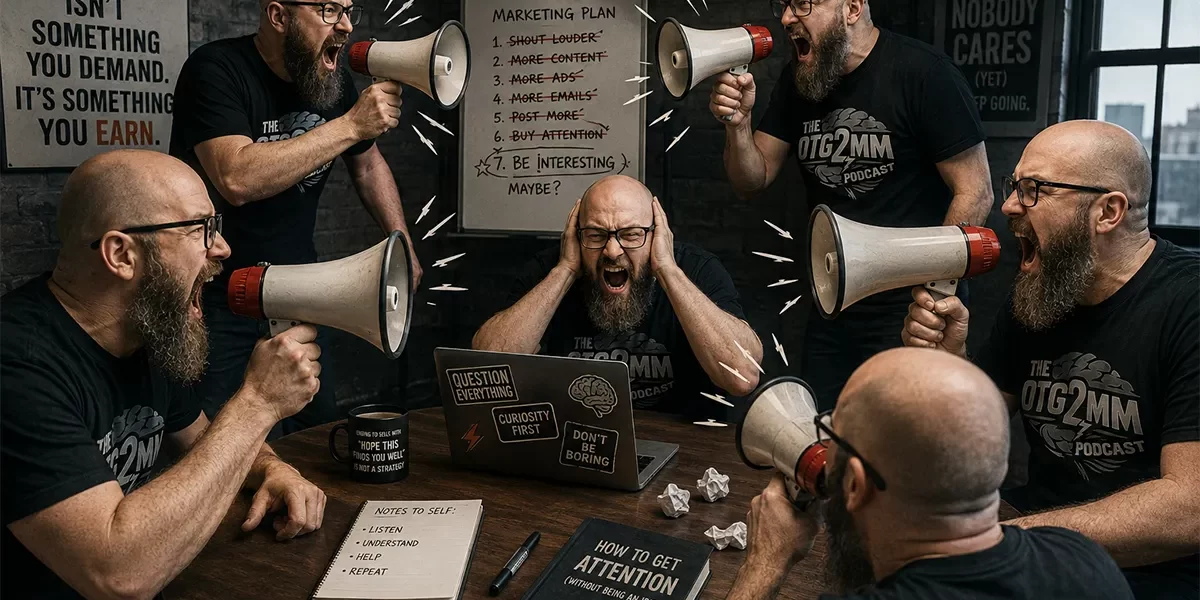
There has never been a better time in human history to get someone’s attention.
There has also never been a worse time.
This is one of those peculiar contradictions modern civilisation produces, like having 147 television channels and nothing to watch, or owning a device capable of accessing almost the entire sum of human knowledge and using it to watch a puppy fall off a sofa.
Businesses today have an extraordinary collection of ways to communicate with customers. Email. LinkedIn. Instagram. TikTok. YouTube. Podcasts. Google. WhatsApp. Webinars. Newsletters. Events. Advertising. Influencers.
And, for the particularly determined, telephone calls from numbers beginning 020 that everyone immediately ignores.
The result is not communication.
It’s noise.
Everyone is standing in the digital marketplace waving their arms and shouting: LOOK AT US!
And because everyone is shouting, the generally accepted marketing solution appears to be: SHOUT LOUDER.
This may not be working.
Welcome to the Great Attention Crisis
Attention has become one of the most valuable commodities in marketing.
Brands want it.
Advertisers want it.
Social networks want it.
Your inbox wants it.
Netflix wants it.
And somewhere, an abandoned mailing list you joined in 2017 because you wanted a free PDF called “Seven Ways to Transform Your Business” would very much like it back.
The problem is that human beings possess a limited amount of attention.
There are only so many things we can care about simultaneously, and most of us have already allocated quite a lot of our available capacity to wondering what we’re having for dinner.
So marketers face a difficult question: How do you get someone to pay attention when everyone else wants them to pay attention too?
The obvious answer is to become more interesting.
Unfortunately, the marketing industry has frequently chosen “become more annoying”.
Attention Isn’t Interest
You can get someone’s attention by throwing a chair through a window.
This does not necessarily mean you’ve successfully communicated your brand proposition.
Getting noticed and being interesting are different things.
Good marketing understands this.
Once you’ve attracted someone’s attention, you need to give their brain a reason not to wander off.
One of the best ways to do that is curiosity.
Curiosity creates a small hole in our understanding.
We know there’s an answer.
We don’t know what it is.
And our brain, which dislikes unfinished business almost as much as an accountant dislikes an unlabelled expense, wants to close the gap.
Which is why questions can be incredibly powerful.
Compare: “Our strategic marketing services help businesses achieve sustainable growth.”
With: “What if the biggest thing holding back your marketing isn’t your marketing?”
One sounds like a brochure.
The other creates a question, and questions make brains inconveniently curious.
Please Stop Introducing Your Company
One of the strangest traditions in business marketing is the belief that customers desperately want to hear your corporate biography.
- “We were founded in 1987…”
- “We have more than 30 years’ experience…”
- “We are a leading provider…”
- “We pride ourselves on delivering innovative solutions…”
Nobody has ever reached this point on a website and shouted: “Margaret! Come quickly! They pride themselves on delivering innovative solutions!”
Customers generally aren’t interested in your company. At least not yet.
They’re interested in themselves. This is why a useful old advertising principle suggests that if you’re selling fire extinguishers, start with the fire.
Don’t start with: “Established in 1974, Acme Fire Solutions is one of the UK’s leading suppliers of high-quality fire suppression equipment.”
Start with: “What would happen if a fire started in your warehouse tonight?”
Suddenly we’re interested.
Because now there’s a warehouse on fire.
Possibly ours.
Show Me the Problem
People often understand problems much faster when they can see themselves experiencing them.
Imagine trying to sell software that automatically organises business receipts.
You could explain: “Our innovative AI-enabled receipt aggregation platform seamlessly integrates expenditure documentation into a centralised digital ecosystem.”
Or you could ask: “Have you ever returned from a business trip with 23 receipts stuffed into your pockets and absolutely no idea which one was for £47.80?”
Immediately, half the room starts experiencing flashbacks.
There’s a taxi receipt.
A hotel invoice.
Something inexplicable from Copenhagen Airport (I still haven’t solved that).
And a restaurant receipt that you’re fairly certain is legitimate but which you’ll struggle to explain to Finance.
The problem has become real, and once someone recognises the problem, they’re naturally interested in the solution.
Different Is Not Something You Write in a Brand Workshop
Every business wants to be different.
Unfortunately, most businesses describe their differences using the same words.
- Innovative
- Trusted
- Experienced
- Customer-focused
- Passionate
- Flexible
- Solutions-driven
- Bespoke
These words are now so overworked they deserve statutory annual leave.
If everyone is innovative, nobody is innovative.
If everyone delivers exceptional customer service, statistically someone is lying.
And if everyone is a “leading provider”, we’re going to need a much larger podium.
Real differentiation comes from specificity.
- What have you actually done?
- What do you know that others don’t?
- What unusual experience do you possess?
- What measurable result have you achieved?
- What can you say that your competitors genuinely cannot?
“We help businesses grow.”
Means almost nothing.
“We helped a 50-person engineering company reposition itself, improve lead quality and reduce its dependence on expensive agency support.”
Now we’re getting somewhere.
Specificity is interesting. Generality is corporate wallpaper.
Your Customer Has Already Said No
Before encountering your marketing, many customers have already decided they’re not interested.
They have reasons.
- “We don’t have the budget.”
- “We already have someone.”
- “We tried that before.”
- “We’re too busy.”
- “We don’t need it.”
- “Marketing is mostly people making PowerPoint presentations containing funnels.”
Some of these objections may even be reasonable. The mistake is pretending they don’t exist.
Good communication acknowledges them.
Imagine opening with: “You probably don’t need another marketing consultant.”
That’s interesting.
Or: “The last thing your business needs is another piece of marketing software.”
Also interesting.
Why?
Because you’ve joined the conversation already happening inside the customer’s head.
You have demonstrated something incredibly powerful: you understand why they might not buy from you.
This makes you approximately 700% more interesting than someone shouting about their “award-winning solutions”.
Want People to Listen? Try Listening.
Here we encounter one of marketing’s more magnificent contradictions.
Businesses desperately want customers to listen to them.
Yet many are remarkably reluctant to listen to customers.
Instead, they conduct internal workshops.
They create personas.
They build customer journey maps.
They invent audience segments called things like: Growth-Focused Gary and Transformation Tina.
Gary is 43, drives a Tesla, enjoys cycling and is “digitally savvy”.
Gary does not exist.
Actual customers do, and actual customers will happily tell you what matters to them if you bother asking.
Listen to sales conversations.
Read customer emails.
Look at support requests.
Read reviews.
Talk to customers.
Find out what frustrates them.
Find out what they’re trying to achieve.
Most importantly, listen to the words they use.
Then use those words in your marketing.
This is considerably more useful than describing your business as providing: “End-to-end transformational solutions designed to unlock strategic value.”
Nobody talks like this.
Not even Transformation Tina.
Make It Relevant
Data can be fascinating. Data can also be incredibly boring.
Consider the difference between saying: “Marketing efficiency among SMEs has declined by 17.3%.”
And asking: “Have you ever spent £10,000 on marketing and then realised nobody could explain what it actually achieved?”
The second one creates recognition.
Someone reading it remembers a campaign.
A meeting.
A spreadsheet.
Possibly an agency presentation containing a graph pointing upwards.
Then they remember the Managing Director asking: “So how much did we sell?”
There is a brief silence.
Someone mentions brand awareness.
A biscuit is nervously eaten.
Relevance makes information personal, and personal things are difficult to ignore.
Tell Me About Dave
Human beings have another curious feature.
We’re often terrible at emotionally processing large numbers.
Tell us 50,000 customers experience a problem and we’ll nod thoughtfully.
Tell us Dave experiences the problem and suddenly we’re concerned about Dave.
What happened to Dave?
Did Dave solve the problem?
Is Dave alright?
Could someone make Dave a cup of tea?
This is why stories are so powerful.
Not enormous corporate narratives beginning: “Since the dawn of civilisation, mankind has sought innovative logistics solutions…”
Small stories.
One person.
One situation.
One problem.
One outcome.
Instead of: “Our platform increases productivity.”
Try: “Sarah used to spend every Friday afternoon preparing reports. Now they’re finished automatically before she arrives at work.”
That’s understandable. It’s tangible, and somewhere, someone who spends Friday afternoons wrestling with Excel has just become extremely interested in Sarah.
Don’t Be Clever. Be Useful.
Marketers enjoy cleverness.
We enjoy campaigns, concepts, wordplay, creative executions and occasionally we say things like “creative execution”, which is itself evidence that we probably shouldn’t be allowed unsupervised access to language, but customers don’t necessarily want clever.
They want useful.
They want relevant.
They want understandable.
And occasionally they want someone to explain something without requiring them to download an ebook, attend a webinar and surrender their telephone number.
The best marketing doesn’t make people work hard.
It makes them think: “That’s exactly my problem.”
Followed shortly afterwards by: “Perhaps these people can help.”
That’s the journey.
Not awareness → consideration → conversion → advocacy → 46 slides of funnel diagrams.
Just: They understand me.
The Great Marketing Paradox
This brings us to perhaps the strangest thing about the modern attention economy.
We’ve never measured attention more carefully.
We know impressions.
- Clicks
- Views
- Reach
- Watch time
- Engagement
- Bounce rate
- Scroll depth
- Open rates
- Conversion rates.
We can determine that someone in Dundee looked at 63% of a webpage for 47 seconds before disappearing into the internet forever.
What we can’t measure quite so easily is: Did they care?
Because attention isn’t merely a metric. It’s a human exchange.
You want someone to listen?
Listen to them.
You want someone to care?
Talk about something they care about.
You want someone to remember you?
Give them something worth remembering.
You want someone to trust you?
Demonstrate that you understand their world.
And if you want someone to stop scrolling?
Don’t simply shout louder than everyone else.
Say something worth stopping for.
Because perhaps the winners in the attention economy won’t be the brands producing the most content, posting most frequently or making the most noise.
Perhaps they’ll be the ones that understand something rather more fundamental.
Attention isn’t something you demand. It’s something you earn. Which is deeply inconvenient, because there isn’t an app for that…Yet.
If you enjoy exploring marketing strategy, customer psychology, branding, AI, and business growth with a healthy dose of humour, subscribe to The Overthinker’s Guide to Modern Marketing podcast. Because sometimes the best marketing ideas come from asking better questions rather than chasing bigger budgets.