
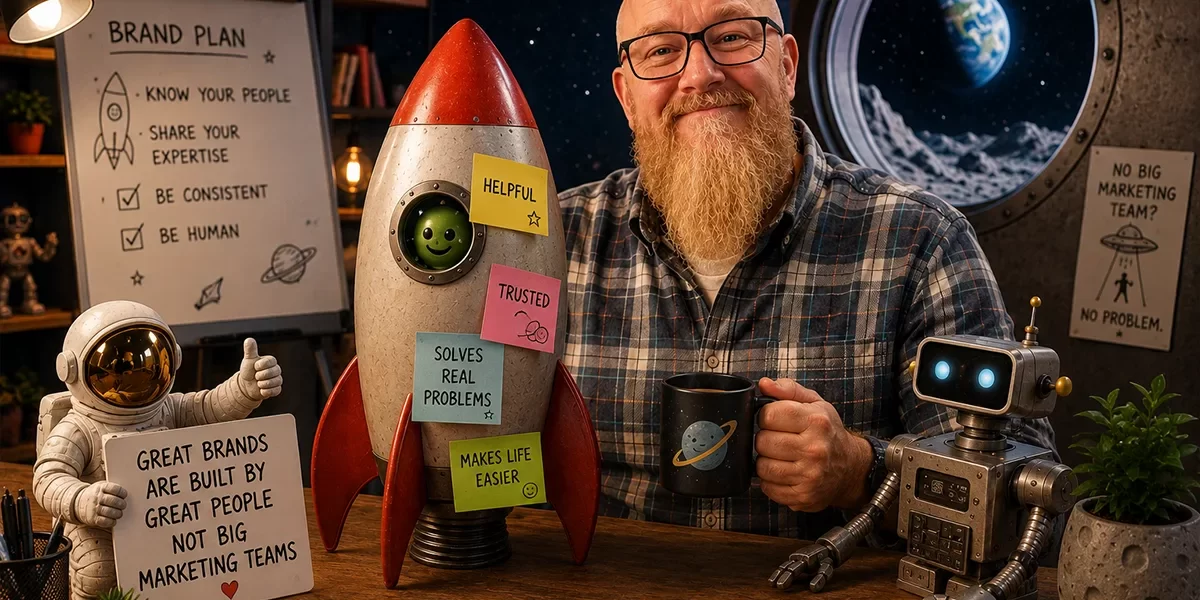
Why your best marketing department might already be sitting in the office next door.
Many people in business believe that it takes large teams of marketers to build a successful brand.
Some imagine there are hundreds or even thousands of them.
They picture everyone wearing the same lanyards and sipping coffee with names that could be mistaken for Scandinavian furniture.
People often picture these teams in shiny glass offices, surrounded by big digital screens showing colourful graphs that seem to justify yet another quarterly strategy meeting.
It all sounds very impressive.
But for most businesses, this image doesn’t matter, since most successful companies don’t have fifty marketers.
Some don’t even have five.
Quite a few have one.
Occasionally that one is also responsible for organising the Christmas party, updating the website, finding the missing HDMI cable before client presentations and explaining, for the seventeenth time this month, why Comic Sans isn’t appropriate for investor documents.
And yet many of these businesses build remarkable brands.
How?
Instead of hiring more people, these companies focus on getting everyone they already have to work together toward the same goals. This isn’t always what the marketing industry expects.
The Marketing Department Doesn’t Build a Brand.
This can come as a slight shock to marketing departments.
It’s not that marketing teams are doing anything wrong. It’s just that branding has never been only their job.
Imagine walking into a restaurant with beautiful branding.
Elegant menus.
Stylish décor.
Beautiful photography.
Then the waiter ignores you for twenty minutes before accidentally serving your soup to a nearby accountant called Keith.
In that moment, the brand’s meaning has changed.
It wasn’t marketing that changed it, but the customer’s experience.
Your receptionist influences your brand.
Your engineers influence your brand.
Accounts influence your brand.
Customer support influences your brand.
The delivery driver.
The installation technician.
Even Janet from Finance, who always answers the phone with more warmth than most people online.
Brands aren’t built in meeting rooms.
They are built through everyday moments.
Thousands of them. Every single day.
Small Teams Have an Unexpected Superpower
Big companies have lots of resources. Small businesses have the advantage of speed.
Need to change your messaging?
You don’t have to wait for a dozen approval meetings or several committees.
Need to improve customer communications?
You can do it before lunch.
Need to start a podcast?
If someone has a microphone and isn’t shy about speaking, you could start recording as soon as tomorrow.
Smaller businesses can adapt astonishingly quickly.
Ironically, small businesses often overlook this advantage because it seems too simple.
Consistency Beats Complexity
Businesses frequently mistake activity for progress.
A new logo or website, a different colour palette, another social platform and yet another AI tool everyone insists will “change everything.”
Meanwhile, the company still can’t answer one deceptively simple question.
“What makes us different?”
The strongest brands don’t try to say everything. They repeat the right things consistently.
Customers rarely remember your sixth key message. They remember the message you repeat over and over for years.
Your Experts Are Sitting Quietly Waiting
If you walk through almost any business, you’ll find something surprising.
Someone knows the answer to almost every customer question imaginable.
The problem is, no one has ever asked them to share their knowledge in writing.
Your sales team knows why deals are won.
Your engineers understand how products solve real problems.
Customer support knows which questions appear every week.
Your founder has stories that competitors can’t copy.
Marketing doesn’t need to invent expertise. It needs to uncover it.
The greatest untapped content strategy in most businesses is simply talking to the people already working there.
Technology Has Levelled the Playing Field
Twenty years ago, producing professional marketing required considerable budgets.
- Design agencies
- Printers
- Photographers
- Video production
- Developers
Today?
A small business with a clear plan can publish blogs, record podcasts, make videos, design presentations, and reach people all over the world from a laptop at the kitchen table.
Technology has dramatically reduced the cost of publishing.
What it hasn’t reduced is the value of good ideas, which is reassuring because good ideas remain delightfully difficult to automate.
Stop Waiting for Permission
Some businesses behave as though becoming recognised requires an official invitation.
“We’ll start creating content once we’re bigger.”
“We’ll launch a podcast when we’re more established.”
“We’ll build thought leadership after we’ve grown.”
This way of thinking is completely backwards.
Businesses become recognised because they begin sharing expertise.
They do it before they become well-known, not after.
Before.
Customers rarely ask how many people work in your marketing department. They ask whether you understand their problem.
Everyone Becomes Part of Marketing
One of the biggest shifts in modern business is that marketing no longer begins when someone opens LinkedIn.
It begins the moment somebody interacts with your organisation.
The invoice, onboarding email, proposal, customer service call, packaging and the follow-up.
Every interaction either strengthens your reputation or slowly weakens it.
That’s why businesses with small marketing teams often do better than much bigger competitors.
Everyone plays a part, even if their email signature doesn’t say “Marketing.”
Build Systems, Not Heroes
Here’s the real secret.
Successful brands don’t rely on one marketing genius. They rely on repeatable systems.
- A process for collecting customer stories
- A regular publishing schedule
- Simple brand guidelines
- A shared understanding of tone of voice
- Regular conversations between sales and marketing
- Clear messaging
- Documented knowledge
Systems help small teams achieve big results. People need breaks, but systems keep things running.
Where Brands Are Truly Built
If you wait to build a stronger brand until you have a bigger marketing team, you might be waiting a long time.
The businesses people admire aren’t always the ones with the largest teams.
They’re often the ones with the clearest thinking.
The strongest culture.
The most helpful content.
The happiest customers.
And the confidence to consistently share what they know.
Because, in the end, brands aren’t built by departments.
People build them.
Ideally, these are people who answer the phone quickly and don’t claim that Comic Sans is “friendly.”
That still matters more than having another marketing automation tool.
If your marketing manager disappeared for two weeks tomorrow, would your brand continue to grow or would all of your marketing disappear with them?
Your answer will probably show whether you have a marketing team or a real marketing system.
If you enjoyed this article, subscribe to The Overthinker’s Guide to Modern Marketing podcast, where we explore customer psychology, branding, business growth, and the wonderfully irrational ways humans continue making decisions.