
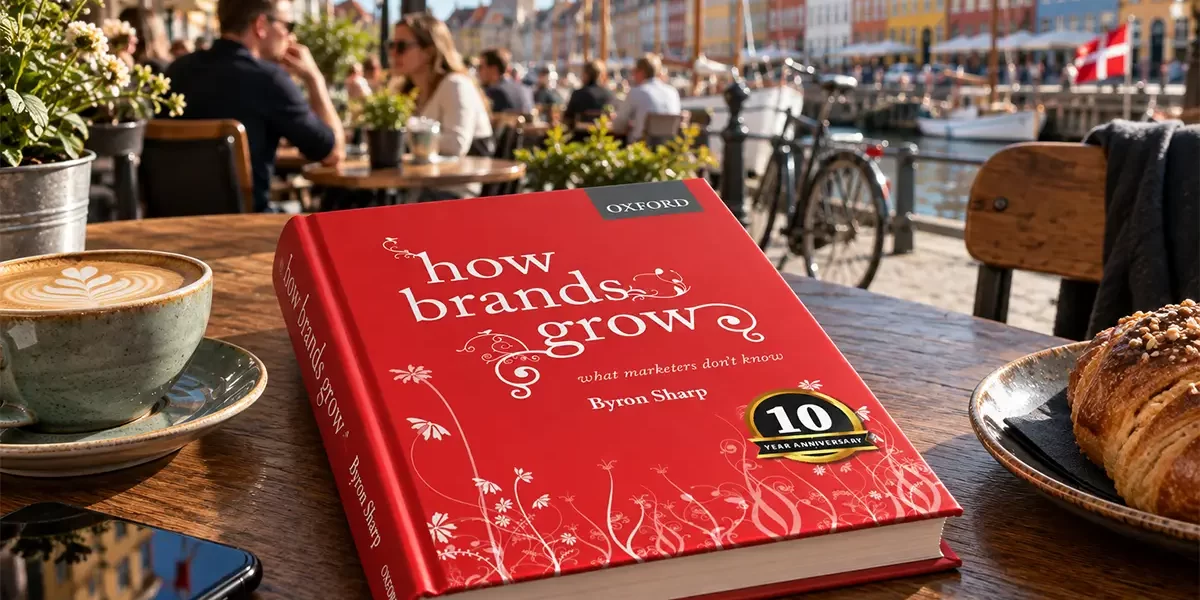
Book Review : How Brands Grow: What Marketers Don’t Know by Byron Sharp.
Marketing has accumulated a reassuring collection of beliefs over the years.
Find your ideal customer. Build a tribe. Create passionate brand advocates. Reward your most loyal buyers. Differentiate yourself from everyone else. Then nurture those customers until they become so emotionally attached to your brand that they presumably start inviting it to family weddings.
Then Byron Sharp came along with some data.
How Brands Grow: What Marketers Don’t Know was published in 2010 and set out to challenge much of the accepted marketing wisdom. Based on decades of research into actual buying behaviour, it asks marketers to rely less on what sounds sensible and start looking at what customers actually do.
More than fifteen years later, it remains one of the most important, and occasionally uncomfortable, books in modern marketing.
The Big Idea: Growth Comes From More Buyers
The central argument of How Brands Grow is deceptively simple: Brands grow primarily by getting more people to buy them.
Yes, I realise this doesn’t initially sound like the sort of revelation requiring 246 pages.
But the implications are significant.
Sharp challenges the idea that growth mainly comes from persuading existing customers to become increasingly loyal. The research underpinning the book shows that larger brands tend to have considerably more buyers and only somewhat higher loyalty. This pattern is associated with what marketing science calls the Double Jeopardy Law.
In other words, the route to growth isn’t simply persuading Dave, who already buys your product regularly, to buy even more of it.
At some point, you need another Dave. Preferably several thousand of them.
The Awkward Problem With Loyalty
Marketers love loyalty.
It’s comforting.
We imagine our customers developing meaningful relationships with brands, becoming passionate advocates and remaining faithfully beside us while competitors wave introductory discounts in their general direction.
Sharp’s research paints a rather less romantic picture.
Most brands have lots of relatively light buyers. Customers also buy competing brands, and differences in loyalty between rival brands are often smaller than marketers assume. The book consequently argues that increasing market penetration, reaching more category buyers, is generally more important for growth than attempting to increase loyalty among existing customers dramatically.
That doesn’t mean existing customers suddenly don’t matter.
Nor does it mean customer experience and retention can be cheerfully abandoned while everyone goes looking for strangers.
It means loyalty shouldn’t automatically be mistaken for the primary engine of brand growth.
A subtle distinction. But an important one.
Mental Availability: Be Easy to Remember
One of the book’s most influential concepts is mental availability.
This isn’t simply brand awareness.
Sharp defines it as the likelihood that someone will notice, recognise or think about your brand in a buying situation. It depends on the strength and breadth of the memory structures associated with the brand.
That’s enormously important.
Because customers don’t spend their lives thinking about our brands.
I appreciate this may come as disappointing news to anyone who has just completed a 74-slide brand strategy presentation.
People are busy.
When a buying situation occurs, the brands that come readily to mind have an obvious advantage.
Marketing therefore has an important job beyond generating immediate clicks and conversions: Build memories.
That’s one reason consistent, distinctive branding matters so much.
Distinctiveness Versus Differentiation
This is another area where How Brands Grow enjoys kicking the furniture.
Traditional marketing thinking often tells us that brands must identify a meaningful point of differentiation and communicate it relentlessly.
Sharp places considerably more emphasis on distinctiveness.
Can people recognise you?
- Your colours.
- Your logo.
- Your packaging.
- Your characters.
- Your typography.
- Your sounds.
- Your shapes.
The visual and sensory cues that allow someone to recognise your brand without needing to read the company name carefully.
The book argues that clear, distinctive branding helps create the memory structures that make brands easier to notice and recall.
Being different can certainly matter.
But being recognisably you matters enormously.
Physical Availability: Being Famous Is Useless If Nobody Can Buy You
The other half of Sharp’s availability argument is considerably less glamorous.
Physical availability.
Your brand needs to be easy to buy.
That means distribution, accessibility, visibility and removing unnecessary barriers between wanting something and actually purchasing it.
Together, mental and physical availability form the core of Sharp’s prescription: make your brand easier to think of and easier to buy, for more people and in more buying situations.
It’s wonderfully straightforward.
You can have the most beautifully positioned brand in the category, but if customers can’t remember you, or can’t find you when they’re ready to buy, you have something of a problem.
Marketing strategy occasionally turns out to be annoyingly practical.
Why It Still Matters in 2026
This is what surprised me most about revisiting How Brands Grow.
The 2010 marketing landscape now feels almost quaint.
TikTok didn’t exist. Instagram had barely arrived. Generative AI wasn’t producing 400 LinkedIn posts before breakfast. Marketing technology hadn’t yet expanded into a small industrial complex.
And yet the principles in this book haven’t become less relevant.
If anything, they’ve become more so.
Modern marketing has become extraordinarily good at targeting smaller and smaller groups of people with increasingly personalised messages.
Sharp forces us to ask whether, in doing so, we sometimes forget something rather obvious:
Brands need new customers to grow.
That’s a useful thought to keep somewhere near the marketing dashboard.
A Book That Makes You Argue With It
Part of the appeal of How Brands Grow is that you don’t have to agree with every conclusion.
Indeed, you probably won’t.
Some of Sharp’s arguments have generated substantial debate, particularly around differentiation, loyalty and how universally findings from repeat-purchase categories apply across different markets. Later work from the Ehrenberg-Bass Institute has continued to extend the research into services, emerging markets, luxury brands and durable goods.
But that’s precisely why the book is valuable.
It makes you question assumptions.
- Why are we targeting this particular audience?
- Are our “loyal customers” actually as loyal as we think?
- Are we building distinctive brand assets or constantly redesigning them?
- Are we reaching enough potential buyers?
- Are we easy to remember?
- Are we easy to buy?
And, perhaps most importantly: Do we know this, or have marketers simply been saying it to each other for twenty years?
The Overthinker’s Verdict
How Brands Grow isn’t necessarily a comfortable marketing book.
That’s a compliment.
It challenges deeply embedded beliefs about segmentation, loyalty, differentiation, and targeting, and replaces comfortable assumptions with evidence drawn from observed buying behaviour. Oxford University Press describes the book as presenting decades of research tested across different conditions, periods and countries.
Some sections are more academic than the average business book, and there are moments when you’ll probably find yourself mentally constructing an argument with Professor Sharp.
That’s healthy.
Good marketing books shouldn’t simply confirm what we already believe.
They should make us reconsider it.
The Quiet Takeaway
If there’s one lesson from How Brands Grow worth remembering, it’s this:
Growth requires more buyers.
To get them, brands need to reach broadly, build strong memory structures, remain distinctive and make themselves easy to buy.
Not terribly glamorous.
No revolutionary funnel.
No secret psychological hack.
No AI prompt that will transform your business by lunchtime.
Just a deceptively simple reminder that marketing’s job is to help more people notice, remember and buy the brand.
Published in 2010, How Brands Grow remains highly relevant precisely because the technology surrounding marketing has changed far more quickly than the fundamentals of buying behaviour.
We may have considerably more sophisticated tools today.
But we still need people to remember us.
And eventually buy something
Purchase this book online through our Amazon affiliate link https://amzn.to/4haw9S1 or download the audible book version from https://amzn.to/3Tb33ds