
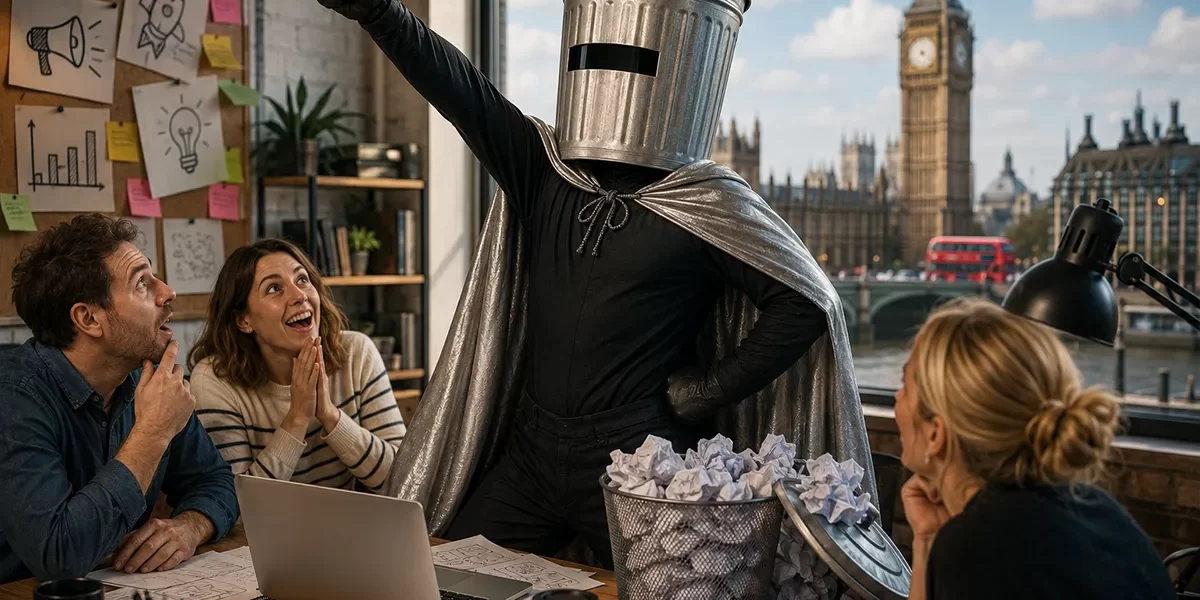
There are moments in British public life when you wonder whether reality has quietly wandered off for a cup of tea and forgotten to return.
A giant bin wearing a silver cape starts dominating the news cycle.
National newspapers can’t stop talking about him.
Television crews eagerly chase him down for a news segment.
Journalists who once interviewed Prime Ministers are suddenly asking a six-thousand-year-old space warrior whether he believes parking restrictions should apply on Jupiter.
Meanwhile, somewhere in an anonymous business park just outside Milton Keynes, a perfectly sensible marketing team has spent £47,000 on a campaign that approximately twelve people noticed.
This, dear reader, is marketing. Or at least, it is attention.
Count Binface has once again found himself generating enormous media coverage across the UK, not because he possesses an unlimited advertising budget, but because he understands something many businesses still haven’t quite grasped.
People don’t share the ordinary.
They share remarkable.
The World’s Most Successful Bin
Let’s be honest. If Count Binface appeared in an ordinary office wearing a sensible navy suit and announced a carefully researched five-year strategic plan, nobody would remember him.
Instead, he appears wearing what looks suspiciously like a recycling container that’s won an Oscar for Best Costume.
It immediately creates curiosity.
Curiosity creates attention.
Attention creates conversations.
Conversations create coverage.
Coverage creates momentum, and momentum is something no amount of Google Ads can buy.
The interesting part isn’t the costume. It’s that every single appearance has a story built into it.
There is always something journalists can write about.
Always something social media users can share.
Always something people can laugh about on the train.
That’s not luck. That’s engineered shareability.
Stop Selling Features. Start Selling Stories.
One of marketing’s greatest tragedies is that businesses often mistake information for interest.
“We’ve launched Version 4.3.”
“We’ve expanded our warehouse.”
“We’ve introduced a new customer portal.”
Wonderful.
My pulse remains stubbornly unchanged.
Count Binface, however, understands narrative. His policies are intentionally absurd enough to earn headlines, while often containing a grain of truth that people recognise instantly. The humour makes the message memorable, and the underlying observation gives people a reason to discuss it rather than simply laugh and move on.
Businesses can do exactly the same.
No, I’m not suggesting your Managing Director should wear a household appliance on their head.
Although… depending on quarterly sales…
What I mean is this:
- Instead of announcing what you’ve built… Create a story around why it matters.
- Instead of publishing updates… Create conversations.
- Instead of listing specifications… Give people something they’ll want to repeat over lunch.
The Curiosity Gap
Marketing often assumes people wake each morning desperate to hear about another software update.
Sadly, they do not.
They wake wondering:
- “What’s happened?”
- “What’s unusual?”
- “What’s everyone talking about?”
Count Binface consistently positions himself inside those questions.
His campaigns don’t simply communicate. They interrupt.
The modern attention economy rewards interruption, not through shouting louder, but by being impossible to ignore.
That’s why unexpected collaborations work.
That’s why unusual product launches work.
That’s why genuinely funny campaigns still outperform many expensive corporate productions.
People remember surprises.
Nobody remembers Page 47 of your annual brochure.
Give Journalists Something To Do
One overlooked lesson is that journalists need stories. Not advertisements. Stories.
Count Binface repeatedly provides media outlets with exactly what they need:
- An unusual visual.
- A witty quote.
- A topical angle.
- A recognisable character.
- A headline that practically writes itself.
Compare that with many company press releases.
“We are delighted to announce…”
No.
You’re delighted.
Everyone else is checking whether there’s any coffee left.
When your business launches something, ask yourself one simple question: “Would somebody tell a friend about this without being paid?”
If the answer is no… Keep thinking.
Character Beats Corporate
One reason Count Binface attracts attention is consistency. He has a recognisable personality.
You know what sort of humour to expect.
You recognise the costume instantly.
You can almost predict the tone of every interview.
Brands often underestimate how powerful consistent character can be.
People follow personalities. Not style guides.
Think about the founders, podcast hosts and creators you enjoy.
You know exactly how they’ll communicate before they open their mouths.
That’s branding.
Not fonts.
Not logos.
Personality.
The Rule of Delightful Absurdity
The internet rewards people who can surprise without confusing. There’s a sweet spot between predictable and ridiculous.
Count Binface occupies that space beautifully.
His ideas are absurd enough to make people smile, but coherent enough that they feel connected to current events. That combination has helped him generate recurring media attention across multiple election campaigns.
Businesses can borrow the same principle.
- Launch an annual “worst customer excuse” awards.
- Publish data nobody else has spotted.
- Invent a playful challenge.
- Run an experiment.
- Reveal something unexpected.
Do something that’s just unusual enough that people feel compelled to mention it.
Remarkability doesn’t always require a massive budget. Sometimes it simply requires bravery.
Stop Trying To Look Professional All The Time
Somewhere along the line, professionalism became confused with being desperately boring.
Every LinkedIn post started looking identical. Every website became a sea of blue gradients and stock photography featuring smiling people pointing enthusiastically at laptops.
Marketing departments began speaking fluent Corporate.
Nobody voluntarily speaks Corporate.
Humans speak Human.
Humour is human.
Curiosity is human.
Surprise is human.
Stories are human.
People don’t remember the safest campaign. They remember the one that made them feel something.
Your Homework
This week, before approving your next piece of marketing, ask yourself:
- Would someone photograph this?
- Would someone forward it?
- Would a journalist write about it?
- Would somebody tell their colleagues over coffee?
- Would anyone laugh?
- Would anyone care?
If every answer is “probably not”…
Perhaps your campaign needs slightly less committee approval and slightly more Count Binface.
Not the helmet. Definitely not the helmet. Although if your quarterly figures are looking particularly alarming, don’t rule it out entirely.
Because in a world where everyone is desperately trying to blend in, sometimes the fastest route to being remembered is to arrive dressed like an intergalactic recycling enthusiast.
Marketing, after all, has never really been about shouting the loudest.
It’s about giving people a story they can’t resist repeating.