
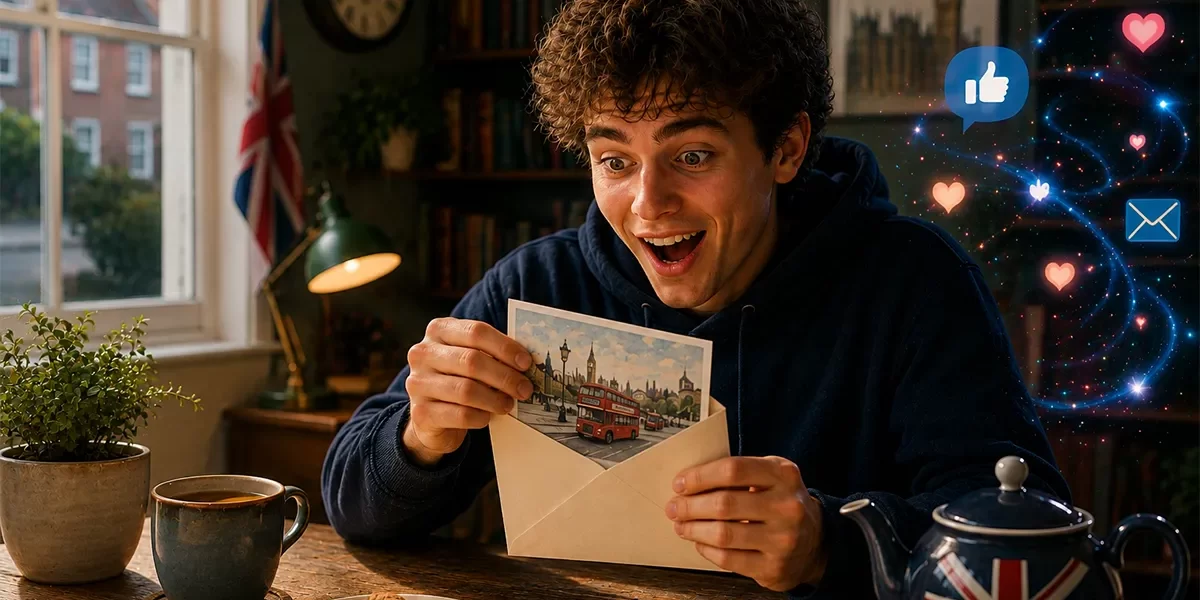
These days, getting a letter in the mail can feel more surprising than anything artificial intelligence can do.
There was a time when checking the mail was something to look forward to.
Admittedly, it was usually bills and the occasional pizza menu, and maybe you’d get a handwritten birthday card from a relative who thought stamps were one of the best inventions.
Then, marketing took over.
For years, direct mail meant piles of catalogues, insurance offers, takeaway menus, and random invitations to switch your energy supplier right away.
Naturally, marketers declared it dead.
Digital had arrived. Email was free. Social media was instant. Search engines were magical.
We were told everything would move online for good. That made sense, until something unexpected happened.
Nobody expected to receive anything through the post anymore.
Surprise Has Become a Competitive Advantage
Marketing has always been about capturing attention.
Today, getting people’s attention is harder and more expensive than ever.
Every smartphone contains hundreds of notifications.
Every social feed competes with thousands of creators.
Every inbox overflows before breakfast.
People have gotten really good at tuning out digital marketing. It’s not that it’s bad; there’s just too much of it.
Ironically, getting something in the mail is rare now, and rare things get noticed.
Getting a well-designed piece of direct mail now feels almost unexpected. It’s like someone showing up to talk in person instead of just sending another calendar invite.
Gen Z Didn’t Grow Up With Actual Junk Mail
This is where things get really interesting.
A lot of marketers think direct mail is just for older generations who grew up with it, but Gen Z’s experience is very different.
Most have grown up in an entirely digital world.
Streaming instead of DVDs. Messaging instead of letters. Digital wallets instead of cheque books. Cloud storage instead of filing cabinets.
For many younger consumers, receiving something physical through the post isn’t boring.
It’s new, feels personal and intentional, and it’s real.
In a world full of disappearing stories and endless scrolling, something you can actually hold stands out just because it’s real.
Physical Marketing Feels More Human
There’s something comforting about holding something in your hands.
A beautifully printed brochure.
An invitation.
A handwritten note.
A well-designed sample.
Even nice packaging can create a small emotional moment.
You can’t accidentally scroll past it. You can’t swipe it away.
It occupies actual space, which means it occupies mental space too.
Human beings have always responded emotionally to physical objects, and marketers occasionally forget this when they become distracted by dashboards.
Direct Mail Doesn’t Compete With Email
A big mistake businesses make is thinking direct mail should replace digital marketing. That’s not the case.
The strongest campaigns combine both.
A prospect discovers you through Google.
They follow you on LinkedIn.
They download a guide.
They receive useful emails.
Then, out of the blue, a well-made package shows up in the mail. Suddenly, your business stands out. More established, memorable and thoughtful.
The physical piece reinforces everything the digital journey has already started.
Marketing channels don’t usually compete; they make each other stronger.
AI Makes Direct Mail Even More Powerful
Here’s the biggest twist: artificial intelligence is actually making direct mail better, not replacing it.
AI now allows businesses to personalise messaging, analyse customer behaviour, predict buying intent, and automate campaign planning with extraordinary precision.
Instead of sending 10,000 identical leaflets to everyone with a postcode, businesses can identify exactly which customers are most likely to respond and tailor the message to them.
Technology makes the targeting smarter.
Getting something physical makes the experience memorable. That’s a powerful mix.
The Economics Have Changed
Yes, direct mail costs more than sending an email.
Paper, printing, and postage do cost money, but cost isn’t the same as value.
Sending ten thousand emails that no one opens isn’t really a bargain. It’s simply invisible.
Sending 500 well-targeted pieces of direct mail that spark real conversations can be a smart investment.
Marketing shouldn’t just aim for the lowest cost per message. It should focus on getting real attention.
Those two goals aren’t always the same.
The Best Direct Mail Doesn’t Feel Like Marketing
No one likes getting obvious ads, but people do like getting something useful, creative, surprising, helpful, or valuable.
Perhaps it’s a beautifully designed guide.
A personalised invitation.
A sample.
A handwritten thank-you card after becoming a customer.
A clever piece of dimensional mail that genuinely makes someone smile before they’ve even opened it.
The goal isn’t just to land in someone’s mailbox. It’s to be remembered.
Direct Mail Isn’t Old. It’s Just Different.
Perhaps we’ve misunderstood direct mail entirely.
It isn’t an outdated marketing channel waiting to be replaced.
It’s just become a more specialised tool.
Like vinyl records, bookshops and independent coffee shops.
Sometimes, things we thought were outdated become valuable again simply because they’re no longer common. The same may now be true of direct mail.
When everything else is digital, physical experiences stand out and are easier to remember.
Sometimes the Best Way to Stand Out Is to Do the Unexpected
Modern marketing often assumes newer automatically means better.
History suggests otherwise.
Sometimes, the biggest advantage comes from bringing back an old idea and using it in a smarter way.
Direct mail won’t replace digital marketing. Nor should it. But for businesses willing to surprise customers, send something worth opening, and mix physical experiences with smart digital marketing, direct mail is still one of the most overlooked tools out there.
This is especially true when you’re trying to reach a generation that’s always expected everything to happen on a screen. In a world where everyone is fighting for space in someone’s inbox… the letterbox has become surprisingly quiet, and that’s exactly why it deserves another look.
When was the last time you received a piece of direct mail that genuinely made you stop, smile, or take action? What made it memorable?
If you like learning about the psychology behind marketing, customer behaviour, branding, AI, and old marketing channels that deserve a second chance, subscribe to The Overthinker’s Guide to Modern Marketing. Sometimes, the oldest ideas turn into the best new opportunities.