
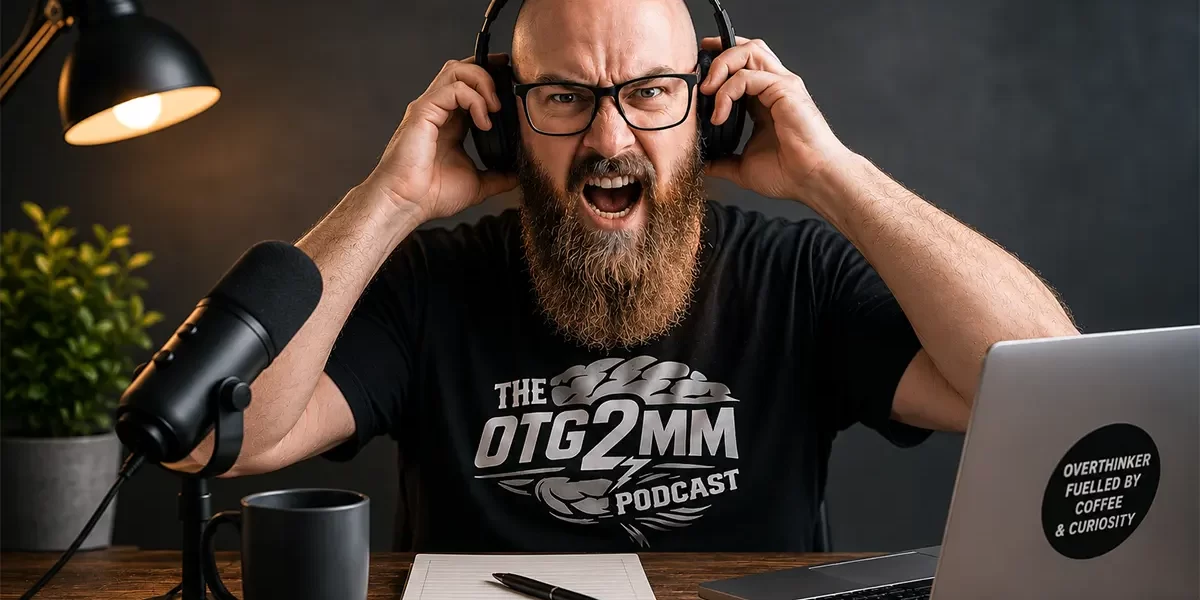
How to spend a small fortune communicating brilliantly with people who were never going to buy anyway.
Marketing has existed for a very long time. Not always in its current form, obviously.
Ancient Romans did not spend their mornings optimising click-through rates or arguing about LinkedIn algorithms. They simply painted messages on walls and hoped people would buy more olives.
Yet despite centuries of progress, technology, data, analytics, artificial intelligence, and enough marketing books to fill several medium-sized bookcases, businesses continue to make many of the same mistakes.
Which is strangely reassuring.
It suggests marketing remains fundamentally human.
And humans, as history repeatedly demonstrates, are exceptionally talented at making avoidable mistakes.
Mistake #1: Talking About Yourself Too Much
Most businesses believe they are fascinating.
This is understandable. After all, they spend every day thinking about themselves.
Their products. Their services. Their processes. Their awards. Their exciting new strategic roadmap that absolutely nobody outside the company has ever requested to see.
Customers, however, wake up each morning thinking primarily about themselves.
Their problems. Their goals. Their frustrations. Their increasingly alarming email inboxes.
One of the most common marketing mistakes is creating content that answers the question: “Why are we amazing?”
Instead of the far more useful question: “How can we help?”
The difference sounds small. The results rarely are.
Mistake #2: Confusing Activity with Progress
Marketing has become remarkably good at generating activity.
Businesses produce social posts, videos, blogs, newsletters, webinars, podcasts, downloadable guides, downloadable guides about downloadable guides, and enough content to keep several cloud storage providers financially secure.
Unfortunately, activity and progress are not the same thing.
Posting daily is not a strategy.
Sending emails is not a strategy.
Being busy is not a strategy.
These are tactics.
The uncomfortable truth is that marketing success depends less on how much you do and more on whether what you do actually moves people closer to becoming customers. Which is significantly less exciting than announcing you’ve published your twentieth piece of content this week.
Mistake #3: Chasing Every New Trend
Every few months, marketing discovers something new.
A platform. A technology. A tactic. A format. A shiny object.
Suddenly, thousands of businesses abandon whatever they were doing previously and rush towards the latest opportunity with the collective enthusiasm of seagulls spotting an unattended packet of chips.
Sometimes the trend matters. Often it doesn’t.
The problem isn’t experimenting. Experimentation is healthy.
The problem is abandoning proven fundamentals every time a new marketing trend appears, in favour of an impressive PowerPoint presentation.
Brands are built through consistency. Not panic.
Mistake #4: Making Things Needlessly Complicated
Marketing professionals occasionally develop an unfortunate belief that complexity equals intelligence.
This leads to messaging that sounds as though it was generated by feeding a strategy document into a blender and then asking a lawyer to edit the results.
Customers don’t want complexity. They want clarity.
They want to know:
- what you do,
- who it’s for,
- why it matters,
- and whether it solves their problem.
Anything beyond that is often decoration. Useful decoration perhaps, but decoration nonetheless.
Mistake #5: Ignoring Brand Building
Many businesses become obsessed with immediate results.
Clicks.
Leads.
Conversions.
Sales.
Everything must happen now. Preferably before next Tuesday.
The challenge is that customers rarely buy from businesses they’ve never heard of.
Brand building creates familiarity.
Familiarity creates trust.
Trust creates sales.
Attempting to skip this process is a bit like trying to harvest crops without first planting anything. Occasionally, something grows. Mostly you’re just staring at an empty field, wondering what went wrong.
Mistake #6: Copying Competitors
At some point, nearly every business looks at a successful competitor and thinks: “Perhaps we should do exactly what they’re doing.”
This feels sensible.
It is also responsible for a remarkable amount of marketing mediocrity.
When every company copies every other company, differentiation quietly disappears.
Soon, every website sounds identical.
Every social post sounds identical.
Every brand promise sounds identical.
Customers struggle to distinguish one business from another, and businesses wonder why nobody remembers them.
The purpose of branding is not fitting in. It’s being remembered.
Mistake #7: Expecting Immediate Results
Modern marketing has created unrealistic expectations.
People launch campaigns on Monday and become concerned by Wednesday.
A social media strategy receives seven days of attention before being declared a failure.
A new website goes live, and someone immediately asks why revenue hasn’t doubled.
Businesses often underestimate how long it takes to build trust.
Customers need repeated exposure.
Repeated reassurance. Repeated evidence that you’re credible.
Patience may not be the most exciting marketing tactic, but it remains one of the most effective.
Mistake #8: Forgetting That Customers Are Human
Perhaps the biggest marketing mistake of all is forgetting that customers are people.
Real people. Busy people. Imperfect people.
People who make emotional decisions and then invent logical reasons afterwards.
Businesses often focus on algorithms, funnels, automation, attribution models, and performance dashboards.
All useful things.
But none of them replaces understanding human behaviour.
The best marketing has always started with empathy, and despite all technological progress, that hasn’t changed.
Final Thought (Filed Under Preventable Self-Inflicted Damage)
The fascinating thing about marketing mistakes is that most are entirely avoidable.
Businesses don’t usually fail because they lack technology, data, or tools.
They struggle because they lose sight of simple fundamentals.
Talk to customers.
Communicate clearly.
Build trust.
Be distinctive.
Stay consistent.
Remain patient.
Which sounds disappointingly straightforward, but then so does eating healthily, exercising regularly, and getting enough sleep.
Human beings have never allowed simplicity to stand in the way of making life unnecessarily complicated. Marketing, it turns out, is no exception.
What’s the biggest marketing mistake you’ve seen a business make, and did they ever realise they were making it?
If you enjoyed this post, you might also enjoy the latest episode of The Overthinker’s Guide to Modern Marketing, where we explore branding, customer behaviour, strategy, and the many fascinating ways businesses accidentally make marketing harder than it needs to be.