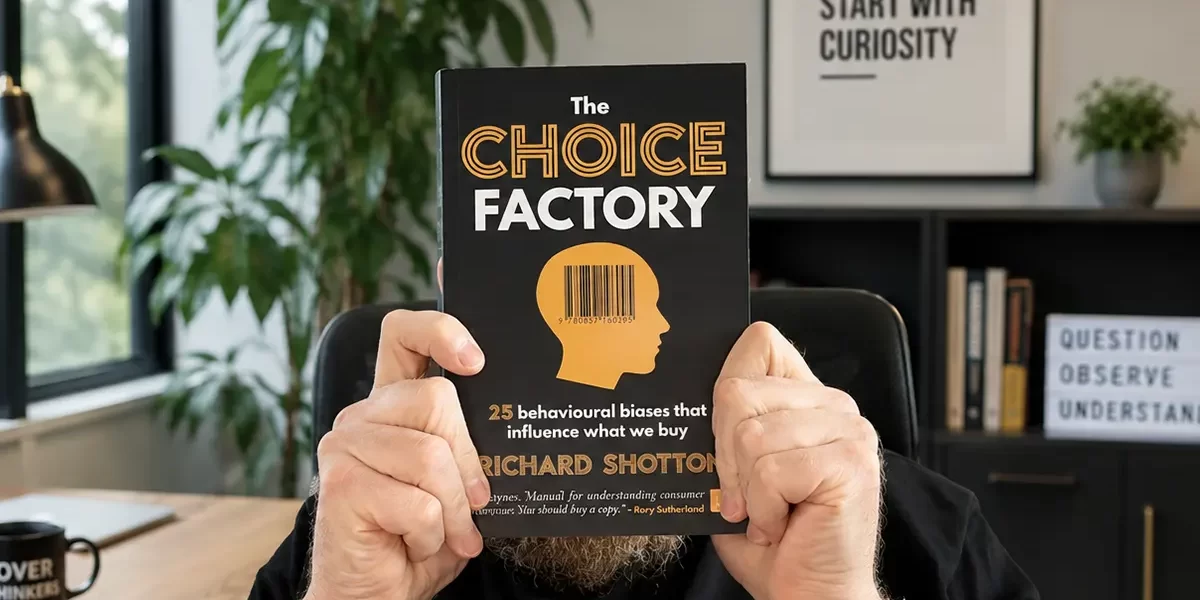
Book Review : The Choice Factory by Richard Shotton.
Many people in marketing like to think customers carefully compare products, look at features, consider value, and then make logical choices.
The Choice Factory by Richard Shotton spends about 200 pages showing why this belief is a bit too hopeful.
Luckily, the book explains this in a way that is actually fun to read instead of feeling like a tough academic text.
The Big Idea (Spoiler: Your Brain Is Weird)
The book focuses on behavioural science, a fascinating field that tries to explain why people often make choices that seem to make no sense.
Shotton looks at 25 cognitive biases that quietly shape what we buy, how we think, and why we often tell ourselves we “meant” to buy the family-sized snacks.
The book shows how things like social proof, scarcity, charm pricing, and the pratfall effect influence what people do, often more than logic does.
Which is mildly concerning. It’s a little worrying when you realise how often these techniques are already affecting you every day.
One of the best things about The Choice Factory is that it doesn’t turn into a heavy behavioural economics textbook.
Instead, Shotton breaks the book into short, easy-to-read chapters, each focused on one bias and a real marketing example.
The book moves at a good pace, avoids too much jargon, and always connects ideas to real advertising examples and experiments.
This means you feel like you’re learning something useful without the usual pain of reading academic research papers.
That’s not something you see often.
Behavioural Science Without the Self-Importance
Shotton’s approach also feels refreshingly practical.
Instead of acting like behavioural science is a secret skill only big agencies can use, the book shows how small changes in messaging, framing, timing, or presentation can have a big impact.
Importantly, many of the ideas are things you can use right away.
By the end of the book, you’ll probably find yourself:
- questioning your own purchasing decisions
- noticing biases everywhere
- and maybe becoming a bit annoying in meetings for a couple of weeks
But it’s completely worth it.
Why It’s Become a Modern Marketing Essential
Since its 2018 release, The Choice Factory has become required reading among many marketers and advertisers. It won BBH’s World Cup of Advertising Books and the Sales & Marketing category at the Business Book Awards.
It’s easy to understand why.
This book is one of those rare marketing titles that manage to be:
- genuinely useful
- scientifically grounded
- and actually enjoyable to read
That might sound obvious, but it’s actually pretty rare.
The Overthinker’s Verdict
If you’ve ever thought customers make decisions logically, this book will gently challenge that idea, one chapter at a time.
The Choice Factory isn’t about manipulating people. It’s really about understanding them better, and when you think about it, that’s what good marketing should have always done.
The Quiet Takeaway
Technology changes, platforms evolve, and algorithms come and go. But human psychology stays unpredictable, which is why this book still feels so relevant. Even though marketing trends change quickly, human behavior always stays the same.
You can learn more about the author, Richard Shotton, by visiting his website at www.richardshotton.com
Purchase this book online through our Amazon affiliate link https://amzn.to/48XLbaF or download the audiobook from https://amzn.to/4wpWTVx
The Choice Factory
Writing Style
Content
Insight
Great
The Choice Factory by Richard Shotton is an engaging and highly practical exploration of behavioural science and the hidden psychological biases that shape consumer decision-making. Breaking down complex ideas into accessible, real-world marketing examples, the book reveals how small changes in messaging, pricing, timing, and presentation can significantly influence behaviour. Insightful without becoming overly academic, it has become a modern favourite among marketers for its ability to make behavioural psychology both understandable and immediately useful. Above all, it’s a timely reminder that while marketing tools constantly evolve, human behaviour remains wonderfully irrational.