
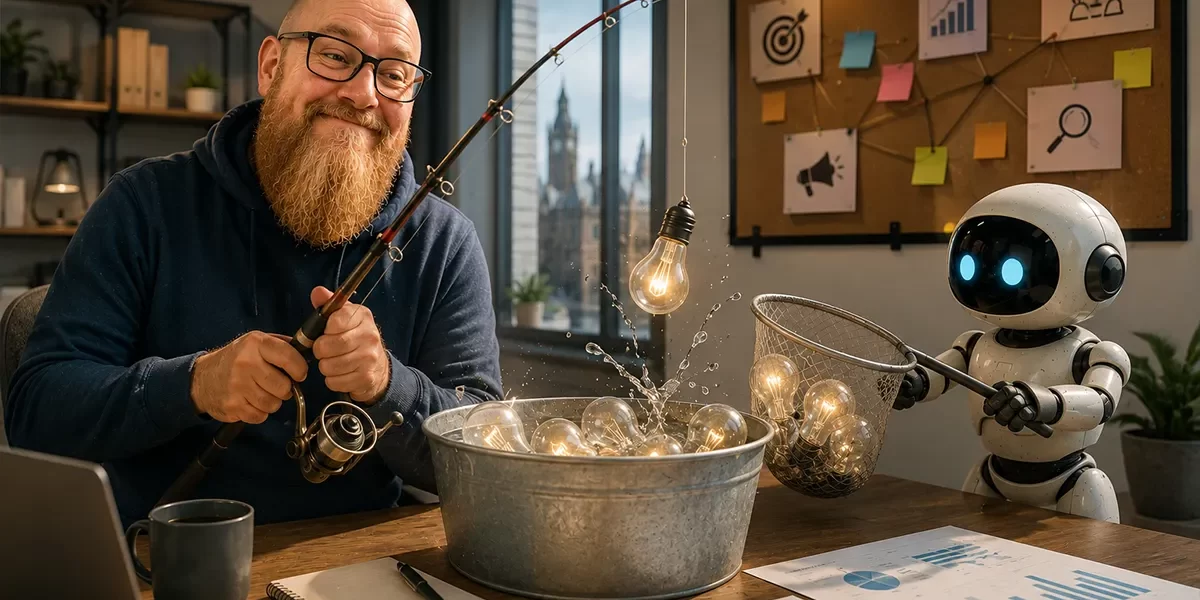
Why growing a forest is still better than renting a plastic tree.
Every few years, someone confidently announces the death of organic marketing.
Usually on LinkedIn and occasionally in a webinar.
Sometimes, while trying to sell you a course explaining why organic marketing is dead.
That’s actually a pretty clever business model when you think about it.
The argument generally follows the same reassuringly familiar pattern.
Google has changed.
AI has changed everything.
Social media algorithms are impossible.
Nobody reads blogs anymore.
Nobody listens to podcasts.
SEO is finished.
Content marketing is dead.
Apparently, the only smart move is to keep spending more and more on ads, hoping your competitors never notice the bill.
And yet…
Organic marketing just won’t go away. It’s a bit like vinyl records, indie bookshops, or people who swear tea tastes best in a bone china cup with a matching saucer.
People Still Search for Answers
Technology has changed dramatically, but human curiosity hasn’t.
People still wake up wondering how to solve problems.
- How to grow a business
- How to choose a supplier
- How to improve productivity
- How to avoid making expensive mistakes
The main thing that’s changed is how people find those answers.
- Some people ask Google.
- Some ask ChatGPT.
- Some search LinkedIn.
- Some listen to podcasts.
- Some watch YouTube.
The platforms evolve. The questions remain remarkably consistent.
Businesses that consistently provide useful answers continue attracting customers regardless of where those questions begin.
AI Rewards Expertise, Not Noise
One of the biggest misconceptions surrounding artificial intelligence is that it has made expertise less valuable. In reality, it’s done almost the opposite.
AI can generate content astonishingly quickly, which means the internet now contains even more articles saying exactly the same thing.
What AI struggles to invent is experience.
- Original research
- Personal stories
- Industry insight
- Lessons learned from success
- Lessons learned from failure
- Practical advice that comes from actually doing the work
As it gets easier to make generic content, truly original work becomes even more valuable. In a twist, AI might actually make human expertise matter more, not less.
Trust Still Takes Time
Businesses occasionally become frustrated with organic marketing because it doesn’t behave like paid advertising.
You publish an article. Nothing spectacular happens.
You publish another. Still fairly quiet.
A podcast.
A case study.
A newsletter.
Some LinkedIn posts.
Months pass. Then something rather interesting occurs.
People begin saying: “I’ve been following your content for ages.”
Or: “I’ve listened to several episodes of your podcast.”
Or: “I’ve read quite a few of your articles.”
The enquiry often appears suddenly.
The trust usually took months to build.
Organic marketing isn’t slow because it fails. It just takes time, because building real relationships isn’t instant.
Every Piece of Content Becomes an Asset
Advertising is wonderfully effective. Until you stop paying for it.
Organic marketing behaves differently.
- A helpful blog continues attracting readers
- A podcast continues to be discovered
- A case study reassures future customers
- A useful guide appears in search results months later
- A LinkedIn article gets shared again
Instead of always paying for attention, you slowly build up a library of expertise that keeps working for you, even when you’re focused on other things.
That’s a pretty good return on investment.
The Best Organic Marketing Doesn’t Feel Like Marketing
Think about the businesses you trust; they probably taught you something.
Answered a difficult question.
Explained a complex topic clearly.
Shared an interesting perspective.
Helped you solve a problem.
At no point did it feel like anyone was pushing a sale on you.
It simply felt useful.
That’s one of the subtle strengths of organic marketing.
When done well, it feels less like advertising and more like education. Customers rarely object to learning something helpful.
Consistency Beats Virality
Marketing has become strangely obsessed with going viral.
One million views. Ten million impressions. An unexpected appearance on breakfast television.
It’s great if it happens, but it’s not really needed.
Most successful businesses are built on consistency rather than celebrity.
Publishing useful content every week, sharing ideas regularly, answering customer questions, improving resources… Building authority gradually.
A thousand helpful interactions usually beat one big viral moment that everyone forgets by the end of the week.
How Can Businesses Win with Organic Marketing?
These ideas are explored in much greater detail in Episode 13 of The Overthinker’s Guide to Modern Marketing, “How Can Businesses Win with Organic Marketing?”
The episode examines why organic marketing remains one of the smartest long-term investments a business can make, even as AI, search engines, and customer behaviour continue to evolve. It explores how blogs, podcasts, SEO, thought leadership, and consistently helpful content combine to build trust, authority, and sustainable growth without relying entirely on paid advertising.
If you’re wondering whether organic marketing is still worth investing in during 2026, it’s well worth a listen.
Organic Marketing Creates Competitive Moats
One helpful article can be copied, but five hundred cannot.
A podcast library takes years to build.
Customer trust accumulates.
Search authority grows.
Your reputation strengthens.
Competitors can imitate your products, undercut your prices and even copy your website.
It’s much harder to copy years of steady, helpful work. That’s why organic marketing is still such a strong advantage.
The Internet Still Rewards Helpful Businesses
The technology has changed.
The algorithms have changed.
Artificial intelligence has changed.
Customer expectations have changed.
But one thing still feels comfortingly familiar.
People still prefer buying from businesses they trust, and trust is built remarkably slowly.
- One article
- One podcast
- One conversation
- One helpful answer
- One solved problem at a time
Organic marketing still works in 2026 for exactly the same reason it worked ten years ago.
It’s not because technology stayed the same, but because people did. Even with all the changes in marketing, that’s still one of the safest bets out there.
If someone discovered your business for the first time today, what useful content would convince them that you’re worth trusting?
Listen to Episode 13 – “How Can Businesses Win with Organic Marketing?” on The Overthinker’s Guide to Modern Marketing to discover why organic marketing remains one of the most effective long-term growth strategies for modern businesses.