
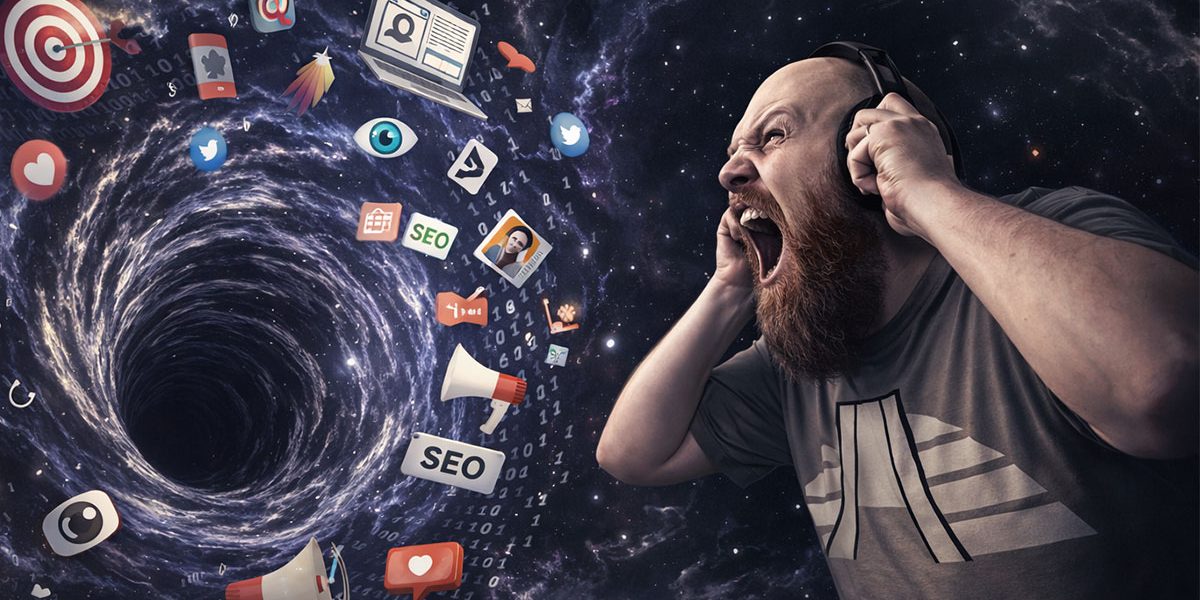
There comes a moment in every marketer’s life when they stare into the abyss of “brand visibility”, and the abyss stares back… before asking if you’ve tried posting more on LinkedIn.
This is deeply unhelpful.
Because modern marketing, much like assembling flat-pack furniture or understanding cryptocurrency, is theoretically simple and practically absurd. Everyone agrees you need to “stand out,” but no one agrees on how, other than vaguely suggesting you “be authentic,” which is excellent advice if you already know what that means and catastrophic if you don’t.
So, in the spirit of overthinking things to a completely unnecessary degree, let’s explore how one might elevate brand visibility without losing their sanity, dignity, or will to live.
1. Content Marketing: Or, Whispering Clever Things Into the Internet
Once upon a time, marketing meant shouting loudly enough that people noticed you.
Now it means writing thoughtful, insightful content and hoping the algorithm, an unknowable digital deity with the temperament of a cat, decides you are worthy.
Content marketing is, at its core, the act of demonstrating you are helpful, intelligent, and not entirely unhinged. Blogs, videos, and podcasts are your tools. Not to sell, but to exist convincingly.
The trick is consistency.
Not the sort of consistency where you post twice in a week and then vanish for six months to “regroup,” but the kind where you reliably show up, like a slightly obsessive but well-meaning neighbour.
Eventually, people begin to trust you. Or at least recognise your name, which is marketing’s version of love.
2. Social Media: Performing Personality at Scale
Social media is often described as a “conversation.” This is technically true in the same way that shouting into a crowded room where everyone else is also shouting counts as a conversation.
The goal here is not merely to post, but to participate, to engage, respond, and occasionally say something that doesn’t sound like it was generated by a committee of mildly enthusiastic robots.
Each platform has its own peculiar ecosystem:
- LinkedIn is where professionalism goes to wear slightly tighter trousers.
- Instagram is a curated reality where lighting solves most problems.
- TikTok is… well, TikTok is what happens when attention spans and creativity collide at high speed.
Success lies in understanding these environments and behaving accordingly, while still remaining recognisably you or at least a slightly more polished, socially acceptable version of you.
3. Influencer Marketing: Borrowing Someone Else’s Gravity
Influencers are, in essence, humans who have successfully convinced a large number of other humans to listen to them.
This is not to be underestimated.
Collaborating with influencers allows your brand to enter established trust networks, like being introduced at a party by someone everyone already likes, instead of standing awkwardly near the snacks hoping to be noticed.
The key is alignment.
Choose someone whose audience actually cares about what you do, rather than someone with an impressive number of followers and no meaningful connection to your offering.
Otherwise, you risk shouting your message into a very large, very indifferent void.
4. SEO: Pleasing the Algorithmic Overlords
Search Engine Optimisation, or SEO, is the art of making your content discoverable by people who are actively looking for something, ideally what you offer, but sometimes just “why is my website invisible and is it personal?”
It involves keywords, structure, and a general willingness to appease Google, which operates less like a search engine and more like a slightly cryptic librarian who rewards clarity and punishes nonsense.
Good SEO is invisible when it works and infuriating when it doesn’t.
But when done properly, it ensures that your brand appears at precisely the moment someone realises they need you which is, in marketing terms, the equivalent of being in the right place at the right time *on purpose*.
5. Experiential Marketing: Making People Feel Something (On Purpose)
Most marketing is seen. Some is heard. The best is felt.
Experiential marketing is about creating moments, events, interactions, and small flashes of delight that embed your brand into memory. Because people may forget what you said, but they will remember how you made them feel, particularly if that feeling was “this is unexpectedly enjoyable and not at all what I was expecting from a brand interaction.”
It doesn’t have to be grand or expensive.
It simply has to be genuine.
Ideally, it would not involve forcing people to download an app in the middle of it.
6. Data-Driven Marketing: Letting Numbers Tell You You’re Wrong
Data is a marvellous thing.
It provides clarity, direction, and most importantly, a polite but firm reminder that your favourite idea may not be as brilliant as you thought.
Tracking performance, analysing behaviour, and adjusting accordingly allows you to refine your efforts with something resembling scientific precision, or at least informed guessing, which is the next best thing.
The goal isn’t to remove creativity, but to guide it like a satnav that occasionally says, “You could go that way, but historically it hasn’t gone well.”
Visibility Is Not Volume
The fundamental mistake in modern marketing is assuming that being louder makes you more visible.
It doesn’t.
It just makes you louder.
True visibility comes from relevance, consistency, and a strange but powerful combination of clarity and personality. It’s about showing up in the right places, saying things that matter, and doing so often enough that people begin to recognise and eventually trust you.
Which, when you think about it, is less like shouting into the void… and more like building a small, well-lit corner of it where people actually want to stay.
If you enjoyed this post, why not check out the latest episode of our podcast?


