
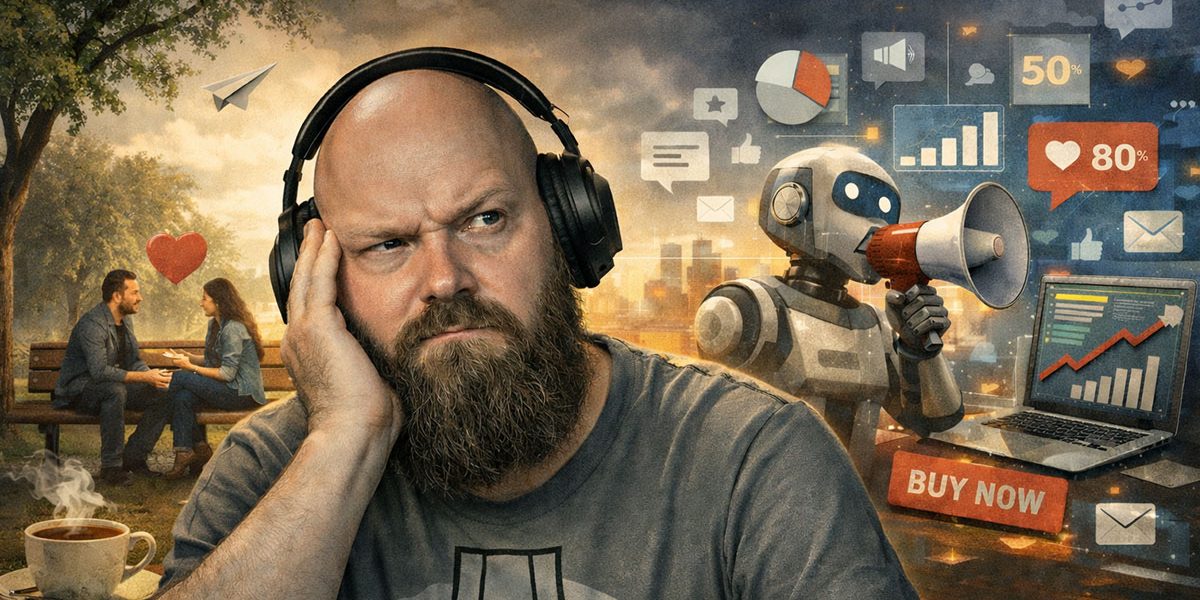
At some point in the last decade, marketing quietly wandered off, got distracted by a glowing dashboard full of analytics, and forgot that humans exist.
Not entirely. Humans are still mentioned, of course, usually in phrases like “target demographic clusters” or “engagement segments.”
Somewhere between the fourth marketing automation platform and the seventeenth social media scheduling tool, actual human beings were gently replaced by spreadsheets with aspirations.
This is understandable. Spreadsheets are very cooperative. They rarely complain about tone of voice, they don’t mind being retargeted seventeen times a day, and they never ask awkward questions like “why does this brand keep shouting at me about synergy?”
Humans, unfortunately, do, and that’s where the trouble begins.
The Curious Case of the Over-Optimised Message
Modern marketing technology is astonishing. You can track clicks, impressions, engagement, dwell time, scroll depth, heat maps, cold maps, lukewarm maps and, if things continue at their current pace, probably maps showing where the reader was emotionally when they scrolled past your call to action.
The problem is that the more precisely we measure behaviour, the easier it becomes to forget the simple reason the behaviour exists.
People.
People who are distracted. People who are busy. People who are trying to buy groceries while reading emails. People who have just opened a website and are immediately assaulted by five pop-ups asking for their attention, their email address, and possibly the name of their childhood pet.
This is not what most people would describe as a pleasant relationship.
Yet somewhere in the marketing world, someone is still proudly announcing that their pop-up conversion rate increased by 0.7%.
Which is a bit like announcing that your dinner guests ate slightly more soup after you shouted at them.
Marketing Used to Be Human
There was a time, historians believe, around the early 2000s, when marketing largely involved talking to people like people.
You might write something interesting. You might say something useful. You might even attempt the radical act of being mildly entertaining.
This approach had two remarkable properties:
- People paid attention.
- People remembered you.
Then digital marketing arrived and decided that what people really wanted was funnels. Not ordinary funnels, mind you. Marketing funnels.
These are diagrams designed to explain how a perfectly ordinary human being might, through a complex series of psychological nudges, behavioural triggers and algorithmic persuasion, eventually buy a moderately priced software subscription.
The funnel is a useful model, but it does occasionally forget that the person inside it is capable of doing something very inconvenient.
Leaving.
The Human Problem
Humans are difficult to optimise.
They don’t behave like marketing models suggest they should. They read things unpredictably. They click on odd things. They sometimes buy things simply because they like the company. Worse still, they talk to each other.
Which means the most powerful form of marketing in the world, a recommendation from one human to another, is also the one least influenced by advertising dashboards.
You cannot automate genuine trust.
You can only earn it.
And unfortunately, trust takes longer than a marketing sprint cycle.
Digital Is Not the Enemy
Now, before anyone throws their CRM system into the sea, it’s worth noting that digital marketing itself is not the villain here.
Digital tools are remarkable. They allow businesses to reach audiences across continents, communicate instantly, and measure outcomes that were once complete mysteries.
But tools are meant to support human connection, not replace it.
When digital becomes the first thought, and the human becomes the afterthought, something subtle but important disappears.
Tone disappears. Personality disappears. Curiosity disappears.
The marketing becomes technically efficient but emotionally invisible.
Which is impressive in the same way that a perfectly optimised voicemail system is impressive.
It works.
But nobody loves it.
The Radical Idea: Start With the Human
Imagine, for a moment, an unusual marketing approach. Instead of starting with platforms, funnels and automation workflows, you begin with a slightly alarming question:
- Would a human actually enjoy this?
- Would they find it useful?
- Would they find it interesting?
- Would they willingly read it without being chased around the internet by a remarketing pixel like a persistent digital pigeon?
If the answer is yes, something interesting happens.
Your marketing starts to look less like marketing.
It looks like communication and, strangely enough, humans respond to communication far better than they respond to optimisation.
A Small Note for Overthinkers
The temptation in modern marketing is to believe that success lies hidden in the next tool, the next dashboard, or the next beautifully complex automation workflow.
But the uncomfortable truth is that most effective marketing principles were discovered long before Wi-Fi.
Be interesting. Be useful. Be human.
Digital platforms can amplify these things beautifully, but they cannot replace them. Which means the most powerful marketing strategy available today is also the oldest.
Talk to people like people.
Preferably before the algorithm does.
If you enjoyed this post, why not check out the latest episode of our podcast?






Thanks for sharing this Sean. It’s a good reminder that the future of marketing isn’t human or AI, but human with AI, with the human perspective still guiding the strategy. Looking forward to the next post!