
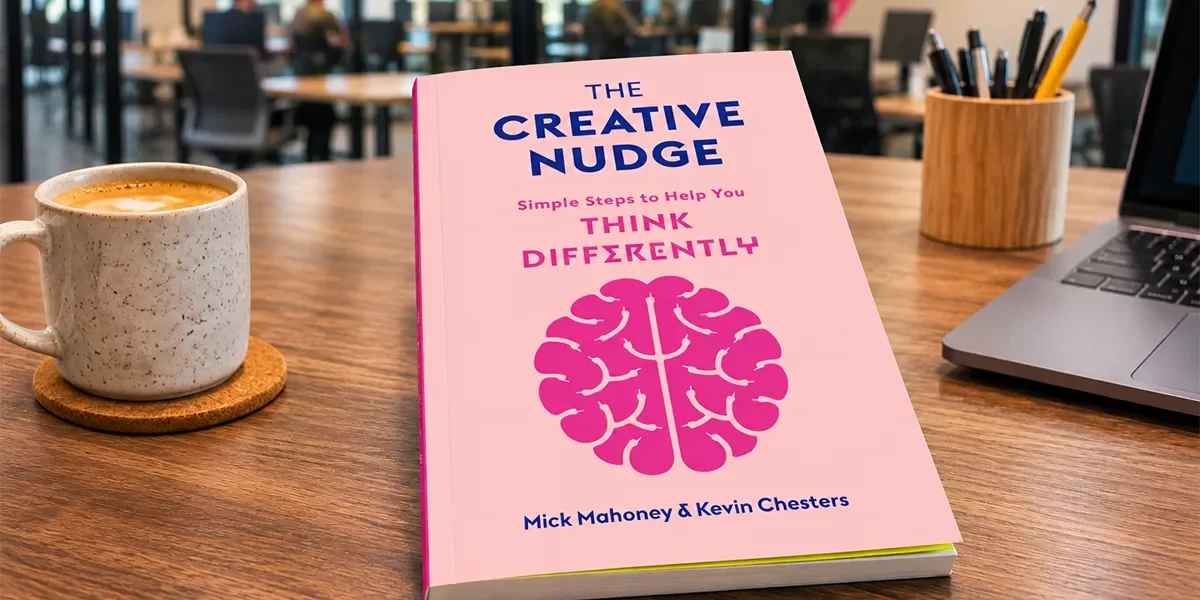
Book Review : The Creative Nudge: Simple Steps to Help You Think Differently by Kevin Chesters and Mick Mahoney.
Creativity has become one of those things that businesses will talk about in the most extravagant terms, right up until you suggest you might do things differently.
At that point, someone will invariably ask if there’s a spreadsheet to back it up.
The Creative Nudge: Simple Steps to Help You Think Differently by Kevin Chesters and Mick Mahoney is a very accessible take on creativity and goes some way to dispelling the myth that creative thinking is some kind of mysterious gift which only a very small number of people (those with the ‘right’ glasses) can possess.
Instead, the authors argue that creativity is something we can all develop by making small tweaks to how we think and behave.
No need for any expensive brainstorming retreats.
Which should come as something of a relief to all concerned.
The Big Idea: Creativity Is a Behaviour, Not a Superpower
Published in 2021, The Creative Nudge uses behavioural science and nudge theory to examine how small tweaks to everyday behaviour can lead to more creative thinking.
Rather than trying to teach us creativity from scratch, Chesters and Mahoney look at the psychological obstacles that can stop us from being creative in the first place.
It’s an interesting flip of the usual approach to the subject.
Perhaps we don’t need to learn how to be creative.
Perhaps we need to unlearn some of the habits that inhibit us from being creative.
The nine chapters of the book go on to look at everything from challenging accepted wisdom and embracing uncertainty, through resisting the consensus, giving ideas space to grow, and accepting that failure is an inevitable part of the process.
Two Authors Who Know a Thing or Two About Creativity
Both authors have considerable experience in the advertising industry.
Kevin Chesters has been creative strategy head at Ogilvy, Saatchi & Saatchi and Wieden+Kennedy. Mick Mahoney is a highly awarded advertising creative director (has a Cannes Grand Prix to his name).
Their combined experience in strategy and creativity gives the book a very useful perspective for marketers. It’s not creativity as some kind of art form. It’s creativity as a way of thinking about problems, challenging the status quo, and finding better ways of doing things.
The Problem With Knowing What You’re Doing
One of the book’s very first challenges is to look again at the things we do so routinely and so confidently.
Experience is of enormous value, but it can also hinder originality. The more familiar you are with a particular problem, the more likely you are to reach for a familiar solution.
In marketing, this happens all the time.
We use the same channels, run the same types of campaigns, follow the same processes, and check in with the same industry benchmarks. Then we wonder why our marketing looks so very much like everybody else’s.
The book urges us to break those established patterns and consider whether familiarity has, in fact, substituted for thinking.
It’s perfectly acceptable to consider something best practice; that doesn’t mean it’s necessarily the right thing to do.
Sometimes it’s just what everyone else is doing.
The Comforting Mediocrity of Consensus
One of the more enjoyable themes in The Creative Nudge is its challenge to conformity and consensus.
Businesses, of course, want to reach agreement. You can’t really blame them. Agreement is reassuring; it’s safe, and it’s far easier to get into the minutes.
Unfortunately, agreement is no guarantee of a good idea.
Anyone who’s been in marketing or design will be familiar with the process whereby a good, original, and potentially brilliant creative concept gets progressively less interesting, less distinct, and a lot less brilliant as it goes through the various approval stages.
Eventually, everyone likes it.
Unfortunately, no one outside the meeting is likely to notice it.
Chesters and Mahoney are urging us to become more comfortable with disagreement, uncertainty, and challenging the status quo.
That’s particularly useful advice in a profession where being different is supposed to be one of our main aims.
Give Your Brain a Little Room to Wander
Modern working environments aren’t necessarily the most conducive to creative thinking.
We’ve got meetings, notifications, deadlines, productivity KPIs, and calendars that suggest every waking minute of our lives should be taken up by something measurable.
Yet creativity often demands something quite different.
Time to explore. Time to make the connections. Time to think about ideas that, at first glance, would seem utterly ridiculous.
The whole ‘don’t be so tidy, don’t rush it’ bit of the book is absolutely spot on.
Not every productive moment is productive.
Sometimes just staring out of the window is part of the process.
Admittedly, you’ll have to be a bit creative in explaining that to your MD.
Failure Is an Option
Another major theme is our relationship with failure.
Businesses will often encourage innovation, whilst at the same time creating an environment in which making a mistake is regarded as a fairly minor career catastrophe.
It’s a rather contradictory arrangement.
Creative thinking necessarily involves an element of uncertainty. If you already know precisely how it’s going to turn out, then you’re probably not being all that experimental.
The book is about getting used to taking risks and accepting that not every idea is going to work.
For marketers, this is an important reminder that experimentation is something we shouldn’t be afraid of.
A bad idea can teach you something.
An idea that never leaves the meeting room tends to teach us far less.
Particularly Relevant in the Age of AI
Although it was published in 2021 (so it predates the era in which generative AI has become such a standard part of marketing), The Creative Nudge strikes us as particularly pertinent right now.
Technology has made it incredibly easy to produce marketing material. You can generate hundreds of headlines, images, campaign concepts, and content ideas in a few minutes.
But making something isn’t the same as being creative.
The ability to question assumptions, make the odd connection, spot opportunities and challenge the way things are done remains absolutely invaluable.
If we’re all using the same tools, pulling the same information, following the same instructions, then the real competitive advantage might be in asking different questions.
AI can help us to explore ideas.
We still need the curiosity to go out and explore them.
Small Book, Big Thinking
The Creative Nudge is remarkably concise at just 128 pages. It’s in an illustrated format and offers a very accessible take on behavioural science as a whole, making it much more approachable than many of the more academic books on the subject.
There’s no need to learn some complicated framework, no need for some elaborate creative methodology you’ll have to be certified in, and absolutely no suggestion that you need to reinvent your personality fundamentally.
Instead, the emphasis is on manageable changes that will, in turn, encourage curiosity, experimentation, and originality.
It’s the sort of book you’d want to have sitting on your desk and go back to time and again if your thinking ever started to get a bit too formulaic.
The Overthinker’s Verdict
The Creative Nudge is a fun, accessible, and thought-provoking look at something we often make far more complicated than it needs to be.
Its blend of behavioural science and creative thinking is very attractive because it recognises that many impediments to creativity are psychological rather than technical.
Our habits, our assumptions, our fears, and our desire for approval can all be barriers to original thinking.
For marketers, designers, strategists, and businesspeople in general, it’s a useful reminder that creativity isn’t just the job of the creative department.
It’s relevant to everything from developing a marketing strategy and improving the customer experience to solving day-to-day business issues.
You don’t need a psychology degree, an expensive workshop, or a brightly coloured beanbag to benefit from it.
The Quiet Takeaway
Perhaps the most important lesson from The Creative Nudge is that thinking differently doesn’t necessarily require a massive change in the way we live or work.
Sometimes it’s just a matter of questioning what we take for granted, breaking the routine and being prepared to look at an idea without immediately asking whether it will work.
Good marketing has always been about curiosity, imagination and the ability to question assumptions.
The tools have changed; the importance of original thought hasn’t.
Perhaps the next time someone suggests thinking outside the box, we should start by asking a slightly different question:
Who put us in the box in the first place?
Purchase this book online through our Amazon affiliate link https://link.amazon/B00X0QFOJ
Enjoy exploring why people think and behave the way they do?
That’s exactly the sort of question we explore on The Overthinker’s Guide to Modern Marketing Podcast. From consumer psychology to the strange decisions brands make, it’s a marketing podcast for people who enjoy questioning conventional wisdom. Listen Now.
The Creative Nudge: Simple Steps to Help You Think Differently
Writing Style
Content
Insight
Great!
The Creative Nudge: Simple Steps to Help You Think Differently by Kevin Chesters and Mick Mahoney is an enjoyable, accessible and thought-provoking exploration of how behavioural science can help us become more creative. Drawing on their extensive advertising industry experience, the authors challenge conventional thinking, encouraging readers to question assumptions, embrace uncertainty, resist conformity and become more comfortable with failure. Published in 2021, its lessons feel particularly relevant in today's AI-powered marketing landscape, where producing content has become considerably easier than generating genuinely original ideas. Concise, engaging and refreshingly practical, it's an excellent read for marketers, designers, business leaders and anyone looking to develop their creative thinking. A timely reminder that creativity isn't a mysterious talent reserved for a select few, but something we can all nurture, preferably without another brainstorming meeting.