
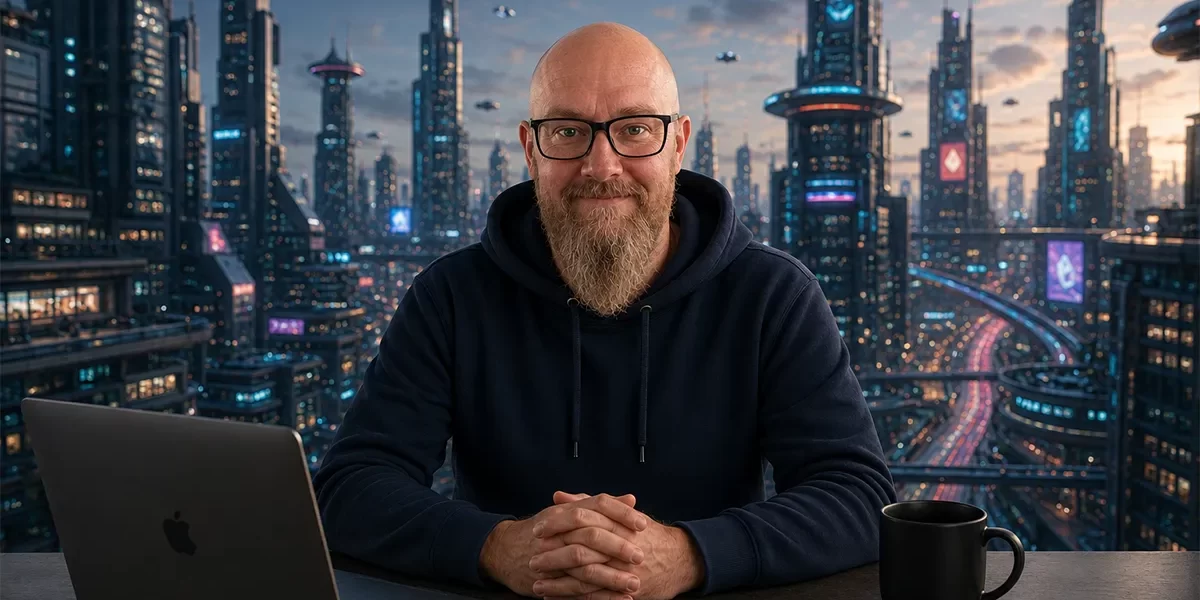
Why the next decade of marketing may be simultaneously more technological and more human than anyone expected.
Predicting the future has always been a risky business.
Entire industries have been built around making confident forecasts that later proved to be spectacularly incorrect. In the 1950s, people imagined we’d all be commuting to work in flying cars by now. Instead, many of us attend video meetings from home while wondering why the printer has suddenly decided it no longer recognises reality.
Marketing has a similar habit of generating bold predictions.
Every year brings a fresh collection of experts explaining what will completely transform marketing forever. Artificial intelligence. Virtual reality. Voice search. The metaverse. Blockchain. Algorithms. Automation. Quantum-powered customer experiences. Somewhere, undoubtedly, someone is currently preparing a presentation that involves all of these simultaneously.
Yet despite all the noise, the future of marketing may be surprisingly simple.
The technology will change.
The fundamentals won’t.
Technology Will Continue to Accelerate
The first thing business leaders need to understand is that technology is not slowing down.
Artificial intelligence is already transforming how content is created, analysed, personalised, and distributed. Automation tools are helping businesses communicate at scale. Data platforms are becoming more sophisticated. Customer journeys are becoming increasingly interconnected.
For marketers, this presents both an opportunity and a challenge.
The opportunity is obvious. Businesses can now achieve things that would have required entire departments only a few years ago. Tasks that once took days can often be completed in minutes.
The challenge is that technology itself is rapidly becoming accessible to everyone.
If every business has access to the same tools, the competitive advantage shifts elsewhere.
Which leads us to an important, albeit slightly inconvenient, conclusion.
Technology alone is unlikely to save you.
Human Connection Is Becoming More Valuable
The more automated marketing becomes, the more people seem to value genuine human interaction. This appears contradictory until you remember that humans are involved.
People are increasingly surrounded by algorithms, automated recommendations, personalised advertising, and machine-generated content. As these technologies become commonplace, authenticity becomes more noticeable.
Customers still want to buy from businesses they trust.
They still respond to stories.
They still value expertise.
They still enjoy dealing with people who appear to understand their problems.
In many ways, the future of marketing is not about replacing human relationships. It is about scaling them more effectively.
The businesses that understand this will have a significant advantage.
Trust Will Become the Ultimate Currency
Historically, businesses competed on price.
Then they competed on quality.
Increasingly, they compete on trust.
Customers today can compare products instantly. They can research competitors, read reviews, watch demonstrations, and ask strangers online for opinions before making decisions.
This means trust is no longer a nice-to-have. It is a commercial asset.
The brands that succeed in the coming years will be those that consistently demonstrate expertise, transparency, reliability, and authenticity.
Not because these qualities sound impressive in annual reports, it’s because customers actively look for them.
Communities Will Matter More Than Audiences
For years, marketers focused on building audiences.
More followers.
More subscribers.
More impressions.
More reach.
These things still matter, but increasingly the real value lies in communities.
An audience watches.
A community participates.
An audience consumes content.
A community creates conversations.
An audience can disappear when attention shifts elsewhere.
A community often stays because members derive value from one another as well as the brand itself.
Business leaders who focus on creating genuine communities around their brands may discover that loyalty becomes easier to maintain and advocacy becomes significantly more powerful.
Founder Visibility Will Continue to Grow
One of the most interesting trends in modern marketing is the growing importance of founder visibility.
People trust people more than logos.
They always have.
Social media, podcasts, video content, and personal branding platforms have simply made this reality more visible.
Customers increasingly want to know who is behind a business. They want to understand the values, beliefs, expertise, and personality driving the organisation.
This does not mean every business owner must become a full-time influencer.
The world is probably busy enough already.
However, leaders who are willing to share their expertise, insights, and perspectives often build stronger relationships with customers than corporate communications alone can.
Clarity Will Beat Complexity
As marketing becomes more sophisticated, there will be an increasing temptation to make it more complicated.
This is unlikely to help.
Customers remain wonderfully uninterested in marketing jargon.
They do not wake up hoping to learn about synergistic omnichannel engagement frameworks.
They want solutions to problems.
They want businesses to communicate clearly.
They want to understand what you do, why it matters, and why they should care.
The brands that communicate with simplicity and clarity will continue to stand out in increasingly crowded markets.
Consistency Will Remain Underrated
If there is one lesson that survives every technological revolution, it is this: Consistency matters.
Marketing success rarely arrives through a single campaign, a single advertisement, or a single viral post.
It emerges through repeated exposure, repeated trust-building, and repeated delivery.
Business leaders often search for breakthrough moments.
The future of marketing may belong to organisations that simply keep showing up.
Consistently.
Competently.
Reliably.
Month after month.
Year after year.
Not the most glamorous strategy.
Remarkably effective nonetheless.
Final Thought: The Future Looks Surprisingly Familiar
The future of marketing will undoubtedly involve more artificial intelligence, automation, data, and technological innovation than ever before.
Yet the businesses that thrive may not be those with the most sophisticated tools.
They may be the businesses that use those tools to become more human, not less.
The ability to build trust.
The ability to communicate clearly.
The ability to create communities.
The ability to tell compelling stories.
The ability to make customers feel understood.
These are not new ideas. They are very old ideas. Technology simply provides new ways to express them.
Which means the future of marketing may not be about learning how to think like machines.
It may be about remembering how to connect with people. A surprisingly old-fashioned solution to an increasingly modern challenge.
What do you think will have the biggest impact on marketing over the next five years: technology, trust, community, or something else entirely?
If you enjoyed this article, tune in to The Overthinker’s Guide to Modern Marketing, where we explore branding, customer psychology, business growth, and the curious intersection between technology and human behaviour.