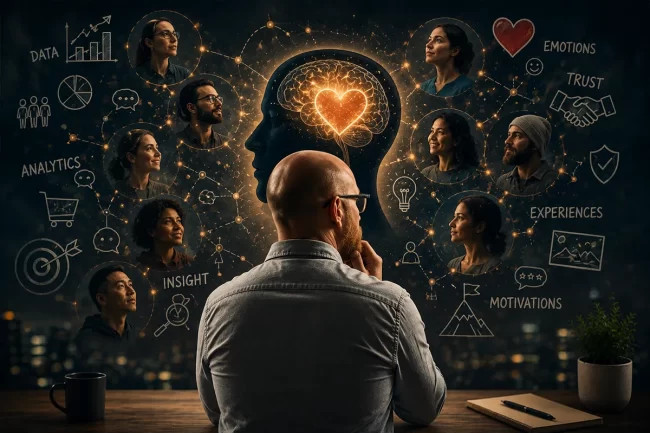
Why do people buy things they don’t need, ignore perfectly sensible advice and remain fiercely loyal to particular brands?
Explore consumer psychology, behavioural science, emotional decision-making and the wonderfully irrational human brain.
Because understanding why people behave as they do is rather important when you’re trying to market something to them.
People like to think they’re always rational. Of course they do until you see a 50% off sticker. Human beings like to think they’re sensible. We look at the options, price them, check the details, etc and try to make sensible decisions when we’re buying something. But then we’re buying ourselves a £400 coffee machine…
Because behind every purchasing decision is a human being, usually one armed with a spreadsheet and a deeply suspicious expression. There’s a curious belief in business-to-business marketing that the moment someone enters a procurement department, they stop being human. Their emotions are quietly removed, their personality is placed in a secure drawer, and they’re issued…
Because the human brain is a magnificent piece of biological engineering, occasionally defeated by a yellow discount sticker. Human beings like to think of themselves as rational. We go through the options carefully, consider the evidence and make sensible purchase decisions based on logic, value and real need. Then we buy a £200 kitchen gadget…
Human beings are supposedly rational creatures, despite overwhelming evidence involving supermarket offers, online shopping and the continued existence of novelty kitchen gadgets. Human beings are remarkable. We’ve invented artificial intelligence, explored the solar system and developed machines capable of performing billions of calculations per second. Yet put a sign saying ONLY THREE LEFT beside an…
Because understanding why people buy things is considerably more useful than shouting at them until they surrender. Human beings are fascinating creatures. We can send spacecraft to distant planets, develop artificial intelligence and perform extraordinary feats of scientific reasoning. Yet we will happily spend £40 on something we don’t need because a little red label…
Because purchasing decisions are rarely as sensible as the people making them. Human beings are wonderfully complicated creatures. We can build spacecraft, perform brain surgery and develop artificial intelligence capable of writing an entire marketing strategy in approximately eleven seconds. Yet we can also spend £85 on a shirt because it has a tiny embroidered…
Because if human beings were entirely rational, nobody would own a kitchen gadget they’ve used once. Marketing has traditionally been rather fond of the idea of the rational customer. This imaginary customer figures out what they need, looks at all the options, compares features and prices, thinks about the value, and then calmly picks the…
Because your customer is a human being, not a conversion event with a LinkedIn account. Marketing has become extraordinarily sophisticated. We have artificial intelligence, automation, predictive analytics, customer data platforms, attribution modelling, behavioural tracking, personalisation engines and dashboards capable of telling us precisely how far someone scrolled before deciding they’d had quite enough of us.…
Why customers continue ignoring perfectly logical marketing plans. One of the more curious assumptions in modern marketing is the belief that customers behave rationally. This assumption appears everywhere. It appears in sales funnels. It appears in customer journeys. It appears in marketing plans, boardroom presentations, and dashboards containing enough charts to make a statistician weep…
Marketing would be a lot simpler if customers acted as predictably as spreadsheets. Many people in boardrooms, marketing teams, and strategy meetings share a common wish. Even some optimistic analysts dream about it. It goes something like this: If we collect enough data, build advanced systems, map out detailed customer journeys, and set up plenty…