
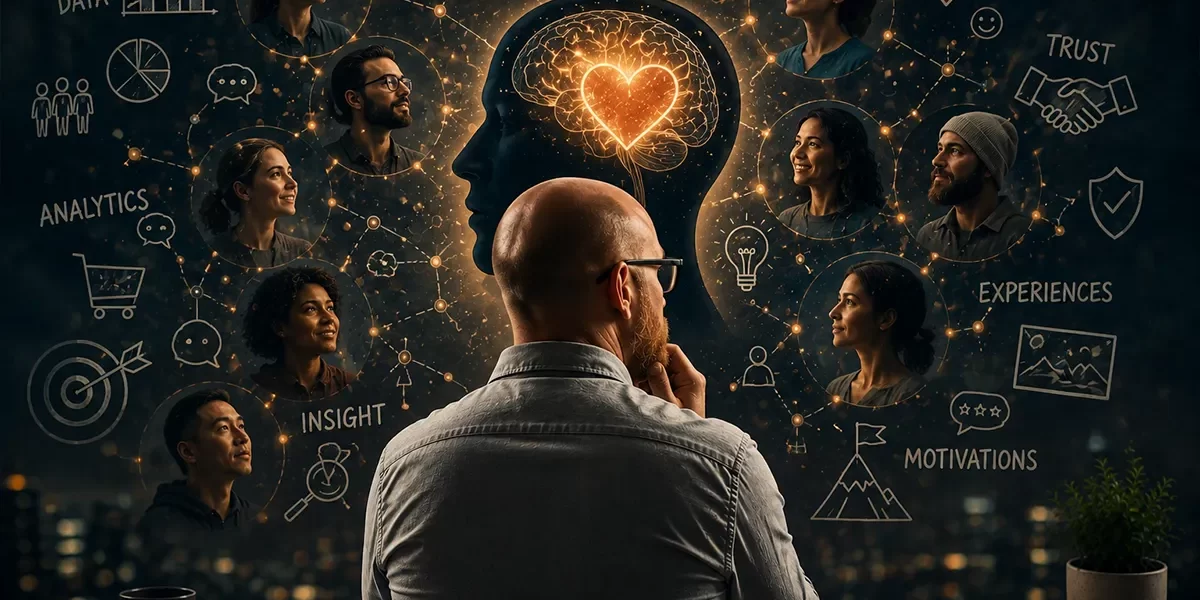
Marketing would be a lot simpler if customers acted as predictably as spreadsheets.
Many people in boardrooms, marketing teams, and strategy meetings share a common wish.
Even some optimistic analysts dream about it.
It goes something like this: If we collect enough data, build advanced systems, map out detailed customer journeys, and set up plenty of dashboards, then customer behaviour will become completely predictable.
At that point, marketing will be transformed into a perfectly logical process.
Campaigns will always work.
Customers will always follow the intended journey.
Conversion rates will steadily increase.
And nobody will ever again ask why a perfectly sensible marketing strategy failed to deliver the expected results.
Unfortunately, there is one small obstacle standing in the way.
People.
The Problem with Humans
The main challenge in every marketing strategy is that customers are people. This sounds obvious. It is also surprisingly easy to forget.
Marketing plans often rely on models, personas, segments, demographics, customer journeys, funnels, and conversion paths. These tools are helpful because they make things less complicated.
The problem is, sometimes these tools make things too simple.
Real customers don’t wake up thinking about where they currently sit in your sales funnel.
They aren’t carefully progressing through a predefined sequence of marketing touchpoints.
They are busy, distracted, and overloaded with information. They have deadlines, family responsibilities, money worries, and a constant stream of notifications from their devices.
Your marketing campaign is competing with all of that, and occasionally with a cat standing on a keyboard.
Customers Rarely Behave Rationally
Traditional business thinking often assumes customers make logical choices. But the evidence shows that’s not always true.
People regularly choose familiar brands over cheaper alternatives.
They trust recommendations from strangers online. They pay extra for products that make them feel confident. They make emotional decisions and then construct perfectly reasonable explanations afterwards.
This isn’t a mistake in how people act; it’s just how we work. Our brains use shortcuts like trust, familiarity, social proof, and emotion.
These mechanisms help people make decisions quickly in a world containing far more information than anyone could possibly process.
So, customer behaviour can seem a bit irrational if you look at it only with logic. But it makes sense when you consider psychology.
Why Data Has Limits
Modern marketing generates extraordinary amounts of data.
We know which pages customers visit, which adverts they click, how long they stay, where they came from, what device they use, and how far they scroll, and what they downloaded.
This information is very useful, but data has its limits.
Data shows us what happened, but it rarely explains why.
A customer abandons a purchase halfway through.
That’s the what.
Did they get distracted?
Lose confidence?
Receive a recommendation from a competitor?
Forget their password?
Decide they needed a coffee before making a decision?
The data doesn’t always know.
Understanding the why requires something more than analytics. It requires understanding people.
The Invisible Forces Behind Every Decision
Much of customer decision-making happens beneath the surface. Trust influences decisions. So do past experiences, personal beliefs, emotions, and social influences. Then there are the factors customers themselves may struggle to explain: the subtle feelings, instincts, and impressions that shape behaviour without ever fully entering conscious thought.
This makes things interesting for marketers. The forces behind customer behaviour are often hidden. They don’t show up in reports, spreadsheets, or dashboards, but they often decide if a campaign works or not.
Businesses that notice these hidden influences often have an edge. It’s not about having more data, but about understanding people and the psychology behind every customer choice.
Marketing Is Part Psychology, Part Science, Part Educated Guesswork
This was one of the themes explored in Episode 12 of The Overthinker’s Guide to Modern Marketing podcast, “Is Marketing Just Guessing?”
The answer is both yes and no.
Marketing isn’t just guessing and hoping something works. But it’s also not an exact science where more data always means success.
The reality sits somewhere in the middle.
Data gives us evidence, experience gives us context, psychology helps us understand, and human behaviour always brings surprises.
The best marketers know how to balance all of these.
If you’ve ever wondered why some campaigns outperform expectations, why customers ignore seemingly obvious messages, or why buying decisions often appear irrational, Episode 12 explores these questions in much greater depth.
It’s definitely worth listening to.
The Businesses That Win Understand People
Technology will continue to evolve. Artificial intelligence will become more capable, analytics platforms will grow increasingly sophisticated, customer journeys will become more measurable, and predictive models will become more accurate. Businesses will have access to more data, more insights, and more powerful tools than ever before.
But the businesses that succeed will probably have one thing in common: they understand people. Not just the data, platforms, or algorithms, but the people behind them.
They get what people fear, want, hope for, and what frustrates them. They know that every click, question, purchase, recommendation, and review comes from a real person making a choice. And people’s decisions are rarely as logical or predictable as they seem.
Understanding this complexity is often what sets great marketing apart from the rest.
The Customer Is Not the Problem
Maybe calling it a human problem isn’t quite right. Customers aren’t the problem, they’re the reason businesses exist. The real challenge is that people are wonderfully complex. They don’t always act predictably, follow logic, or do what the data says they will.
And that’s a good thing. If customers acted just like spreadsheets, marketing would be predictable, and very boring. There’d be no need for creativity, empathy, storytelling, or real understanding. Every decision would be a formula, and every customer journey would look the same.
The businesses that do well are usually the ones that accept this complexity instead of fighting it. They know that every metric comes from a person, every conversion is a decision, and every strong marketing strategy is built on understanding people.
Often, the best way to handle a world full of technology isn’t to add more tech, but to better understand the people it’s meant to help. That’s a very human answer to a modern problem.
What’s the biggest assumption you’ve ever made about customer behaviour that turned out to be completely wrong?
Listen to Episode 12: “Is Marketing Just Guessing?” on The Overthinker’s Guide to Modern Marketing podcast, where we discuss the relationship between data, intuition, psychology, and why understanding people remains one of the most important skills in modern marketing.