
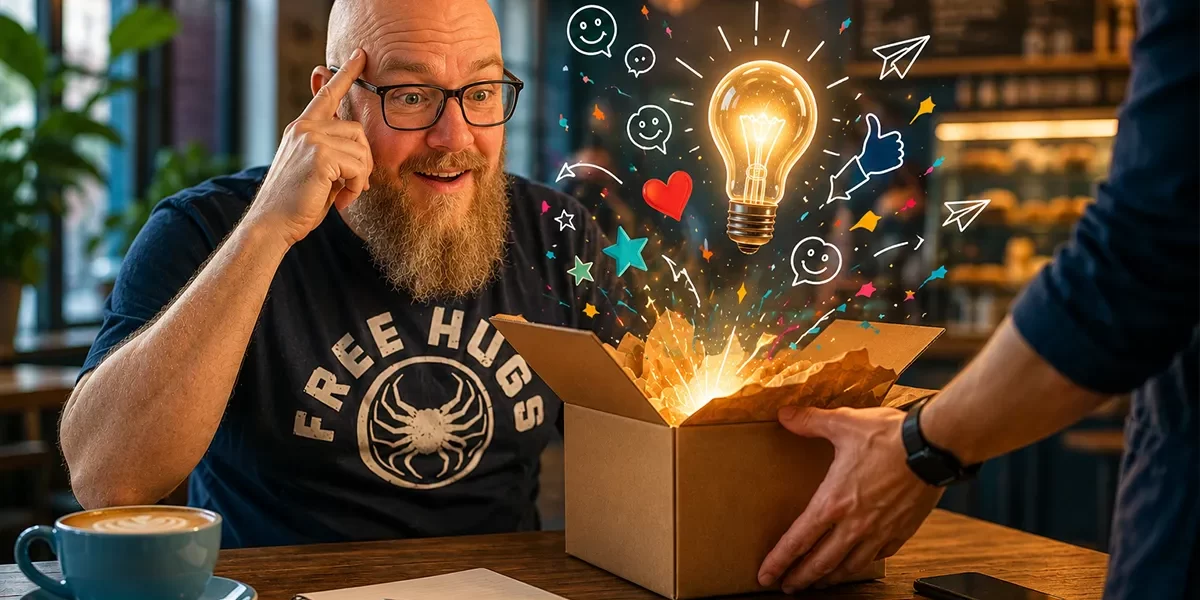
Why do humans continue doing delightfully irrational things like talking about good service twenty years later?
Businesses have a strange pattern that economists have tried to explain for years.
A company can have the best product.
The lowest price.
The fastest delivery.
The slickest website.
Even the most advanced CRM, created by people who love words like “synergy,” can lose a customer to a business that just made them feel better.
This can be a problem if your five-year growth plan is focused only on cutting production costs, because customers don’t always act as expected.
They remember how you made them feel long after they’ve forgotten what you charged.
Customers Rarely Remember Transactions
Think back to the last exceptional customer experience you had.
Not a purchase. An experience.
You probably don’t remember every detail of the invoice.
You almost certainly don’t remember the SKU number.
What you remember is how someone solved a problem.
Made your life easier.
Anticipated a question before you asked it, or turned what could have been a frustrating interaction into a surprisingly enjoyable one.
That’s because humans don’t store memories like spreadsheets.
We store stories.
This makes things tricky for businesses that want to turn everything into a dashboard.
Great Experiences Are Designed, Not Left to Chance
Many businesses assume excellent customer service is simply about hiring friendly people.
Friendly staff help, but memorable experiences are usually planned.
They are built into processes.
Into culture.
Into leadership.
Into decision-making.
The best businesses ask different questions.
- “How can we remove friction?”
- “How can we surprise people?”
- “How can we make this easier?”
- “What would customers remember tomorrow?”
Those questions tend to produce very different businesses.
The Ritz-Carlton: Trust Your People
One of the most frequently cited examples comes from The Ritz-Carlton.
Its employees have long been empowered to spend significant amounts of money to resolve customer problems without waiting for management approval.
Imagine that: a company actually trusts its staff.
They don’t make employees go through a long approval process with several departments and Derek from Finance.
The result isn’t simply quicker problem solving.
It’s confidence.
Employees feel empowered, and customers feel valued. Problems disappear before they become stories on social media.
Disney Understands Emotion
Visit a Disney park, and something becomes immediately obvious.
Everything has been considered.
The music, smells, queues and the language the staff use. Even rubbish bins are placed deliberately because Disney discovered people will generally carry litter for only a surprisingly short distance before abandoning civilisation altogether.
Nothing is accidental.
Disney doesn’t just manage attractions. It carefully shapes how people feel.
That’s a rather different way of thinking about customer experience.
Apple Sells Confidence
Walk into an Apple Store, and you’ll notice something unusual.
Very little feels like traditional retail.
Products are displayed as though they’re waiting to be discovered rather than aggressively sold.
Staff tend to educate before they persuade.
Customers are encouraged to touch, explore and ask questions.
Apple knows something very important.
It’s easier to sell confidence than to pressure people.
People rarely enjoy being sold to. They quite enjoy discovering they’ve already decided to buy.
Unreasonable Hospitality
One of the finest modern examples comes from Will Guidara, whose book Unreasonable Hospitality tells the story of transforming a world-class restaurant by treating hospitality as something extraordinary rather than merely competent.
One famous story describes a family mentioning they’d never tried a New York hot dog.
Instead of just noting this cultural difference and moving on, the team brought in hot dogs from a nearby street vendor after their Michelin-starred meal.
Ridiculous?
Perhaps.
Memorable?
Absolutely.
Customers rarely expect perfection. They remember thoughtful surprises.
Great Customer Experience Is Often Incredibly Small
Here’s the encouraging part. Memorable experiences don’t always require enormous budgets.
Sometimes they’re almost laughably simple.
- A phone call instead of another email.
- Remembering a customer’s name.
- Following up after a project finishes.
- Making information easier to understand.
- Owning a mistake quickly.
- Responding faster than expected.
These moments cost very little, but they often become the stories customers share with colleagues, friends, and future clients.
Marketing departments spend millions trying to generate word of mouth.
Customer experience achieves it naturally.
Technology Should Remove Friction, Not Humanity
Artificial intelligence is already transforming customer service.
- Chatbots answer questions.
- AI agents route enquiries.
- Automation speeds up support.
- CRM systems remember everything customers have ever done.
This is truly helpful, as long as we remember why we use the technology.
The purpose isn’t to replace human interaction. It’s improving it.
Technology should remove repetitive tasks so people have more time to solve meaningful problems.
Not less.
Customers rarely say: “That was the most wonderfully efficient automated workflow I’ve ever experienced.”
They say: “Someone really helped me.”
Even if technology quietly made that possible behind the scenes.
Customer Experience Is Marketing
Many businesses separate marketing and customer service.
Marketing attracts customers. Customer service looks after them.
That sounds neat and organised, but it’s not right.
Every customer interaction shapes your brand.
Every email.
Every invoice.
Every phone call.
Every delivery.
Every apology.
Every thank you.
Marketing sets expectations. Customer experience either meets them or fails to deliver.
The strongest brands understand that customer experience isn’t something that happens after marketing.
It is marketing.
People Share Stories, Not Processes
Customers rarely tell friends about your CRM.
They don’t recommend businesses because the workflow automation was particularly elegant.
They certainly don’t gather around the dinner table discussing how impressive your internal reporting dashboard appeared.
They tell stories about someone who helped, a problem that was solved, a business that exceeded expectations, a company that made them feel valued. That’s the real competitive advantage.
Products can be copied. Prices can be matched. Technology can be purchased.
Memorable experiences are much harder to copy because they start with something simple and timeless.
People who genuinely care about other people.
Even with all our technological progress, caring about people is still good business.
What’s the most memorable customer experience you’ve ever had, and why do you still remember it years later?
If you enjoy exploring branding, customer psychology, business growth and the wonderfully unpredictable nature of modern marketing, subscribe to The Overthinker’s Guide to Modern Marketing. Because sometimes the smallest customer interaction creates the biggest marketing impact.


