
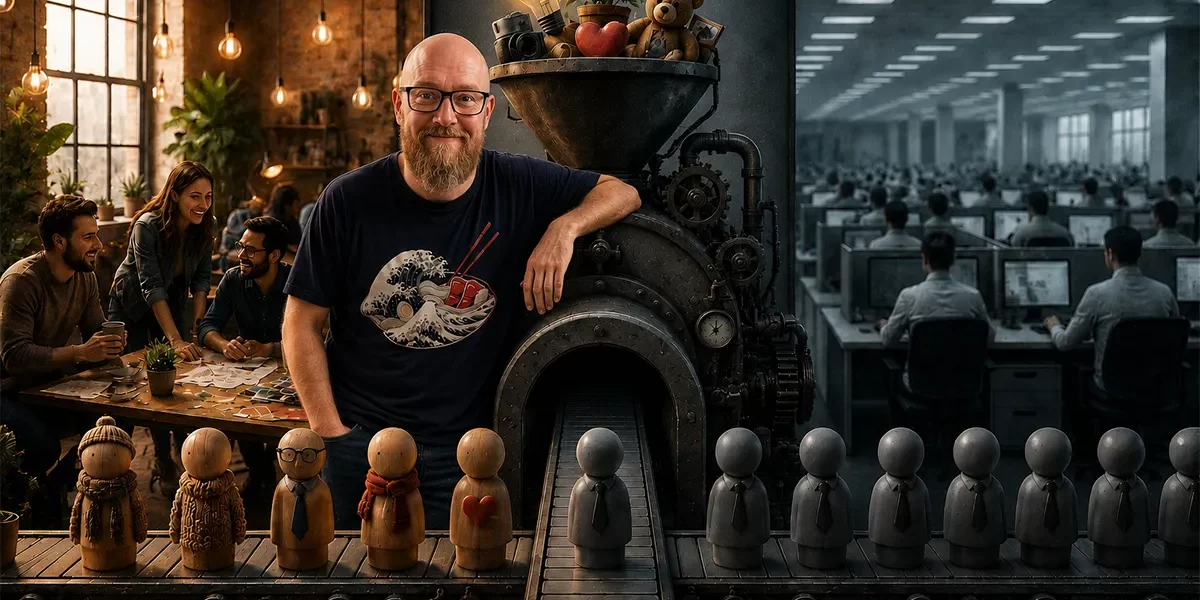
How businesses can accidentally make themselves forgettable by focusing too much on efficiency.
There was a time when efficiency was a relatively straightforward concept.
You found a way to do something faster, cheaper, or better.
Ideally, all three.
Everyone celebrated, productivity increased, and somebody somewhere received a promotion.
Simple.
Then businesses discovered spreadsheets, and things became considerably more complicated.
Today, organisations can track nearly every part of their operations with impressive accuracy.
They can measure costs, optimise processes, allocate resources, and analyse performance. Some dashboards even show so much data that they might make a space agency feel a bit behind.
This has undoubtedly delivered enormous benefits.
The problem is that not everything valuable fits neatly into a spreadsheet.
Particularly, the things that make customers care.
The Dangerous Pursuit of Perfect Efficiency
Most business leaders would agree that efficiency is important.
Nobody wakes up in the morning hoping to waste money, at least not intentionally.
But efficiency can become a problem when it shifts from being a helpful practice to something that is never questioned. This usually happens slowly over time.
A business removes something because it appears unnecessary. Then something else. Then something else.
A few years later, the company might find itself very efficient and streamlined, but about as emotionally engaging as a self-checkout machine.
The numbers look wonderful. The customer experience feels strangely empty.
Customers Rarely Fall in Love with Efficiency
Customers appreciate efficiency. They enjoy quick service and like websites that work.
They prefer not to spend forty-three minutes listening to hold music.
Efficiency matters, but customers rarely become loyal because a business reduced operational costs by 3.7%.
They become loyal because of their experiences.
Relationships, stories, trust, personality, the small moments that make an organisation feel human.
The challenge is that these qualities can be difficult to measure. This often makes them the first things targeted when businesses start searching for savings.
The Rise of Identical Businesses
One unintended consequence of relentless optimisation is that businesses increasingly begin to resemble one another.
Every website looks similar.
Every customer journey feels familiar.
Every message starts to sound like it was written by a group trying hard not to upset anyone.
Brands start removing distinctive characteristics because they appear inefficient.
The unique touches disappear. The personality fades away. The human voice is replaced by polished corporate language.
Before long, customers struggle to tell one business from another. Except for the logo, and occasionally not even that.
Human Friction Isn’t Always Bad
Modern business often treats friction as the enemy.
Remove friction. Reduce friction. Eliminate friction. Optimise friction.
Some friction certainly deserves removal.
No one misses confusing checkout steps, forms that ask for too many passwords, or customer service systems that seem designed by people who don’t like customers.
Yet some forms of friction are surprisingly valuable.
A thoughtful conversation takes time.
Building trust takes time. Relationships take time. Communities take time.
These things are not efficient.
They are effective, and effectiveness often matters more than efficiency.
The Problem with Measuring Everything
Technology has given businesses unprecedented access to data. This is generally positive.
Unfortunately, it has also encouraged organisations to focus on what is measurable rather than what is meaningful.
Customer satisfaction can be measured.
Customer loyalty can be estimated.
Customer trust is significantly harder.
Brand affection is harder still.
How customers feel when they interact with your business might be one of the biggest drivers of future growth. But it’s very hard to show that on a dashboard.
Which means it often receives less attention than it deserves.
The Most Memorable Brands Break the Rules
Consider the brands people genuinely love. They are rarely the most efficient.
Many invest heavily in customer experience.
Many maintain distinctive personalities.
Many prioritise quality over short-term savings.
Many even make choices that might seem irrational if you only look at cost savings.
They understand something important.
Customers do not remember optimised processes. They remember how a brand made them feel.
The businesses that create emotional connections often achieve something far more valuable than operational efficiency. They earn customer preference, and that’s something competitors find very hard to copy.
AI Makes This Even More Important
Artificial intelligence is helping businesses become more efficient than ever before.
Content can be generated faster, and processes can be automated.
Communications can be personalised. Analysis can happen instantly.
All of which is useful.
The risk is that as businesses get more efficient, they can also start to look more alike.
When everyone has access to the same tools, competitive advantage shifts elsewhere. Towards creativity, originality, authenticity and humanity.
The future might belong to organisations that use technology to show more personality, not less.
Finding the Balance
This doesn’t mean businesses should give up on efficiency. That would be an extreme reaction.
The goal is balance.
Efficient operations support growth.
Efficient systems reduce waste.
Efficient processes improve customer experiences.
Problems start when efficiency turns into the main goal instead of just being a helpful tool.
Businesses exist to create value, not merely to reduce costs.
The strongest organisations understand the difference.
They optimise what should be optimised, and protect what makes them unique.
Final Thought: Some Things Are Worth Keeping
Every business faces pressure to become more efficient.
Markets become more competitive. Costs increase. Technology advances. Optimisation is unavoidable.
Yet the organisations that thrive over the long term often understand that some things should never be fully optimised.
- Character
- Creativity
- Relationships
- Trust
- Personality
- Community
These are the qualities that make customers pick one business over another. They build loyalty and give brands their soul. Efficiency might help a business survive, but it’s often humanity that helps it grow.
And if you’re not careful, you can save so much money that customers forget why they liked you in the first place.
It’s an efficient way to create a very expensive problem.
What is one thing your business does that may not be the most efficient, but gives customers a better experience?
If you enjoyed this article, listen to The Overthinker’s Guide to Modern Marketing podcast, where we explore branding, psychology, business growth, and the curious ways organisations sometimes optimise themselves into trouble.