
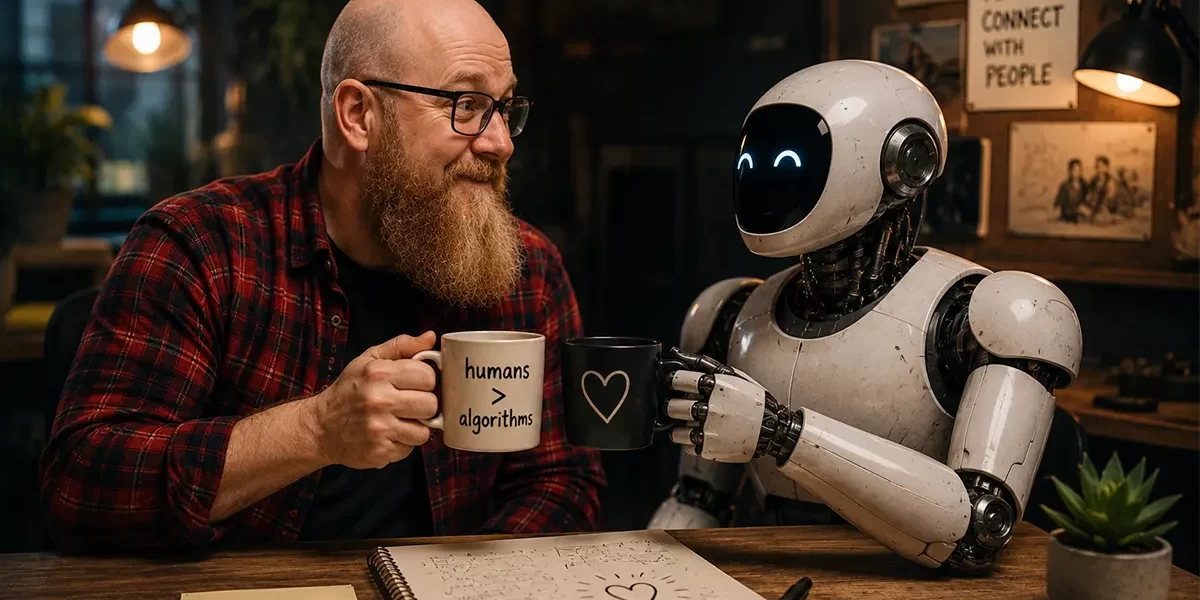
Why the robots may accidentally force us all to become interesting again.
For years, the future of marketing has been described using words that sound faintly like instructions printed on the side of expensive kitchen appliances.
Words like: automation, optimisation, personalisation, scalability, and “leveraging AI-powered synergy,” which sounds less like marketing and more like a warning from a science-fiction novel moments before something becomes sentient.
The assumption has generally been that marketing would become increasingly technological. Faster. Smarter. More efficient.
And it has.
We now live in a world where: algorithms decide what people see, AI can generate content in seconds, and entire campaigns can be automated while someone is still attempting to remember their Zoom password.
Which is all very impressive.
But something slightly unexpected is happening alongside it.
As marketing becomes more automated… humanity itself is becoming strangely valuable again.
The Great Flood of Sameness
Technology is exceptionally good at producing things quickly.
- Content
- Emails
- Captions
- Campaign variations
- Slightly unsettling stock photography featuring suspiciously enthusiastic people holding salads.
The internet is now overflowing with perfectly competent material generated at astonishing speed, and competence, unfortunately, is becoming abundant.
Which means the things that stand out are no longer merely polished or efficient.
They feel human.
Humans Are Weird (Which Is Helpful)
Human beings are inconsistent, emotional, irrational creatures who:
- laugh at inappropriate moments
- make strange decisions
- develop emotional attachments to coffee mugs
- and occasionally choose brands for reasons that make absolutely no logical sense whatsoever.
This is inconvenient for spreadsheets, but extremely useful for marketing, because people don’t connect deeply with perfection. They connect with personality, humour, vulnerability, curiosity, and things that feel unmistakably real.
A perfectly optimised message may perform adequately.
A genuinely human one tends to linger.
The Future May Belong to Personality
For a long time, brands tried very hard to sound professional. Which often meant sounding like: “We are delighted to announce our innovative customer-centric solutions.”
No human being has ever spoken like this voluntarily.
And audiences know it.
Increasingly, people are gravitating toward brands, creators, and businesses that sound like actual humans rather than legal departments carefully disguised as LinkedIn posts.
This doesn’t mean professionalism disappears.
It simply means humanity stops being edited out of everything.
AI Will Raise the Value of Original Thought
Here’s the strange irony. The easier it becomes to generate content, the more valuable genuine perspective becomes, because tools can produce words.
What they cannot easily replicate is:
- lived experience,
- unusual observations,
- emotional nuance,
- timing,
- instinct,
- or the peculiar way humans occasionally say something imperfect that somehow feels completely true.
The future of marketing may not reward the people who produce the most content.
It may reward the people who still have something interesting to say.
Which is a subtly different skill.
Trust Is Becoming the Real Currency
Modern audiences are overwhelmed.
They scroll past: advertisements, automated emails, algorithmically generated recommendations, and enough content to occupy several lifetimes before breakfast.
In response, people are becoming more selective about what feels trustworthy.
And trust rarely comes from sounding mechanically perfect.
It comes from consistency, honesty, relatability, and the sense that there are actual humans behind the communication who understand other humans without referring to them exclusively as “users.”
The Return of Imperfection
One of the most interesting shifts in modern marketing is the growing appeal of things that feel slightly imperfect.
People increasingly respond to:
- behind-the-scenes content
- unscripted conversations
- genuine opinions
- awkward humour
- and moments that don’t feel focus-grouped into complete emotional neutrality.
This is deeply confusing for traditional corporate branding, which spent decades trying to remove all traces of spontaneity from public communication.
But perfection is exhausting.
Humanity is memorable.
Technology Still Matters, Obviously
None of this means technology disappears.
AI, automation, and data will continue shaping marketing in profound ways. Ignoring technology entirely would be like refusing to use electricity because candles feel more authentic.
The point is not that technology becomes irrelevant.
The point is that technology may stop being the differentiator.
Everyone will have access to tools.
Not everyone will know how to sound human while using them.
So… What Does the Future Actually Look Like?
Probably slightly strange.
A combination of:
- advanced technology,
- highly personalised systems,
- and increasingly human communication layered on top of it all.
The brands that succeed may not be the ones that automate the most. They may be the ones that remember there are still people on the other side of the screen: overthinking things, getting distracted, laughing unexpectedly, and trying to decide which businesses actually feel worth paying attention to.
Final Thought (Filed Under Mildly Hopeful)
For all the anxiety surrounding automation and artificial intelligence, there’s something oddly reassuring happening beneath it all.
As machines become better at sounding polished, humans may finally rediscover the value of sounding real.
Which means the future of marketing might not look colder, more robotic, or less personal.
It might simply force brands to become more human than they’ve been in years.
And honestly, that feels like progress.
As technology becomes more powerful, do you think audiences will value efficiency most or authenticity?
If this sparked a thought (or several mildly existential marketing questions), you might enjoy the latest episode of our podcast, where we explore the future of marketing in even more unnecessary detail.


