
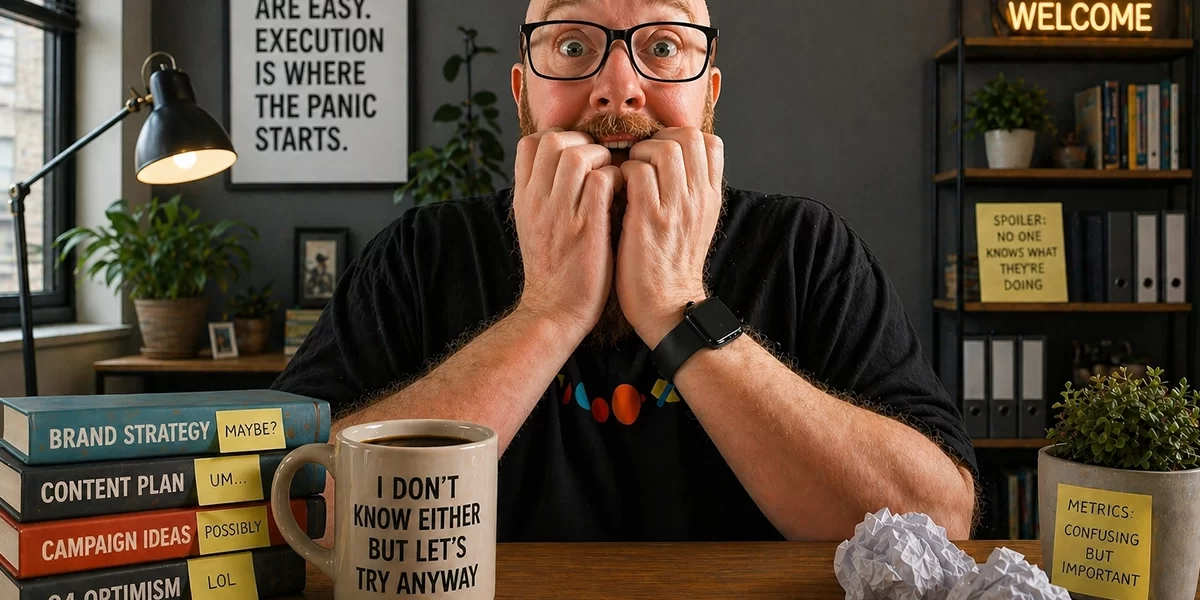
Why even the boldest strategy is secretly clutching a cup of tea and whispering “Oh dear”.
There is, buried deep within every marketing plan ever conceived, a small, persistent fear.
It does not shout. It does not wave its arms. It certainly does not appear in the executive summary wearing a high-visibility vest and announcing, “Excuse me, but none of this may work.”
Instead, it sits quietly in the margins. Possibly with a biscuit.
This fear is not dramatic. It is not the fear of total catastrophe (though that’s often pencilled in for Q4). No, this is a far more refined, British sort of anxiety, the kind that politely wonders whether anyone, anywhere, will actually care.
The Grand Illusion of Certainty
Marketing plans are, on the surface, magnificent documents.
They are filled with confident phrases like:
- “Target audience alignment”
- “Strategic positioning”
- “Optimised engagement pathways”
These are the linguistic equivalent of wearing a very expensive coat to distract from the fact that you’re not entirely sure where you’re going. Because underneath all the graphs, personas, and colour-coded timelines lies a simple, slightly unsettling truth:
You are making an educated guess.
A very well-researched, insight-driven, data-informed guess, but a guess nonetheless.
The Audience Problem (They Exist, But Inconveniently)
Every marketing plan assumes an audience.
Not just any audience, but the audience, a beautifully constructed human archetype named something like “Sophie, 34, digitally savvy but time-poor, enjoys oat milk and meaningful brands.”
Sophie is extremely helpful.
She always behaves exactly as predicted in meetings. She clicks where she is supposed to click. She converts when it’s convenient for the quarterly report.
Unfortunately, real people are less cooperative.
Real people:
- Ignore emails
- Misunderstand messaging
- Click on things accidentally
- Develop sudden, inexplicable obsessions with something entirely unrelated
And occasionally, just to keep things interesting, they do absolutely nothing.
The Algorithm, That Mysterious Creature
No modern marketing plan is complete without acknowledging The Algorithm.
The Algorithm is treated with a mixture of reverence and superstition, much like ancient weather systems or particularly moody cats.
We say things like:
- “The algorithm favours consistency”
- “The algorithm is rewarding video right now”
- “The algorithm has… changed again”
No one has actually met the algorithm, but everyone agrees it must be appeased.
So we produce content. Lots of content.
We feed it into the void, hoping for engagement, reach, and possibly a small sign that someone, somewhere, nodded approvingly.
Metrics: The Comfort Blanket
When the quiet fear grows slightly louder, we turn to metrics.
Metrics are soothing.
They give us numbers. Numbers feel like control.
- Impressions
- Click-through rates
- Conversion percentages
These numbers are then placed into tidy reports, where they behave themselves beautifully, but even metrics have their own quiet secret: They can tell you what happened, but they are often maddeningly vague about why.
Which brings us right back to where we started, staring gently into the unknown, spreadsheet in hand.
The Real Fear (It’s Not Failure)
Interestingly, the quiet fear is not actually about failure.
Marketers are quite used to failure. Campaigns flop. Ads underperform. Ideas go down in flames so quietly you almost miss them.
No, the real fear is something far more existential:
What if no one notices at all?
Not outrage. Not criticism. Just… silence.
Because silence offers no feedback. No data. No story to tell in the next meeting. It’s the marketing equivalent of telling a joke and hearing nothing but the distant hum of a refrigerator.
And Yet, We Carry On
Despite all of this, the uncertainty, the algorithmic mysteries, the occasionally imaginary audience, marketing plans continue to be written.
Carefully. Thoughtfully. Optimistically. Because beneath the quiet fear, there is also something else: A belief that connection is possible.
That somewhere out there, a real human (not just Sophie) might:
- Laugh at your copy
- Recognise your brand
- Actually care about what you’ve made
And that’s just enough to keep going.
Put the Kettle On
So the next time you’re staring at a marketing plan, wondering if it will work, remember: Everyone else is wondering the same thing. They’ve just dressed it up in slightly more confident language.
The fear doesn’t go away.
You just learn to work alongside it.
Preferably with a cup of tea.
If you enjoyed this post, you might love our latest podcast episode, where we dive even deeper into the ideas behind content. Give it a listen and let us know what you think!






2 Comments