
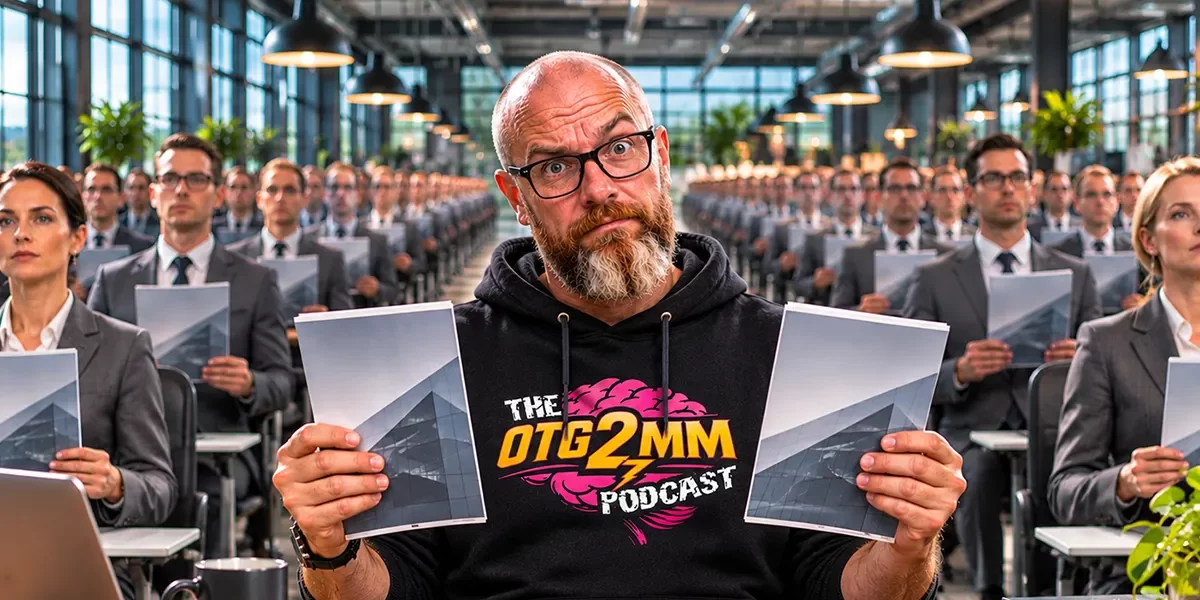
Because apparently, the secret to standing out in a crowded market is to dress exactly like everyone else.
There’s a peculiar phenomenon happening in marketing departments worldwide.
Every business wants to be different.
Every business claims to be innovative.
Every business insists it has a unique approach.
And yet, somehow, they all have remarkably similar websites, identical messaging and photographs of the same three people pointing enthusiastically at a laptop.
It’s almost as though the entire business world attended the same branding workshop and nobody thought to question the instructions.
Welcome to the wonderful world of competitive sameness.
The Great Corporate Identity Crisis
Take five competing businesses in pretty much any industry.
Open their websites. Remove the logos. Now can you work out which is which?
Good luck.
You’ll probably come across the same spiel about innovation, customer focus, quality and delivering the best possible solutions.
There will be blue gradients. There will be handshakes. There might even be a photo of a wind turbine (regardless of whether the company has any kind of connection to renewable energy at all).
Every business is a trusted partner in delivering innovative solutions.
Which is impressive. As nobody seems entirely sure what that means.
If customers can’t tell you apart from your competitors then your brand differentiation is in tatters.
Why Do Brands Copy Their Competitors?
The answer is actually quite simple.
Nobody wants to look foolish.
Businesses look at their competitors, work out what they think is working and then go and do the same thing.
Marketing teams refer to this as competitive benchmarking.
Which is a hell of a lot more sophisticated than just copying someone else’s homework and changing the font.
The problem is that the competition are often doing the same thing.
Everyone watches everyone else.
Everyone copies everyone else.
And eventually the whole industry starts to look like a family reunion attended by nothing but identical twins.
Following the industry conventions can make your business look credible. Following every convention can make it invisible.
Being Professional Doesn’t Mean Being Forgettable
One of the great myths in B2B marketing is that professionalism means you have to be completely devoid of personality.
Apparently serious businesses have to communicate in serious language.
They must use the approved terminology.
They must never state an interesting opinion.
And in absolutely no circumstances should their website contain anything that would make a human being smile.
But the customer is still a person.
Even when they’re in suits and buying industrial equipment.
They remember the stories, the ideas, the bits of useful information and the brands that make them feel something.
Professionalism builds confidence. Personality is what enables you to be remembered. You can have both. It’s not illegal. I’ve checked.
Brand Differentiation Is More Than Looking Different
Now before anyone goes out and commissions a fluorescent orange logo with a tap dancing rhino on it, an important caveat.
Brand differentiation isn’t just about being different. It’s about giving the customer a good reason to choose you.
That could be down to your expertise.
Your approach to customer service.
Your specialist knowledge.
Your company culture.
Your willingness to question the assumptions of the industry.
Or your ability to explain the complex without making the customer feel as if they’ve somehow signed up for an advanced physics course.
The best brands are those that can identify what is of genuine value to them and communicate that in a distinctive and memorable way.
A different colour palette might help. But it won’t compensate for having absolutely nothing else to say.
If Everyone Is Different, Nobody Is
Here’s a useful experiment.
Take the main headline from your site. Replace your company name with a competitor’s. Does it still make sense?
Could they make the same claim?
If the answer is yes then you may have found a problem.
Because delivering innovative solutions via customer focused excellence isn’t a unique position.
It’s a collection of corporate adjectives attempting to get out of a PowerPoint.
Try being more specific.
What do you actually do?
Who you help.
What problems you solve.
And why your approach is worth remembering.
The aim isn’t just to look different from your competitors. It’s to be genuinely different in the customer’s mind.
Stop blending in. Start being remembered.
Customers are constantly bombarded with marketing.
Most of it vanishes from memory pretty quickly.
And when the brands are all looking and sounding and behaving the same, it becomes even harder to remember which one said what.
That’s why distinctiveness matters.
A clear visual identity, a distinct point of view and clear, memorable brand cues will all help people to identify and remember your business.
But those things work at their best when underpinned by a very good reason to pick you.
As there’s very little point in creating marketing that looks absolutely proper if no one ever actually sees it.
So have another look at your competitors.
Then take a very long and uncomfortable look at your own marketing.
If it all looks rather suspiciously familiar, it might be time to stop going with the flow.
After all, being mistaken for your competitors is an awful way of advertising someone else’s business.
And somewhere three smiling people are still pointing at a laptop.
Nobody knows why.
Listen to Episode 17: The Science of Being Memorable
Why do some brands end up in our memory for decades whereas others are completely gone before we’ve even finished scrolling?
In Episode 17 of The Overthinker’s Guide to Modern Marketing Podcast we look at the science of memory, brand distinctiveness and why being noticed is only half the battle.
From the psychology of recognition and recall through to the importance of emotion and the nature of distinctive brand assets we look at what makes marketing actually memorable.
If your business looks and sounds exactly like every other business in your industry then this episode is definitely worth a listen.
Listen to Episode 17: The Science of Being Memorable
Because the only thing worse than being forgotten is being remembered as someone else.