
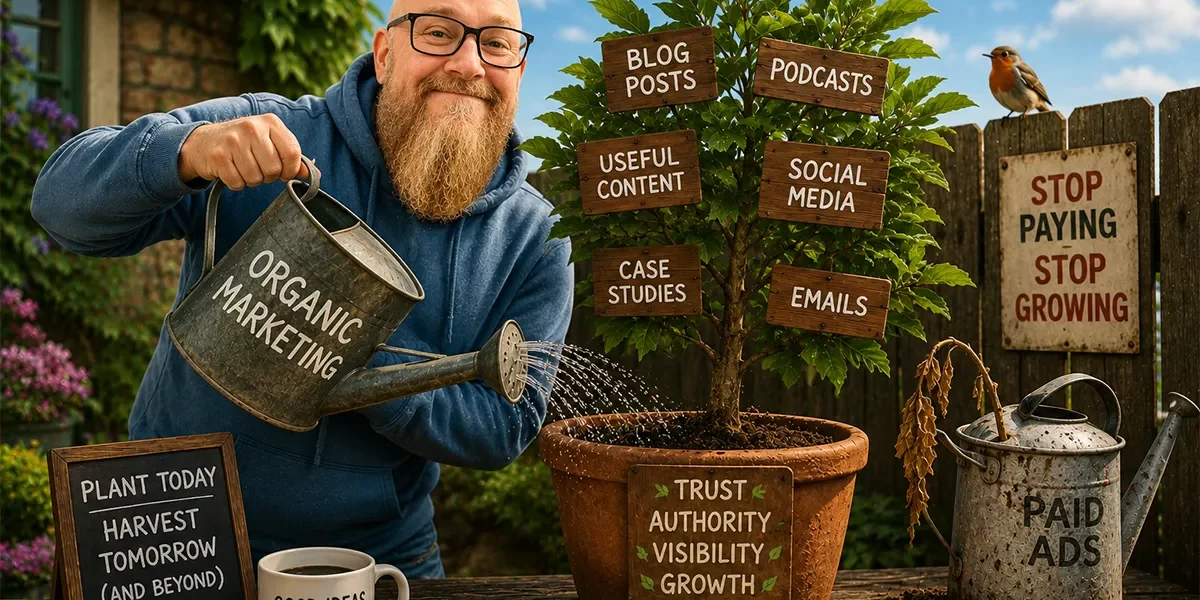
Why does planting a garden usually work better than constantly buying plastic flowers?
Many modern businesses share a common habit.
The moment sales become a little sluggish, someone inevitably says: “Let’s spend more on advertising.”
Which is a perfectly reasonable suggestion.
But when the advertising budget runs out, everyone looks at the dashboard with the same disappointment as someone who realises they booked a holiday during the rainy season.
The leads disappear.
The clicks stop.
The traffic falls.
The marketing machine, which was working well just moments before, suddenly stops like a toaster that’s been unplugged.
This is when organic marketing steps in.
Organic Marketing Is an Asset, Not an Expense
Paid marketing is wonderfully useful.
It quickly creates visibility, speeds up campaigns, and brings in immediate traffic, but it works more like hiring a taxi.
The moment you stop paying, the journey ends.
Organic marketing is different.
- Every article
- Every podcast episode
- Every customer case study
- Every LinkedIn post
- Every email newsletter
- Every useful guide
- Every video
- Every customer review
They continue working long after they’ve been published.
A blog post you write today could bring in enquiries next month, next year, or even three years later.
That’s not a campaign.
That’s an asset.
Customers Don’t Buy Immediately
One of the biggest misconceptions in marketing is that customers discover your business and instantly decide to buy.
Sometimes this does happen, usually after someone wins the lottery or has an unusually good cup of coffee.
Most buying journeys are rather slower.
People research. They compare suppliers, ask colleagues, read reviews, visit your website several times, and then disappear, only to return weeks later as if nothing happened.
Organic marketing supports this entire journey.
It answers questions before they’re asked.
Builds trust before a meeting.
Demonstrates expertise before the proposal arrives.
By the time the sales team gets involved, most of the marketing work is already done.
Trust Compounds
One helpful article builds credibility, but ten helpful articles build authority.
Fifty helpful articles can make your business the first place people think of when they have a question.
This is one of the great strengths of organic marketing. Trust accumulates.
The customer who reads your latest article may also discover one you wrote six months ago, then another, then your podcast and then your case studies.
Every interaction reinforces the last.
The relationship keeps growing, even when you’re focused on other things.
This is remarkably efficient.
Google Is Changing. Expertise Isn’t.
The rise of AI-powered search has understandably made many people nervous.
If Google now answers more questions directly, does that mean content marketing is over?
Not quite.
Generic content has certainly become easier to replace.
Original thinking hasn’t.
Businesses that simply repeat information available everywhere else may find it increasingly difficult to stand out.
Businesses that share their experience, practical insights, customer stories, original research, and real expertise stay valuable because they add something new to the conversation instead of just repeating what’s already out there. AI-powered search favours content that shows real expertise and helps users solve real problems, not just content made to rank for keywords.
The future belongs to businesses worth quoting.
Not just businesses that show up in search results.
Organic Marketing Works Harder Together
One of the biggest mistakes businesses make is treating every marketing activity as a separate project.
The blog belongs over here.
The podcast lives over there.
LinkedIn is somebody else’s responsibility.
The newsletter only goes out when someone remembers the password.
High-performing businesses think differently.
One podcast becomes a transcript.
The transcript becomes a blog.
The blog becomes five LinkedIn posts.
Those posts spark conversations.
Those conversations inspire the next podcast.
One idea becomes an entire ecosystem.
Marketing stops acting like a set of separate campaigns and starts working as a connected system. This approach is also much easier to keep going.
Organic Marketing Is Patient
This is probably the hardest part. Organic marketing rarely delivers spectacular results next Tuesday.
It’s more like planting trees. You water them and take care of them. Sometimes you wonder if anything is happening. Then one day, you realise you’ve grown an entire forest.
Many businesses give up just before this moment.
Not because organic marketing doesn’t work. Because it doesn’t work instantly.
The irony is that the need for consistency, which makes organic marketing hard, also makes it tough for competitors to copy.
Episode 13: How Can Businesses Win with Organic Marketing?
These ideas sit at the heart of Episode 13 of The Overthinker’s Guide to Modern Marketing, “How Can Businesses Win with Organic Marketing?”
The episode explores why organic marketing is becoming one of the most valuable long-term investments a business can make, particularly as search, AI, and customer behaviour continue to evolve. Rather than chasing algorithms or relying solely on paid advertising, it examines how consistent, valuable content helps businesses build authority, trust, and visibility over time.
If you’ve ever wondered whether blogging, podcasts, LinkedIn content, newsletters, or thought leadership are still worth the effort, Episode 13 explains why they matter more than many
businesses realise.
The Businesses That Win Become Teachers
Perhaps that’s what organic marketing has always been.
- Teaching
- Helping
- Explaining
- Sharing
- Not interrupting customers
- Not shouting louder
Simply becoming the business people naturally turn to because they’ve already learned something useful from you.
People rarely object to useful information. They actively seek it.
This makes organic marketing one of the few types of marketing that customers actually choose to engage with. That’s an important difference.
Grow Something Worth Finding
There will always be a place for paid marketing.
Sometimes you need immediate visibility.
Sometimes you need to launch quickly.
Sometimes speed matters.
But businesses that rely only on paid attention end up needing to pay for every new customer.
Organic marketing offers something different. It helps you build an audience, a reputation, a library of expertise, and a collection of work that keeps attracting customers long after it’s created.
In a world increasingly dominated by AI, automation, and algorithm changes, one thing hasn’t changed at all.
People still trust businesses that consistently help them.
So the smartest marketing strategy might be to create something worth finding.
Again.
And again.
And again.
If your advertising budget disappeared tomorrow, would your business still be visible to potential customers six months from now?
Listen to Episode 13 – “How Can Businesses Win with Organic Marketing?” on The Overthinker’s Guide to Modern Marketing and discover why organic marketing remains one of the most valuable investments a business can make.


