
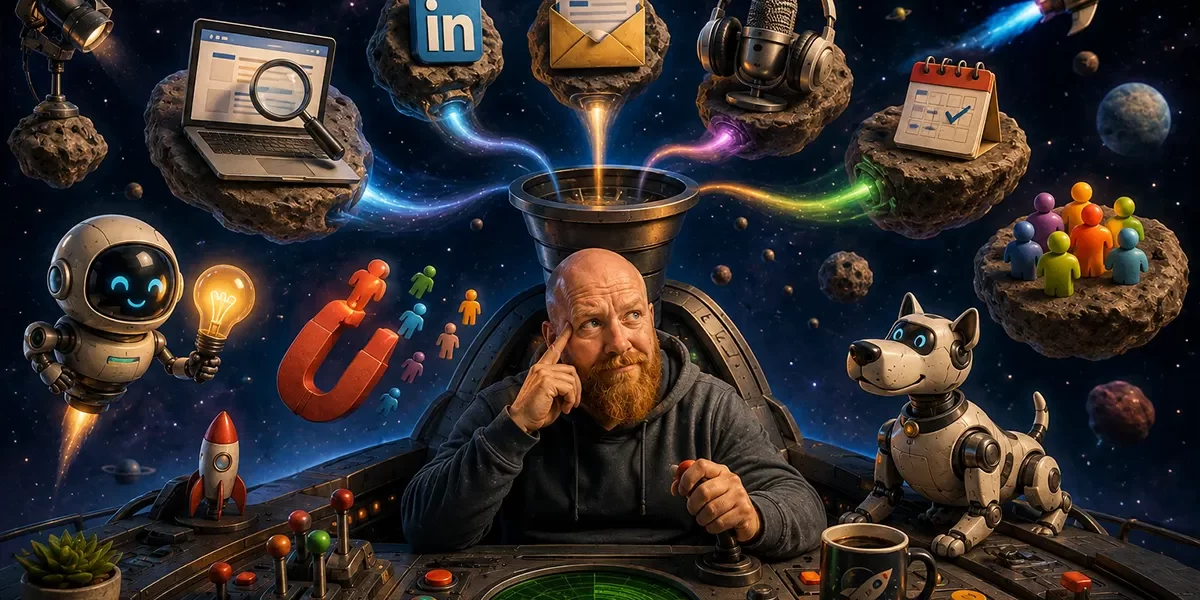
Marketing now seems to have more channels than most televisions.
There was once a simpler time.
If you wanted to market a business, you placed an advert in a trade magazine, attended an exhibition, printed an alarming number of brochures, and hoped someone important wandered past your stand while searching for free pens.
Life had a certain reassuring predictability.
Today, the average B2B marketer wakes up to find three new social platforms, another change to Google search, someone on LinkedIn declaring email marketing dead yet again, and an AI agent publishing a blog post before breakfast.
It’s enough to make anyone wonder whether there are simply too many marketing channels.
The answer is yes.
The more useful question is this: Which ones actually work?
There Is No Best Marketing Channel
This is probably not the answer anyone wanted.
People enjoy certainty. They like lists and appreciate articles entitled “The Five Marketing Channels Guaranteed to Triple Revenue Before Tuesday.” But marketing rarely lives up to that kind of optimism.
The best marketing channel depends entirely on your customers.
- Where do they spend their time?
- How do they research suppliers?
- Who influences their decisions?
- What information do they trust?
A civil engineer buying specialist equipment behaves very differently from a software founder looking for investors.
The channel matters.
The audience matters more.
Google Search Still Deserves Your Attention
Despite endless predictions of its demise, search remains one of the most valuable ways customers discover businesses.
That doesn’t mean search hasn’t changed. Far from it.
Google’s AI-powered search experiences are increasingly answering questions directly, reducing clicks for straightforward informational content. This means simply publishing generic articles stuffed with keywords is becoming a remarkably inefficient hobby.
The businesses benefiting today are creating content that demonstrates genuine expertise.
Original research, practical insights, case studies, opinion pieces, and customer stories all offer something that AI summaries can’t easily copy.
In other words, content written by people who actually know what they’re talking about. This old-fashioned strategy is becoming popular again.
LinkedIn Has Become the Modern Trade Show
For many B2B organisations, LinkedIn has quietly evolved into the industry’s largest networking event.
The conversations happen daily.
Customers observe long before they engage.
Potential buyers research leadership teams.
Employees become brand ambassadors.
Thought leadership reaches much farther than brochures ever did.
The businesses seeing the greatest success rarely spend all day selling.
They educate, explain, challenge assumptions and share lessons from real projects.
Then something interesting happens. People begin contacting them. Not because they posted more, but because they consistently shared something worth reading.
Email Refuses to Die
Email marketing has survived so many predictions of its end that it almost deserves a lifetime achievement award.
While every few years someone confidently announces that email is finished, businesses continue generating remarkable results from well-written newsletters.
Perhaps because email does something social media rarely guarantees.
It arrives directly. It doesn’t depend on mysterious algorithms that sometimes show your content only to Derek from Accounts and no one else.
The best newsletters don’t simply promote products.
They share expertise, useful ideas, industry observations and original thinking.
People don’t unsubscribe from valuable emails.
They forward them.
Podcasts Build Relationships
Hearing another person’s voice feels very human.
You begin to understand how they think.
How they explain ideas.
How they approach problems.
This is why podcasts have become such a powerful B2B marketing channel.
They don’t simply transfer information. They build familiarity, trust, and credibility. By the time someone reaches out after listening to several episodes, they often feel as though they already know the host.
It’s hard to build that kind of connection with a banner ad.
Events Still Matter
Even with all our technology, people still want to meet each other in person.
- Trade exhibitions.
- Conferences.
- Workshops.
- Roundtables.
- Networking events.
- Customer forums.
These remain valuable because business is still built on relationships.
Yes, many conversations now begin online, but significant commercial decisions are still frequently accelerated by face-to-face interaction.
Technology has changed how we start relationships, but it hasn’t made them any less important.
Your Website Is More Important Than Ever
Ironically, as marketing channels multiply, the company website has become even more important.
Every road eventually leads there.
Prospects who discover you through LinkedIn visit your website.
People who hear your podcast visit your website.
Search visitors arrive on your website.
Recommendations lead to your website.
It’s where customers decide whether your business genuinely understands their challenges.
An outdated website doesn’t just look old. It creates doubt, and that doubt can be costly.
The Most Powerful Channel Isn’t Really a Channel
Here’s the twist.
The businesses enjoying the strongest marketing performance often have one thing in common.
Consistency.
They don’t rely on one channel. They connect several of them together.
A podcast becomes a blog.
The blog becomes LinkedIn content.
The LinkedIn discussion becomes a webinar.
The webinar becomes a downloadable guide.
The guide generates email subscribers.
The email nurtures relationships.
The relationship becomes a customer.
The customer becomes a case study.
The case study restarts the whole process.
The magic isn’t choosing one perfect channel. It’s building an ecosystem where each activity supports the next.
AI Is Changing Distribution, Not Strategy
Artificial intelligence is transforming how marketing is produced and distributed.
Content creation is faster.
Research is easier.
Campaigns are more automated.
AI agents can schedule activity, analyse performance, optimise workflows, and complete repetitive tasks that once consumed hours.
This is very useful, but AI hasn’t changed the basics.
Customers still buy from businesses they trust.
They still seek expertise, value originality and respond to stories.
Technology changes the tools, but it rarely changes how people behave.
Stop Looking for Shortcuts
Every year, someone announces the next revolutionary marketing channel.
Every year, businesses rush towards it.
Every year, they discover that success still depends on understanding customers better than competitors do.
The most effective B2B marketing channels aren’t always the newest. They’re the ones your customers actually use.
Combined with useful content, consistent communication, original thinking, and a genuine desire to help rather than simply sell.
Marketing has always been less about finding the perfect channel and more about being worth listening to.
That hasn’t changed. The technology has. The people haven’t.
If you could keep only one B2B marketing channel for the next three years, which would it be and why?
If you enjoy exploring strategy, branding, customer psychology, AI, and the wonderfully unpredictable world of modern marketing, subscribe to The Overthinker’s Guide to Modern Marketing podcast for more conversations designed to make marketers think a little differently.