
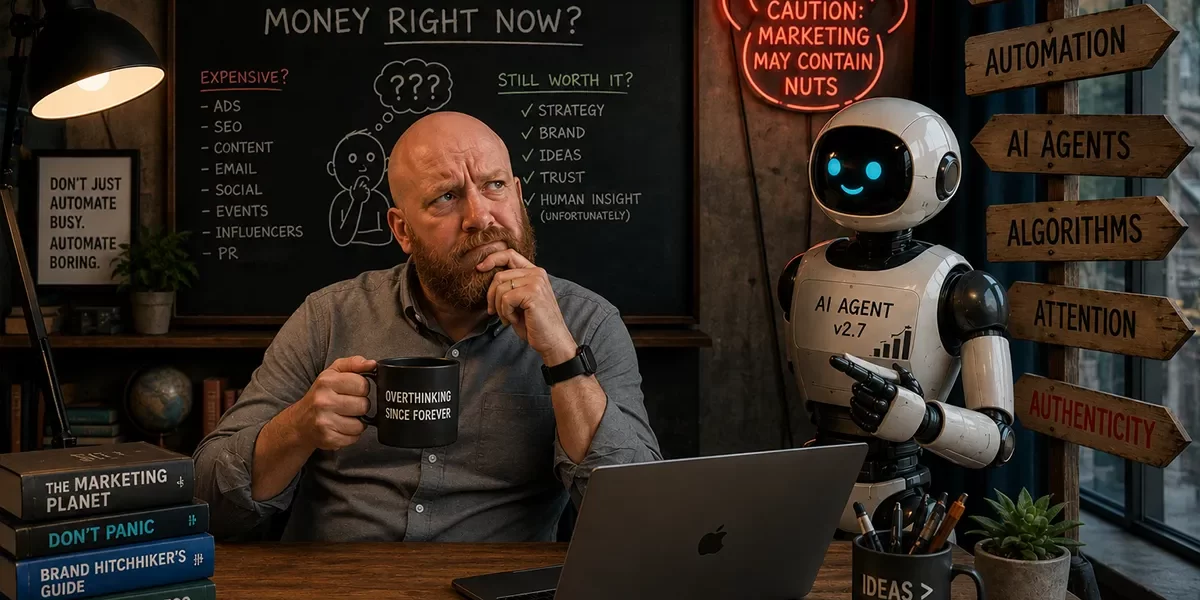
Artificial intelligence has quietly entered the marketing world, changed everything around, and now everyone is left wondering how to find their way forward.
A question is quietly circulating in boardrooms, marketing teams, agencies, and among business owners: “Is any marketing actually worth the money any more?”
It’s a fair question.
After all, the rules seem to change every Tuesday.
One week, you’re told SEO is everything.
The following week, Google’s AI-generated search results might answer questions before anyone even clicks on your well-written article.
Yesterday, you needed a copywriter, designer, video editor, researcher, translator and automation specialist.
Now, you might see someone on LinkedIn saying they replaced all those roles with three AI agents, a workflow diagram, and a lot of confidence.
It’s enough to make anyone question if marketing has become lost in endless presentations.
Fortunately, the answer is rather more interesting than that.
Marketing Isn’t Dying. It’s Being Repriced.
Every major technological shift forces businesses to rethink value.
When websites became common, brochures became less important.
When social media exploded, advertising changed forever.
When smartphones arrived, customer behaviour changed overnight.
Artificial intelligence is just the latest development. What’s different is that this time, the changes seem to be happening on their own.
Many marketing activities that once required hours of manual effort can now be completed in minutes.
Tasks like research, content planning, email writing, image creation, data analysis, campaign reporting, customer segmentation, and even full marketing campaigns can now be started in just a few minutes.
This is extraordinary.
It also means many businesses are asking a perfectly reasonable question.
If AI can do so much, what exactly am I paying marketers for?
The Cost of Doing Things Has Fallen
One thing seems increasingly clear: The cost of producing marketing is falling.
Writing an article now takes much less time. Creating graphics no longer needs special software. Video editing is much easier. Customer service can be partly automated, and research that used to take days can often be finished in an hour.
AI agents are beginning to connect systems, automate repetitive workflows, monitor campaigns, generate reports, and even recommend improvements without anyone needing to manually transfer information between platforms.
This shift changes the economics of marketing.
Businesses should absolutely expect greater efficiency. They should expect faster delivery and, in many cases, lower costs.
That’s good news.
Unfortunately, AI Hasn’t Invented Wisdom
The challenge is that efficiency isn’t the same thing as effectiveness.
Artificial intelligence can generate content remarkably quickly. It cannot always determine whether it’s the right content.
It can identify patterns. It cannot always understand context.
It can recommend keywords. It cannot sit in a customer’s office and understand the politics behind a buying decision.
It can automate communication. It cannot build genuine trust.
At least, not for now.
Marketing has never really been about producing things.
It has been about influencing people.
Those are not quite the same skill.
Google Just Moved the Goalposts
For years, marketers focused on winning clicks.
Optimise the page. Rank highly. Answer the search query. Wait for visitors to arrive.
Increasingly, Google is answering many of those questions itself through AI-generated search experiences.
For simple information searches, users might not need to visit a website at all. That can feel unsettling, but maybe we have been measuring success the wrong way.
If your only objective was attracting traffic, AI search presents a challenge.
If your objective was to become recognised as a trusted authority, the opportunity still exists.
Businesses that consistently produce original insights, expert opinions, unique research, and genuinely useful content are far more likely to be referenced, cited, and remembered than those simply repeating information already available elsewhere.
In other words, originality has become more valuable, not less.
The Rise of AI Agents
Perhaps the most fascinating development isn’t AI content generation. It’s AI agents.
Instead of simply creating content, these systems are beginning to complete entire workflows, monitor competitors, research markets, prepare campaign reports, schedule activity, optimise advertising and analyse customer behaviour.
These tools can now coordinate marketing tasks across different platforms with very little human involvement.
For smaller businesses, this is potentially transformative.
The marketing department that once required several specialists may soon operate with a handful of experienced people supported by intelligent automation.
That’s not necessarily a threat.
It’s a natural step forward.
History suggests technology rarely eliminates valuable expertise.
It tends to eliminate repetitive work.
So What Are We Actually Paying For?
This may become the defining marketing question of the next decade.
If software creates content… AI manages workflows… automation handles reporting… and search engines increasingly answer questions directly…
What remains?
Quite a lot, actually.
- Strategy
- Positioning
- Creativity
- Customer psychology
- Storytelling
- Brand development
- Commercial judgement
- Original thinking
- Understanding human behaviour.
These have always been the hardest parts of marketing. Now, they are becoming even more valuable, because while AI can produce answers quickly, it still depends on people to ask the right questions.
Marketing Is Becoming More Human, Not Less
There’s an interesting twist happening. As technology gets better at creating content, real human expertise is becoming more important.
Customers are already beginning to distinguish between generic information and original thinking.
Between recycled advice and genuine experience.
Between automated content and authentic perspective.
Businesses that simply use AI to produce more average content may find themselves competing with millions of other businesses doing the same.
Those that combine AI efficiency with genuine expertise, customer understanding and distinctive ideas are likely to stand out.
Technology creates scale.
Humans create meaning.
The future probably needs both.
Is Marketing Still Worth the Money?
Yes.
But perhaps not in the same places.
Businesses should question expensive manual processes that automation can now perform more efficiently.
They should embrace AI where it genuinely improves productivity. They should automate repetitive work wherever practical, but they should also invest in what remains difficult to automate.
Understanding customers.
Building brands.
Developing strategy.
Creating memorable experiences.
Solving commercial problems.
Generating original ideas.
These skills are becoming more valuable because they are harder to find.
Don’t Buy More Marketing. Buy Better Thinking.
The future of marketing probably won’t belong to the businesses with the biggest teams, nor will it belong to those using the most AI tools.
The future will belong to organisations that know where technology adds value and where human judgement is still important.
Use AI to remove repetitive work.
Use automation to improve efficiency.
Use agents to eliminate administrative tasks.
But never outsource curiosity.
Never automate empathy.
And never assume that because something was generated quickly, it automatically deserves a customer’s attention.
Marketing has always been about understanding people. Artificial intelligence hasn’t changed that.
It’s simply made everything else considerably faster.
Honestly, this gives us all a bit more time to think. For some, that’s great news, but for overthinkers, it could be a mixed blessing.
If AI can create almost anything in seconds, what do you think will become the most valuable skill in marketing over the next five years?
If you enjoy exploring how technology, psychology and human behaviour are reshaping modern marketing, subscribe to The Overthinker’s Guide to Modern Marketing podcast for more conversations that look beyond the hype and ask what really matters.