
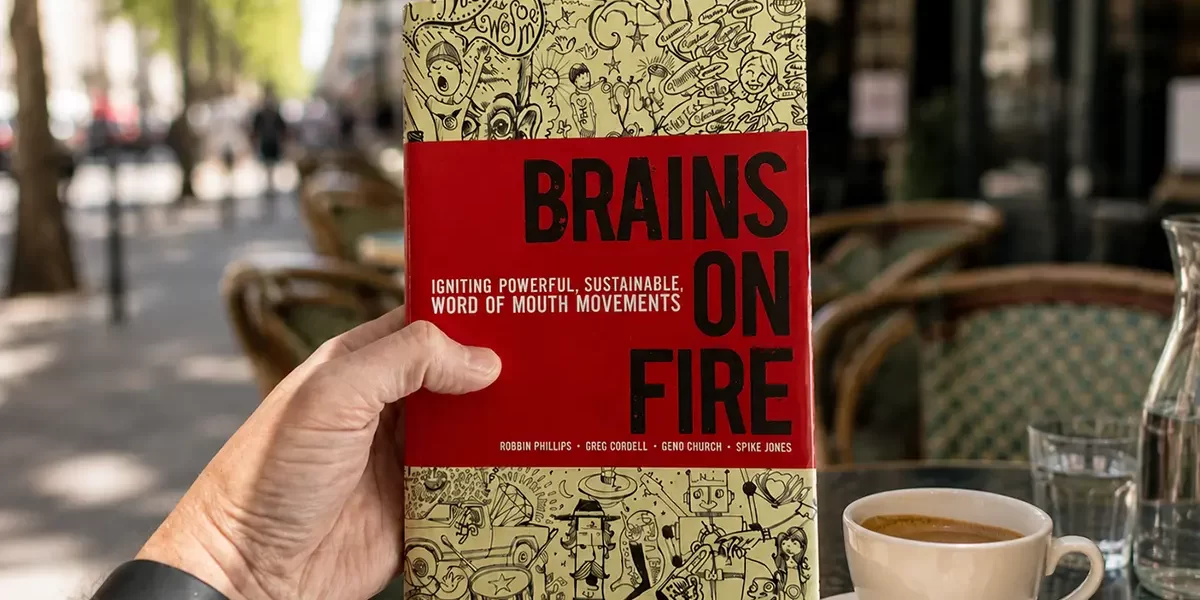
Book Review : Brains On Fire by Robbin Phillips, Greg Cordell, Geno Church & Spike Jones.
There’s a particular kind of optimism in modern marketing that suggests if we automate enough emails, optimise enough funnels, and post enough short-form video content, customers will eventually fall lovingly into our sales pipeline.
Brains on Fire offers a slightly different idea.
What if people simply talked about you because they genuinely cared?
Radical, really.
The Big Idea (Which Turns Out Not to Be New)
Originally published in 2010, Brains on Fire explores how brands create passionate word-of-mouth communities by focusing less on broadcasting messages and more on building movements.
And despite the book now being well over a decade old, the core principles feel remarkably unchanged in 2026, because while platforms evolve at alarming speed, human behaviour mostly doesn’t.
People still trust people more than brands.
They still share stories, experiences, recommendations, and frustrations, and they still want to feel part of something bigger than a transaction.
Which is mildly inconvenient for anyone hoping AI alone would solve marketing.
Why It Still Feels Relevant
One of the more surprising things about Brains on Fire is how modern much of it still sounds.
Long before “community-led growth” became a LinkedIn personality trait, the book was already making the case that customers are not passive audiences, they’re participants.
The authors argue that the most effective marketing often comes from creating spaces where people feel heard, involved, and emotionally connected to a shared purpose.
Simple in theory. Considerably harder in practice. Because it requires brands to loosen their grip on control and trust that customers might tell the story better themselves.
The Case Studies (And Why They Matter)
The book is packed with case studies, and thankfully they’re not presented in the usual “brand achieves incredible synergy” style.
Instead, they offer practical examples of how businesses built genuine advocacy by listening to communities and empowering customers to spread the message organically.
There’s a lot here modern marketers can still learn from, particularly at a time when many brands are confusing visibility with connection.
A large audience is useful. A passionate community is considerably more powerful.
The Overthinker’s Verdict
If you’ve ever spent hours refining messaging while ignoring the people already talking about your brand, this book may feel like a quiet but necessary correction.
Brains on Fire reminds us that word of mouth isn’t something you manufacture.
It’s something you earn.
Usually by being interesting, useful, or genuinely worth talking about.
Which, admittedly, is harder than scheduling another content calendar.
One Last Thought
For a book published in 2010, Brains on Fire has aged remarkably well. Not because the tactics are trendy, but because the underlying truth remains the same: people trust other people far more than they trust marketing. And despite everything that’s changed since then, that part still feels wonderfully stubborn.
Purchase this book online through our Amazon affiliate link https://amzn.to/4eXCYXV or download the audiobook from https://amzn.to/4dzM6Ax
Brains On Fire - Igniting Powerful, Sustainable, Word of Mouth Movements
Writing Style
Content
Insight
Useful
Brains on Fire is a thoughtful and surprisingly timeless look at how genuine word-of-mouth movements are created. Despite being published in 2010, its core ideas remain highly relevant in 2026, reminding marketers that while platforms constantly change, human behaviour rarely does. Through a series of strong case studies and practical insights, the book makes a compelling case for building communities, encouraging advocacy, and creating emotional connections rather than simply chasing visibility. It’s a refreshing reminder that the most powerful marketing still happens when people genuinely want to talk






Hey Sean! Thanks for the kind words about the book. It was a labor of love and I’m glad you agree it has aged well! Cheers.
You’re very welcome, Spike! I genuinely enjoyed it. It’s become one of those books I find myself recommending to new clients and colleagues all the time, and I suspect I’ll be doing so for many years yet. Great work!