
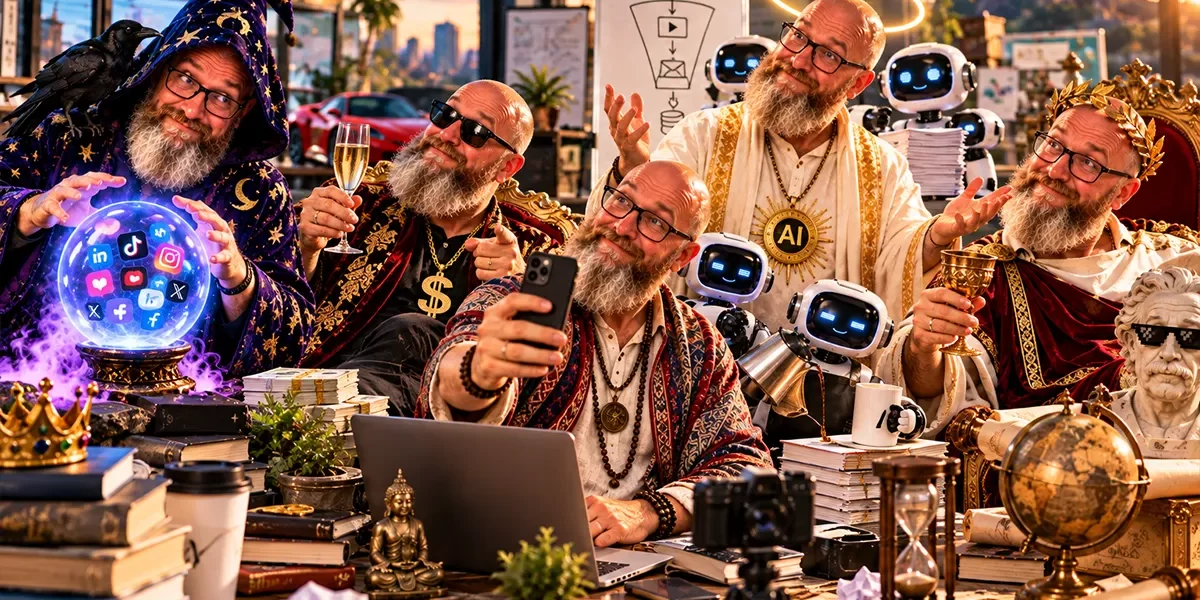
How to spot the modern marketing guru in the wild, preferably before you buy their £997 masterclass.
The modern marketing landscape is home to a remarkable variety of creatures.
There are strategists, consultants, specialists, practitioners and people who have genuinely spent decades understanding how businesses grow.
And then there are the marketing gurus.
You can usually identify these extraordinary individuals by their ability to turn a fairly ordinary observation into a revolutionary business philosophy, preferably while standing beside a rented sports car.
Not all marketing gurus are dangerous. Some even offer useful advice.
But for the inexperienced business owner, distinguishing genuine expertise from enthusiastic nonsense can be surprisingly difficult.
Fortunately, this field guide should help.
1. The Algorithm Whisperer
Guruus algorithmicus
This creature claims an almost supernatural understanding of social media algorithms.
They know exactly when you should post, how many hashtags to use and why your latest LinkedIn update failed to achieve international recognition.
Their advice changes approximately every fortnight.
Common call: “The algorithm has changed EVERYTHING!”
Natural habitat: LinkedIn carousels featuring dramatic arrows.
Warning signs: Claims to have discovered a secret posting time that will guarantee 400% more engagement.

2. The Six-Figure Funnel Wizard
Funnelus magnificus
The Funnel Wizard has developed a revolutionary system that generates enormous revenue while requiring remarkably little work.
Curiously, the system always involves purchasing access to another system.
Their sales funnel leads to a webinar, then a masterclass, then a private community, then a more expensive masterclass explaining why the original masterclass wasn’t quite enough.
Common call: “I made six figures while sleeping!”
Natural habitat: Hotel balconies in Dubai.
Warning signs: Refuses to clarify whether six figures refers to revenue, profit or the number of emails sent.

3. The Personal Brand Prophet
Authenticus performativus
The Personal Brand Prophet believes every human experience is a content opportunity.
Missed a train? Leadership lesson.
Burnt some toast? Resilience.
Saw a pigeon? Five things CEOs can learn about strategic positioning.
They often encourage everyone to be authentic, as long as that authenticity follows a carefully optimised 14-step content framework.
Common call: “Here’s what nobody tells you about personal branding.”
Natural habitat: LinkedIn, usually accompanied by a thoughtful photo of someone standing just outside the frame.
Warning signs: Hasn’t experienced an ordinary Tuesday in seven years.

4. The AI Evangelist
Automatus everythingus
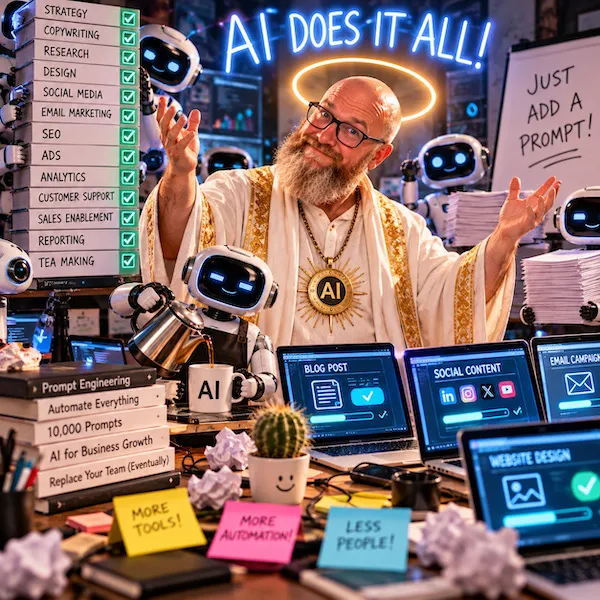
According to this creature, artificial intelligence has rendered every existing marketing skill obsolete.
Strategy? AI.
Copywriting? AI.
Customer research? AI.
Making tea? Presumably AI, once somebody integrates the kettle.
They promise that a carefully constructed prompt can replace an entire marketing department. Unfortunately, the resulting content often sounds like a committee of enthusiastic management consultants attempting to describe a sandwich.
Common call: “If you’re not using AI for EVERYTHING, you’re already behind!”
Natural habitat: Webinars demonstrating 47 tools nobody has time to learn.
Warning signs: They’ve automated every part of their business except finding actual customers.
5. The Thought Leadership Emperor
Insightus profundus
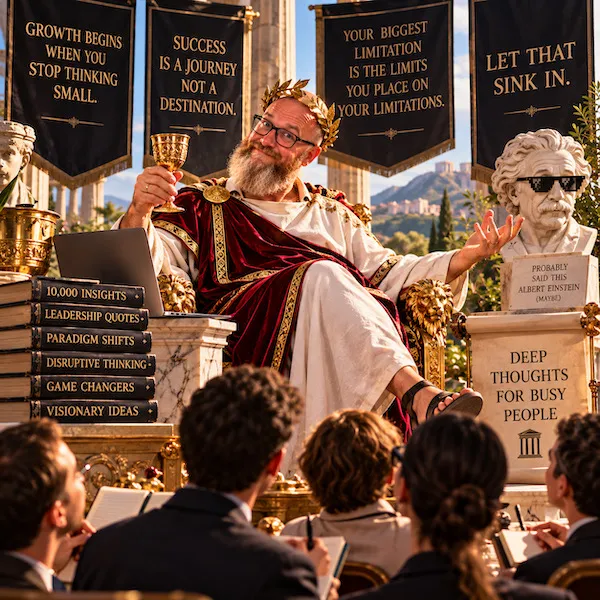
This guru specialises in statements that sound profound until you examine them.
“Growth begins when you stop thinking small.”
“Success is a journey, not a destination.”
“Your biggest limitation is the limits you place on your limitations.”
These observations are usually paired with a dramatic black-and-white portrait.
Occasionally, people attribute them to Einstein.
Einstein, who was apparently an exceptionally busy contributor to LinkedIn.
Common call: “Let that sink in.”
Natural habitat: Conference stages.
Warning signs: Has published 300 leadership insights without explaining how to solve a single business problem.
How to Protect Yourself
The difficulty isn’t that every marketing guru is wrong.
Good advice and confident nonsense can look remarkably similar when delivered with enough enthusiasm.
Before following anyone’s advice, ask a few questions.
- Have they actually done what they’re recommending?
- Can they explain why it works?
- Do they acknowledge limitations?
- Is their advice relevant to your business, customers and circumstances?
And perhaps most importantly, are they selling you a solution to a problem you actually have?
Real marketing expertise is rarely magical.
It involves understanding customers, making difficult decisions, testing ideas, learning from mistakes and occasionally admitting that something didn’t work.
Which is considerably less exciting than promising to triple your revenue by Thursday.
But rather more useful.
A Final Note From the Field
The marketing industry doesn’t particularly need more prophets.
It needs more people willing to ask sensible questions, challenge assumptions and do the difficult work of understanding businesses and their customers.
So the next time someone promises to reveal the one secret that will transform your marketing forever, be cautious.
Especially if the secret costs just £997.
And especially if there’s a countdown timer.
Because the most expensive marketing advice is often the advice that makes everything sound suspiciously easy.