
Marketing has developed a slight technology problem.
Not in the sense that technology is bad. Quite the opposite.
Technology has given marketers extraordinary capabilities. We can understand audiences, automate communications, personalise experiences, analyse behaviour and distribute an idea to millions of people before someone in finance has finished asking whether the logo could be slightly bigger.
The problem is that somewhere along the way, we started confusing having more technology with being more creative.
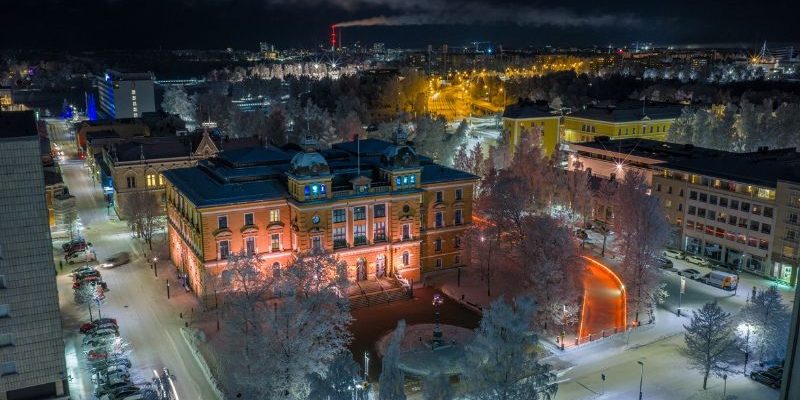
Which is why something happening in northern Finland caught my attention.
When art meets technology
This November, the Finnish city of Oulu will host the inaugural Lumo Art & Tech Festival, a ten-day event bringing together art, technology and science through exhibitions, performances, light, sound, talks and installations.
And it isn’t exactly starting quietly.

Opening on 13 November, Björk will bring her three audiovisual installations to Oulu, following their debut in Reykjavík: Ancestress, Sorrowful Soil and Björk Orkestral, with a DJ set taking place on 15 November
Björk will present three audiovisual installations, Ancestress, Sorrowful Soil and Björk Orkestral, alongside a special DJ set.
Elsewhere, artists will use real-time Arctic climate data, cosmic signals, spatial audio, robotics, digital media and scientific research to create experiences across the city.
There will even be an experimental ensemble combining human performers with robotic folk instruments.
Which, depending on your perspective, represents either the glorious future of human creativity or the precise moment the accordion finally becomes self-aware.
But beneath all the technology is something marketers should notice.
The technology isn’t the idea.
It enables the idea, and that’s an important distinction.
Technology works best when you stop noticing it
Consider Arctic Clouds, an installation by Josefina Nelimarkka.
The work combines mist, glass, water and ice with real-time climate data gathered from Oulu and Arctic research stations.
Technically, a lot is going on.
But presumably nobody walks into the exhibition and says: “Excellent API integration.”
They experience something.
They feel something.
The data and technology help create that experience, but they aren’t necessarily the reason the experience matters.
Marketing occasionally gets this backwards.
We become fascinated by the machinery.
- The CRM.
- The automation platform.
- The attribution model.
- The AI tool.
- The dashboard.
- The increasingly alarming collection of browser tabs required to send one email.
And because the technology is sophisticated, we assume the marketing must therefore be sophisticated too.
Unfortunately, customers aren’t particularly interested in your marketing stack.
They are interested in what you have to say.
AI is making this question even more important
Artificial intelligence has accelerated this problem considerably.
We can now produce content faster than at any point in human history.
- Articles.
- Videos.
- Images.
- Emails.
- Social posts.
- Campaign ideas.
- Research.
- Presentations.
Entire marketing strategies can seemingly appear before you’ve finished making a cup of tea.
This is genuinely remarkable.
But creating more things doesn’t automatically make them more interesting.
Efficiency and creativity are not the same thing.
AI can help us explore ideas, analyse information, develop concepts and execute them.
But someone still has to decide what is worth saying.
Someone has to understand the audience.
Someone has to recognise an interesting cultural observation.
Someone has to decide that combining Arctic climate data with mist, glass and ice might create something meaningful.
Technology can amplify creativity.
It cannot replace the need for an idea.
Perhaps marketers should think more like artists
There is another interesting lesson here.
Artists rarely begin with: “Which platform should we use?”
They begin with an idea.
A question.
An emotion.
Something they want people to experience. Only then do they decide how to express it.
Marketing often does precisely the opposite.
“We need to do TikTok.”
Why?
“Because everyone is on TikTok.”
What are we going to say?
“We’ll work that out later.”
This is how organisations end up enthusiastically producing content nobody particularly wanted, simply because a platform existed to put it on.
The better question is: What do we want someone to think, feel or do?
Then choose the technology that helps make that happen.
Experiences are becoming increasingly valuable
The Lumo programme is particularly interesting because so much of it is experiential.
- Light.
- Sound.
- Physical spaces.
- Installations.
- Performances.
Things people actually encounter rather than merely scroll past.
That’s significant in a world where we’re being buried beneath digital content.
When almost everyone can create content cheaply and quickly, content itself becomes less scarce.
Experience becomes more valuable
This doesn’t mean every brand needs to commission an immersive audiovisual installation involving Björk and 30 loudspeakers.
Although it would certainly make the quarterly marketing meeting more interesting. It means marketers should think beyond content and take experiences more seriously.
- What happens when someone visits your website?
- What happens when they speak to your sales team?
- What happens after they buy?
- What does your packaging feel like?
- What happens at your event?
- What does customer service sound like?
- What do people remember afterwards?
Your brand isn’t simply the advertising people see. It’s the accumulation of experiences they have with you.
Creativity happens at the edges
There’s something else interesting about Lumo. It deliberately brings together disciplines that don’t naturally sit side by side.
Art and science.
Music and data.
Nature and technology.
Humans and machines.
Astrophysics and sound.
That’s often where interesting ideas appear.
Marketing has become increasingly specialised.
- SEO people talk about SEO.
- Performance marketers talk about performance marketing.
- Brand people talk about brands.
- Data people talk about data.
- AI people currently talk about AI to anyone who can’t escape the room.
Specialisation is useful. But creativity frequently comes from connecting things that weren’t previously connected.
- Psychology with advertising.
- Behavioural science with ecommerce.
- Customer service with brand strategy.
- Culture with product development.
- Technology with storytelling.
The interesting question isn’t always: What’s happening in marketing?
Sometimes it’s: What’s happening outside marketing that we could learn from?
Oulu itself might be part of the lesson
The location makes the festival particularly interesting. Oulu has deep connections with technology and innovation, including its historic relationship with Nokia, and in 2023 it became a UNESCO Creative City of Media Arts. Lumo Art & Tech is now being launched as part of Oulu’s year as a European Capital of Culture.
That’s an interesting example of positioning.
Cities have brands too. Not simply logos, slogans and tourism campaigns, but associations.
Edinburgh has festivals. Copenhagen has design. Nashville has music. Silicon Valley has technology.
These associations are built through repeated experiences, stories, institutions, businesses and cultural activity.
Oulu is deliberately connecting its technological heritage with culture and creativity.
That’s far more powerful than simply announcing: “Oulu is an innovative city.”
Instead, it creates evidence.
Marketing works the same way.
Don’t simply tell people what you are. Create experiences that demonstrate it.
The future probably isn’t human versus machine
The debate around technology, particularly AI, is frequently framed as a competition.
Humans versus machines.
Creativity versus automation.
People versus algorithms.
But that may be the wrong argument.
The more interesting future is probably about what happens when technology extends human creativity rather than attempts to replace it.
That’s what makes projects such as Lumo interesting.
The technology can be incredibly sophisticated.
Real-time climate data. Spatial audio. Digital installations. Robotics. Thousands of cosmic signals transformed into sound. But the objective isn’t to demonstrate that the technology exists.
It’s to use technology to help people experience something they couldn’t experience otherwise.
And perhaps that’s a useful principle for marketing too.
Before adopting the next platform, AI tool, automation system or piece of martech, ask:
- Does this help us understand people better?
- Does it help us communicate an idea more clearly?
- Does it help us create a better experience?
- Does it help us make something genuinely worth noticing?
If the answer is yes, excellent. Use it.
If the answer is no, you may have acquired another dashboard, and marketing already has quite enough of those.
Technology should make creativity bigger, not smaller.
The most exciting thing about technology isn’t that it allows us to remove humans from creativity. It’s that it gives humans new ways to be creative.
New canvases. New instruments. New experiences. New ways of telling stories. New ways of helping people see familiar things differently.
That’s considerably more interesting than simply using AI to produce seventeen LinkedIn posts before breakfast.
The lesson from a dark Finnish city this November may be surprisingly simple.
Use the technology.
Experiment with it.
Push it.
Play with it.
But don’t mistake the tool for the idea.
Because the technology people remember is usually the technology they barely noticed. What they remember is how it made them feel.
The inaugural Lumo Art & Tech, 13 – 22 November 2026, takes place as part of Oulu2026, European Capital of Culture, www.oulu2026.eu