
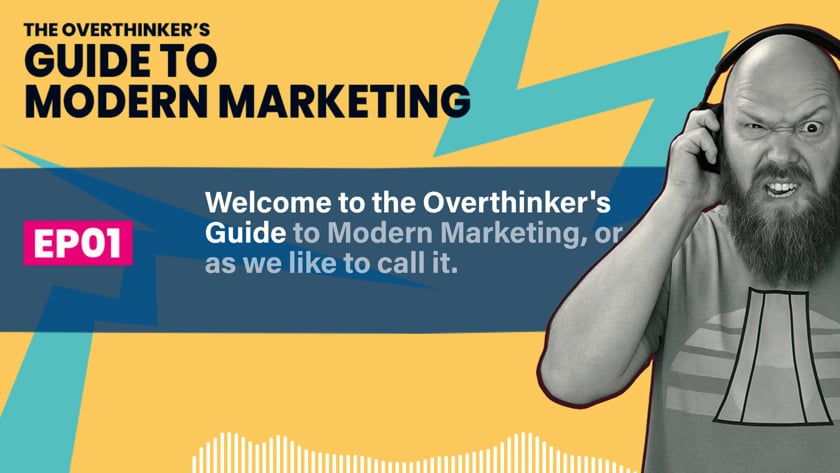
Episode one of The Overthinker’s Guide to Modern Marketing podcast explores the thin, uncomfortable line between persuasion and propaganda and why modern marketing isn’t always as innocent as it pretends to be.
I unpack how influence really works: from emotional manipulation and “truth-adjacent” messaging, to repetition, tribal thinking, and the subtle ways audiences are nudged, shaped, and steered.
It’s a witty, thoughtful look at how marketing can either respect people… or quietly recruit them If you work in marketing, branding, content, or business — or you’ve ever felt uneasy about how influence actually functions — this episode will resonate.
Listen to episode one now and please then share it with someone who:
- works in marketing
- doesn’t trust marketing
- or needs reminding that not every message deserves blind belief
Because the best marketing doesn’t manipulate – it earns attention.
Stay sceptical. Stay alert. And for the love of marketing – question the tagline.
Podcast Transcript
The Overthinker’s Guide to Modern Marketing Podcast: Episode One: The Thin Line Between Marketing and Propaganda
How to Use a Colourful Poster to Make People Buy Socks Without Convincing Them to Overthrow a Small Democracy
Hello, I’m your host, Sean Makin, and I am a man who has spent far too long wondering whether engagement means likes, comments, or just emotional dependency.
I reckon this may be the only podcast that promises absolutely no enlightenment whatsoever, but instead offers a very pleasant sense that you might be on the verge of understanding something terribly important about marketing.
In each episode, I’ll be poking, prodding, and possibly apologising to the strange creature that is modern marketing. We’ll explore why we do what we do, how we convince other people to do what they do, and whether any of us actually know what we’re doing at all.
So sit back, grab a cup of something artisally overpriced, and prepare to journey with me through the bewildering galaxy of algorithms, branding, and buzzwords, where logic is optional, data is king, and authentic storytelling is the new black.
After all, this is The Overthinker’s Guide to Modern Marketing, and I’m here to make sure we overthink it properly.
PART ONE – The Cosmic Joke of Influence
Let’s begin with a small but significant truth:
Marketing and propaganda are essentially the same thing, except one has better fonts and the other usually ends in a revolution.
Both are trying to make you think things, feel things, buy things, occasionally burn things. The main difference lies in whether you’re being helpfully persuaded or politely brainwashed.
It’s a bit like the difference between a tour guide and a hypnotist. One points out the Eiffel Tower. The other convinces you it’s a spaceship and that you’re its queen.
PART TWO – Intent (Or Why You’re Being Whispered At)
The first big difference between marketing and propaganda is intent.
Imagine a cheerful salesperson trying to sell you a vacuum cleaner. They’re smiling. They’re polite. They’re only mildly terrifying. They want you to be happy with a slightly cleaner floor.
Now imagine a billboard telling you that without this vacuum cleaner, society will collapse. Your pets will leave you. Your neighbours will talk.
See the difference?
One wants your money. The other wants your soul. And possibly your dog too.
PART THREE – Emotion: The Big Slippery Lever
Emotion is the tool of choice for both marketers and propagandists. It’s the Swiss Army knife of influence.
Good marketing gives you a little chuckle, a little joy. You feel seen. Maybe you buy a hoodie. Maybe you follow a likeable fellow on LinkedIn.
Propaganda, however, comes charging in with emotional napalm, fear, rage, nostalgia for a past that probably never happened.
It’s like being hugged and stabbed at the same time by someone shouting,
“It’s for your own good!”
PART FOUR – The Truth, But Lightly Salted
Ah, truth. That elusive substance — rarer than a vegan sausage in a meat factory.
Marketing, at its base, uses truth to inform.
“Our soap gets you clean.”
Probably cleaner than Dave’s soap.
But don’t tell Dave.
Propaganda, on the other hand, is less truthful and more truth-adjacent.
It’s like saying your car is eco-friendly because it only explodes once a week.
It’s not a lie, exactly.
It’s just not the kind of truth you’d bring home to meet your mother.
PART FIVE – Repetition: Say It Again. Louder.
Marketing repeats itself, but nicely.
“Buy now.”
“Still available.”
“Seriously, we’re running out.”
Propaganda repeats itself like a toddler with a conspiracy theory.
It says things louder, faster, and with flags.
You’re not just hearing the message.
You’re inhaling it.
Dreaming about it.
Slowly becoming unable to distinguish it from your own thoughts.
It’s like a jingle you didn’t ask for — but now you’re humming it in the shower.
PART SIX – Us vs Them (And Why You’re Always the Hero)
Propaganda loves a good enemy. It doesn’t even need to be a real one — just someone sufficiently moustachioed and different.
It builds a world of “us” – clean, pure, right-handed – and “them” – suspiciously foreign and always scowling.
Marketing, at least on its better days, is more inclusive.
“Hey, you seem cool. Want to join the Hoodie Club?”
Propaganda says:
“Join us or perish.”
Which is frankly a little bit much for a sandwich advert.
PART SEVEN – Audience: Intelligent Beings or Cattle in Hats?
And finally — the ultimate test:
How does the message treat you?
Good marketing respects you. It assumes you have a brain. It offers choices. It may even let you walk away, though probably not without a coupon.
Propaganda doesn’t respect you at all.
It pats you on the head, shouts in your face, and assumes you’ll go along with it because it’s wrapped in a flag and accompanied by dramatic music.
If an ad campaign looks like it was written by a Bond villain… it probably was.
PART EIGHT – The Uncomfortable Conclusion
You may be wondering:
Am I being marketed to or propagandised?
Well, if the message includes facts, respects your ability to choose, and doesn’t require marching orders, mandatory uniforms, or mounting flags to lampposts… it’s probably marketing.
If it smells faintly of extremism, nationalism, and makes you feel like you must act now before the world ends, maybe take a step back.
Perhaps clear your browser history.
So the next time you see an advert, ask yourself this:
Is this trying to sell something to me?
Or is it trying to recruit me for something?
And if it’s both – congratulations. You have perhaps discovered influencer culture.
OUTRO
So we’ve come to the end of this episode.
Thank you for listening.
Until next time – stay skeptical, stay alert, and for the love of marketing… question the tagline.
And if you’ve enjoyed this episode — or didn’t — let me know what you think. I’d love to hear your thoughts.
Until next time.
Cheers.